Esponses in Bone Conduction, please write NR as noted in “Key to Symbols”. 7. Tympanometry - Record Tympanometry test results. See 2.3 above. 8. Reflexometry - Record Reflexometry test results. See 2.4 above. 9. Pure Tone Average – Add 500, 1000, 2000Hz and divided by three (3) for both air and bone testing results. 10. Type of Hearing Loss - Identify the type of hearing loss by placing ‘X’ accordingly as shown on the form for respective ear. 11. Comments - Please write comments as nee.
Loading

Open form follow the instructions

Easily sign the form with your finger

Send filled & signed form or save
How to fill out the ICSD Audiogram Form online
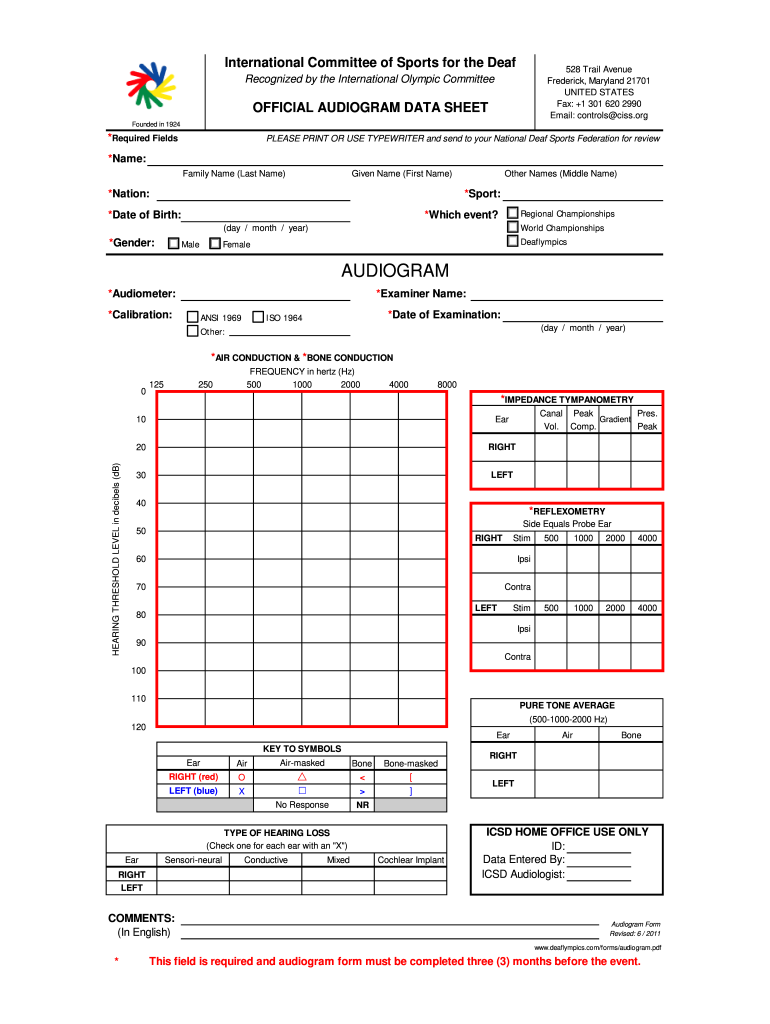
The ICSD audiogram form is a vital document used for athletes participating in deaf sports. Completing this form accurately is essential for receiving an identification number required for competition. This guide provides a detailed overview of how to fill out the form online, ensuring a smooth submission process.
Follow the steps to fill out the ICSD audiogram form online.
- Press the ‘Get Form’ button to access the ICSD audiogram form and open it in your preferred editor.
- Begin filling in the required fields, starting with your name, including family name and given name. Ensure that all information is accurately entered.
- Provide your nation and indicate your sport, selecting from the options for regional championships, world championships, or Deaflympics.
- Indicate your date of birth in the format of day/month/year.
- Select your gender by indicating whether you are female or male.
- In the audiogram section, input data for the audiometer including the name of the audiometer used, the examiner's name, and the calibration standard.
- Enter the date of examination in the required format.
- Fill in the air conduction and bone conduction results by entering frequency levels in hertz (Hz) and hearing threshold levels in decibels (dB). Make sure to write 'NR' for no response where applicable.
- Complete the impedance tympanometry section by detailing the canal peak, pressure gradient, volume compensation, and peak for each ear.
- Document the reflexometry results as indicated, ensuring to check the side that equals the probe ear.
- Calculate the pure tone average by adding the air and bone conduction results for 500, 1000, and 2000 Hz and divide by three.
- Check the type of hearing loss for each ear and mark with an 'X' as appropriate.
- Add any comments in English as needed, detailing any pertinent information about the athlete.
- Finally, ensure all fields are completed and review information for accuracy before saving changes, downloading, printing, or sharing the form.
Complete your ICSD audiogram form online to ensure your eligibility for upcoming events.
Experience a faster way to fill out and sign forms on the web. Access the most extensive library of templates available.
Related content
by B Mester · 2025 · Cited by 1 — The DGSV squad athletes fulfil the criteria for...
The examination must be performed in accordance with the ICSD guidelines. The official...
Get answers to your most pressing questions about US Legal Forms API.
How to tell what type of hearing loss on an audiogram?
To interpret the type of hearing loss on an audiogram, you should focus on where your hearing thresholds are marked. If the results indicate difficulty with higher frequencies, it may suggest sensorineural loss. The ICSD Audiogram Form is designed to make this analysis straightforward, enabling audiologists to offer insights about your hearing challenges and next steps.
How to tell type of hearing loss on audiogram?
An audiogram provides visual evidence of your hearing ability across different frequencies. Each type of hearing loss will present itself differently on the audiogram chart. By examining the results plotted on the ICSD Audiogram Form, an audiologist can explain whether you have conductive, sensorineural, or another type of hearing loss, helping you understand your condition better.
How to tell if hearing loss is sensorineural or conductive?
Distinguishing between sensorineural and conductive hearing loss often requires professional assessment. Sensorineural hearing loss results from damage to the inner ear or auditory nerve, while conductive hearing loss involves issues in the outer or middle ear. An audiologist will use techniques and the ICSD Audiogram Form to analyze your hearing capabilities and determine the type you are experiencing.
How do you know what type of hearing loss you have?
To determine your type of hearing loss, start by noticing how sounds affect your daily life. This awareness can guide you to an audiologist who can perform a comprehensive evaluation. They will use the ICSD Audiogram Form to document your hearing test results and identify the specific type of hearing loss you may have, whether it's conductive, sensorineural, or mixed.
Can I get an audiogram online?
While some services offer online audiograms, their effectiveness can depend largely on your environment and the technology involved. Using these online tools can be a good starting point for assessing your hearing. However, if you require documentation for competitions or other formal needs, ensure that the service provides you with the ICSD Audiogram Form. For the best results, a clinical audiogram conducted in person is always recommended.
Can I get a hearing test online?
Yes, you can get a hearing test online through various telehealth services. These platforms often provide interactive tools to evaluate your hearing, but remember, they should not be a substitute for a comprehensive test conducted by a professional. If you receive results online, ensure they provide an ICSD Audiogram Form to validate the results for official purposes. It’s a convenient option, but follow-up with a specialist is advisable.
Are online audiograms accurate?
Online audiograms can provide useful insights into your hearing, but their accuracy may vary based on the technology used and your environment. These tests often serve as preliminary assessments and should not replace professional evaluations. If you consider using any online audiogram service, ensure they give you the ICSD Audiogram Form upon completion, as that can be necessary for formal documentation. Trusting a qualified audiologist remains the best option for an accurate hearing assessment.
How do I get a copy of my audiogram?
To obtain a copy of your audiogram, start by contacting the audiologist or clinic where you received your hearing test. Most facilities keep records for several years and can provide you with a copy upon request. Be prepared to fill out the ICSD Audiogram Form if needed, as it may be required to validate your claim. Always ensure you have proper identification when making your request.
How to qualify for Deaflympics ICSD?
To qualify for the Deaflympics, you must meet specific eligibility criteria set by the International Committee of Sport for the Deaf (ICSD). Primarily, you need to have a hearing loss of at least 55 decibels in the better ear. Additionally, you'll need to complete the ICSD Audiogram Form to provide documentation of your hearing loss. Make sure to check the latest rules, as they may change for each event.
Can a deaf person hear with a cochlear implant?
An implant does not restore normal hearing. Instead, it can give a deaf person a useful representation of sounds in the environment and help him or her to understand speech.
Use professional pre-built templates to fill in and sign documents online faster. Get access to thousands of forms.
If you believe that this page should be taken down, please follow our DMCA take down process here.