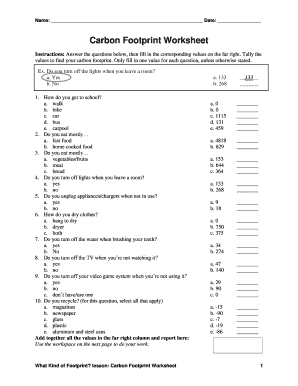
The far right. Tally the values to find your carbon footprint. Only fill in one value for each question, unless otherwise stated. Ex. Do you turn off the lights when you leave a room? a. Yes b. No 1. How do you get to school? a. walk b. bike c. car d. bus e. carpool 2. Do you eat mostly a. fast food b. home cooked food 3. Do you eat mostly a. vegetables/fruits b. meat c. bread 4. Do you turn off lights when you leave a room? a. yes b. no 5. Do you unplug appliances/chargers when not in use.

How it works
  • Open form

    Open form follow the instructions

  • Easily sign form

    Easily sign the form with your finger

  • Share form

    Send filled & signed form or save

How to fill out the Carbon Footprint Tally The Values Worksheets Form online

Filling out the Carbon Footprint Tally The Values Worksheets Form is a crucial step towards understanding and reducing your environmental impact. This guide provides clear and detailed instructions on how to complete the form online, ensuring that users can easily navigate each section.

Follow the steps to effectively complete the form.

  1. Click 'Get Form' button to obtain the form and open it in the editor.
  2. Begin by entering your name and the date at the top of the form. This will help identify your responses.
  3. Answer the questions in the Carbon Footprint Worksheet section. For each question, select only one value from the provided options unless specified otherwise.
  4. Fill in the corresponding values for each answer on the far right of the form. Take your time to ensure accuracy, as these values will contribute to your total carbon footprint.
  5. Once all answers are completed, add together all the values in the far right column to calculate your total carbon footprint. Write this number in the designated area.
  6. Utilize the workspace provided on the next page to note your thoughts on actions you can take to reduce your carbon footprint. Consider the suggestions given in the prompts.
  7. Finally, review your document. You can save your changes, download the form, print it, or share it if necessary.

Start filling out your Carbon Footprint Tally The Values Worksheets Form online today to make a positive impact on the environment.

Get form

Experience a faster way to fill out and sign forms on the web. Access the most extensive library of templates available.

Related content

Guidance for Making Wetland Minimal Effect...

A minimal effect evaluation worksheet will utilize information from the value assessment...

Learn more
Carbon Footprint - College of Agricultural...

The increasing levels of CO2 in the atmosphere are a result of human activities ... carbon...

Learn more
Inhalant Abuse Prevention - Virginia Department of...

by S Adams · 2007 — Many thanks to the professionals whose time and expertise helped...

Learn more
Questions & Answers

Get answers to your most pressing questions about US Legal Forms API.

Contact support

What are the 4 main carbon footprint categories?

The major contributors to carbon footprints are: food, consumption, transportation, and household energy.

Cardboard & Paper: 0.94kg carbon emissions per 1kg of packaging. Styrofoam: 1.16kg carbon emissions per 1kg of packaging. Aluminum: 2.32kg carbon emissions per 1kg of packaging. Plastic: 3.50kg carbon emissions per 1kg of packaging.

Plastic bags generate 39% less greenhouse gas emissions than uncomposted paper bags and 68% less greenhouse gas emissions than composted paper bags. Plastic bags consume less than 6% of the water needed to make paper bags.

What is a ton of CO2 equivalent to? It is hard to visualise what the numbers behind carbon emissions really mean, because greenhouse gases are invisible. However, we can compare one ton of CO2 to things and activities we do often, if not daily. One ton of CO2 is equivalent to 138 meat-based meals.

A carbon footprint is the total amount of greenhouse gases (including carbon dioxide and methane) that are generated by our actions. The average carbon footprint for a person in the United States is 16 tons, one of the highest rates in the world. Globally, the average carbon footprint is closer to 4 tons.

A carbon footprint is expressed in carbon dioxide equivalent (CO2e). GHGs all have a different global warming power (GWP). This indicator is therefore a way of standardizing the reading of these impacts since they are expressed as a volume of CO2 retaining the same amount of solar radiation.

Studies reveal that a single sheet of paper manufacturing requires 47 gallons of water per ream of paper (Illinois Library, 2022). From cradle to consumer, the carbon footprint of office paper is 4.64, 4.74, and 4.29 g CO2eq per A4 sheet (Dias & Arroja, 2012) .

► Cradle-to-costumer study. ► The carbon footprint of one A4 sheet of office paper ranges from 4.29 to 4.74 g CO2eq.

We analyze the contribution of 8 categories: construction, shelter, food, clothing, mobility, manufactured products, services, and trade.

“A carbon footprint is the total greenhouse gas (GHG) emissions caused directly and indirectly by an individual, organization, event or product.”1 It is calculated by summing the emissions resulting from every stage of a product or service's lifetime (material production, manufacturing, use, and end-of-life).

Get This Form Now!

Use professional pre-built templates to fill in and sign documents online faster. Get access to thousands of forms.

If you believe that this page should be taken down, please follow our DMCA take down process here.

Get Carbon Footprint Tally The Values Worksheets Form