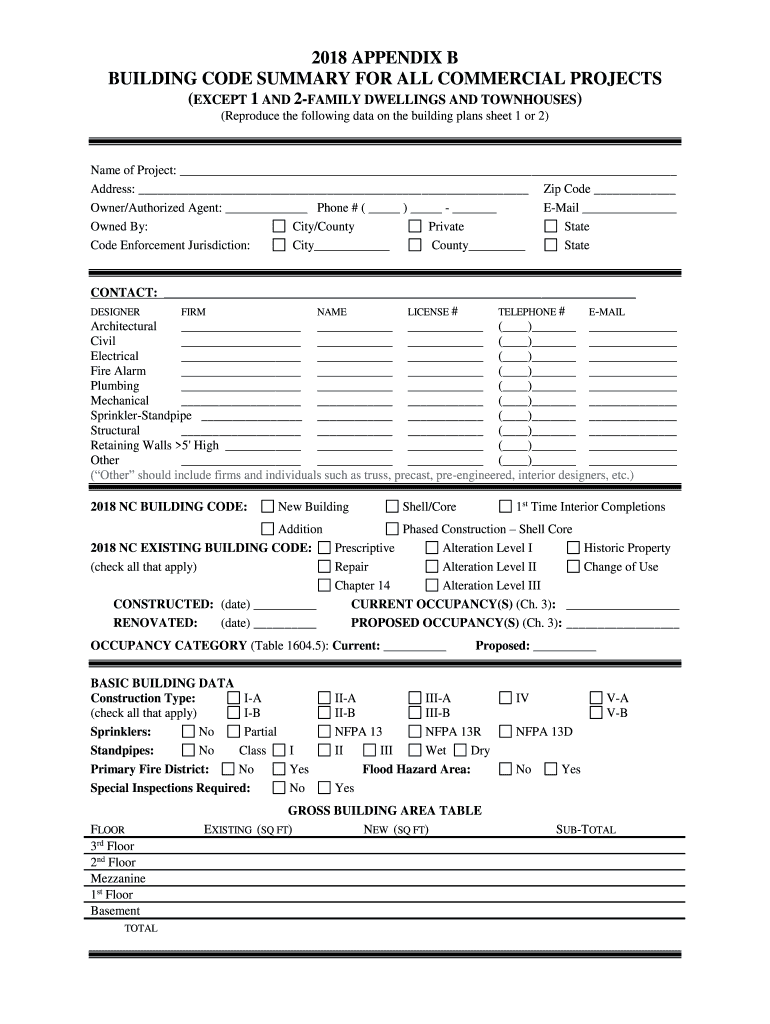
2018 APPENDIX B BUILDING CODE SUMMARY FOR ALL COMMERCIAL PROJECTS (EXCEPT 1 AND 2FAMILY DWELLINGS AND TOWNHOUSES) (Reproduce the following data on the building plans sheet 1 or 2)Name of Project:.

Open form follow the instructions

Easily sign the form with your finger

Send filled & signed form or save
How to fill out the NC Building Code Summary for All Commercial Projects online
Filling out the NC Building Code Summary for All Commercial Projects is an essential step in ensuring compliance with building regulations. This guide provides a detailed, step-by-step approach to completing the form online, making the process user-friendly for individuals with varying levels of experience.
Follow the steps to accurately complete the NC Building Code Summary.
- Click ‘Get Form’ button to obtain the form and open it in the editor.
- Begin filling in the name of the project in the specified field, followed by the complete address, including the zip code. Ensure accuracy to avoid complications later.
- Provide the owner or authorized agent's name and contact information, including phone number and email address. This ensures that all communications regarding the project can be directed to the appropriate individual.
- Indicate who owns the project by selecting from the available options: city/county, private, or state. This is important for jurisdictional purposes.
- Specify the code enforcement jurisdiction by filling in the respective city and county. If applicable, include the state as well.
- Complete the contact details for each designer involved in the project, including firm name, license number, telephone number, and email address. Make sure this information is clear and correct.
- Select relevant designations from the options provided for '2018 NC Building Code' and '2018 NC Existing Building Code.' Check all applicable boxes to confirm the building's status.
- Document the constructed and renovated dates, along with current and proposed occupancy types using Chapter 3 definitions.
- Fill out the basic building data section, including construction type and sprinkler system details. Include any necessary fire protection requirements and structural considerations.
- Calculate the gross building area, allowable area, and occupancy classifications, ensuring compliance with all regulations. Provide any additional details as needed.
- Review and ensure all sections of fire protection requirements, life safety system requirements, and energy summary are completed thoroughly.
- Once all data is filled out accurately, save your changes. You may download, print, or share the completed form as needed for submission.
Complete your documents online using this comprehensive guide to navigate the NC Building Code Summary with confidence.
Experience a faster way to fill out and sign forms on the web. Access the most extensive library of templates available.
Related content
2018 Appendix B Building Code Summary For All Commercial Projects.
Mar 27, 2023 — Defines Appendix B as the Appendix B Building Code Summary for All...
Feb 1, 2016 — The following requirements are met: P. O. P. Stairs are accessible to...
Get answers to your most pressing questions about US Legal Forms API.
What state has the strictest building code?
California is often cited as having the strictest building codes in the United States due to its stringent safety regulations addressing earthquakes and wildfires. This level of regulation aims to protect residents and properties amidst natural disasters. Other states also have high standards in specific areas, but California leads in overall comprehensive safety measures. For a summary of comparable regulations, see the NC Building Code Summary for All Commercial Projects.
What is the basis for commercial building codes by most states?
Commercial building codes in most states are based on safety, accessibility, and structural integrity. They aim to protect the public’s welfare while addressing various construction-related issues. These codes also consider environmental factors and sustainable practices in building. The NC Building Code Summary for All Commercial Projects is an excellent resource to understand these foundations in North Carolina.
What is the most widely used building code in the US?
The International Building Code (IBC) is the most widely used building code across the United States. It serves as the foundation for construction standards and practices, promoting safety and consistency in building design. Communities often adopt the IBC with local amendments to address specific conditions. For a focused understanding of how this impacts commercial projects, refer to the NC Building Code Summary for All Commercial Projects.
Who enforces building codes in NC?
In North Carolina, building codes are enforced by local building inspectors and code enforcement officials. Their role involves reviewing plans, inspecting construction sites, and ensuring compliance with state regulations. This oversight helps to maintain safety and quality in all commercial projects. The NC Building Code Summary for All Commercial Projects can assist you in understanding the enforcement process better.
What is the current Building Code edition in use in North Carolina?
North Carolina currently utilizes the 2018 edition of the NC Building Code. This version incorporates significant updates and amendments geared towards safety and energy efficiency in construction. For those involved in commercial projects, the NC Building Code Summary for All Commercial Projects serves as a reliable guide to understanding these stipulations and requirements.
Where can I find building codes for my city?
To find building codes for your city, visit your local government's website or the city planning department. These resources typically offer downloadable code documents and additional information. Furthermore, you can check online platforms like UsLegalForms, which can supply insights into necessary codes and codes applicable to commercial projects like the NC Building Code Summary for All Commercial Projects.
Do building codes vary by state?
Yes, building codes vary significantly by state due to regional climates, construction trends, and local regulations. Each state tailors their codes to address specific needs, from seismic concerns to hurricanes. Therefore, it’s essential to check the local regulations where your project will occur. The NC Building Code Summary for All Commercial Projects provides guidance for North Carolina and can help align with state-specific requirements.
Which building codes have most US states adopted?
Most US states have adopted the International Building Code (IBC) as their primary standard. This code sets the guidelines for the construction and occupancy of buildings, ensuring safety and accessibility. Additionally, many states may have local amendments that reflect regional needs. For a concise overview, refer to the NC Building Code Summary for All Commercial Projects.
Which edition year of the building code does North Carolina currently use?
North Carolina currently follows the 2020 edition of its building code for commercial projects. This edition reflects the latest updates and requirements that contractors must observe. For a thorough understanding, exploring the NC Building Code Summary for All Commercial Projects will guide you through the specific stipulations necessary for compliance.
What is the title of the model code that is the basis for most building codes in the United States?
The International Building Code (IBC) serves as the primary model code influencing many state building codes across the U.S. This model code provides a comprehensive framework for safety and design standards that states can adopt and adapt. For a clear understanding of your obligations, refer to the NC Building Code Summary for All Commercial Projects to see how this applies in North Carolina.
Use professional pre-built templates to fill in and sign documents online faster. Get access to thousands of forms.
If you believe that this page should be taken down, please follow our DMCA take down process here.