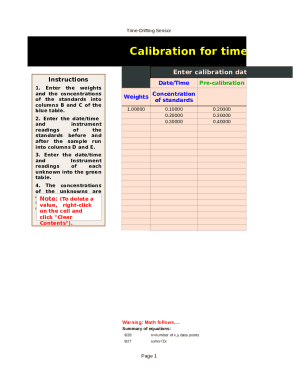
TimeDrifting SensorCalibration for timedrifting Enter calibration data here Instructions 1. Enter the weights and the concentrations of the standards into columns B and C of the blue table.Date/Time WeightsPrecalibrationConcentration of.
Open form follow the instructions
Easily sign the form with your finger
Send filled & signed form or save
How to fill out the Time-Drifting Sensor Document online
The Time-Drifting Sensor Document is essential for capturing calibration data related to time-drifting sensors. This guide provides clear, step-by-step instructions for filling out the form online, ensuring accuracy and efficiency in your data collection.
Follow the steps to successfully complete the Time-Drifting Sensor Document online.
- Press the 'Get Form' button to retrieve the Time-Drifting Sensor Document and open it in the editor.
- In the blue table, enter the weights and concentrations of the standards in columns B and C. These values are crucial for calibration.
- Record the date, time, and instrument readings of the standards before and after the sample run into columns D and E.
- Input the date, time, and instrument readings of each unknown into the designated green table. This step is important for analysis.
- Observe that the concentrations of the unknowns will be calculated automatically in the corresponding column. If you need to clear any calculated value, right-click on the cell and select 'Clear Contents'.
- Once all data is entered correctly, you can save changes, download, print, or share the form as needed.
Complete your Time-Drifting Sensor Document online today for precise calibration data.
Experience a faster way to fill out and sign forms on the web. Access the most extensive library of templates available.
Related content
Instruments used as comparators for calibration, Short-term drift can be a problem ... The...
by JL Campbell · 2013 · Cited by 77 · Related articlesdata produced by sensor...
over time and does not drift, facilitating high reliability and accuracy. • Sensor can...
Get answers to your most pressing questions about US Legal Forms API.
What causes computer clock drift?
The rate of drift depends on the clock's quality, sometimes the stability of the power source, the ambient temperature, and other subtle environmental variables. Thus the same clock can have different drift rates at different occasions.
What is drift in a sensor?
Drift – This is the low frequency change in a sensor with time. It is often associated with electronic aging of components or reference standards in the sensor. Drift generally decreases with the age of a sensor as the component parts mature. A smoothly drifting sensor can be corrected for drift.
What is a clock drift?
Clock drift refers to several related phenomena where a clock does not run at exactly the same rate as a reference clock. That is, after some time the clock "drifts apart" or gradually desynchronizes from the other clock.
What causes time drift?
These effects may be produced by synchronization errors remaining after data correction, by local rheological changes at the source and receiver areas (due, for instance, to weather effects on the ground) or, finally, by a tidal component shared by all wavelets.
How do you calculate clock drift?
Clock drift in PPM = (2.0475 − 2.048) (1 million)/2.048 = −244 PPM. If measured frequency is more than 2.048 MHz, it will give positive PPM.
How do I fix my server clock drift?
Various methods have been devised to correct drift. The simplest and most reliable way is to implement Network Time Protocol (NTP) and receive accurate time signals from a server that is dedicated to that task and maintained to a very high standard of accuracy.
What is the difference between clock jitter and drift?
The rate at which the clocks are drifting is the clock drift. The difference between two clocks at any given instant is the clock offset or skew. The short-term variation of either network delays or clock frequencies is referred to as jitter.
How much clock drift is normal?
Clock Drift: As mentioned, no two clocks would have the same clock rate of oscillations i.e; clock rate would be different. The difference of clock rate is called clock drift. Ordinary quartz clocks drifts by ~ 1 second in 11–12 days.
What is the clock drift rate?
Clock Drift: As mentioned, no two clocks would have the same clock rate of oscillations i.e; clock rate would be different. The difference of clock rate is called clock drift. Ordinary quartz clocks drifts by ~ 1 second in 11–12 days. The drift rate varies from clock to clock.
What is a time drift?
When your server's time doesn't match an authoritative time, such as ntp.org, you have a problem called time drift. This problem is incredibly common and happens slowly over weeks and months. To easily check the time drift, compare the server's current date and time to The Official NIST Time.
Use professional pre-built templates to fill in and sign documents online faster. Get access to thousands of forms.
If you believe that this page should be taken down, please follow our DMCA take down process here.