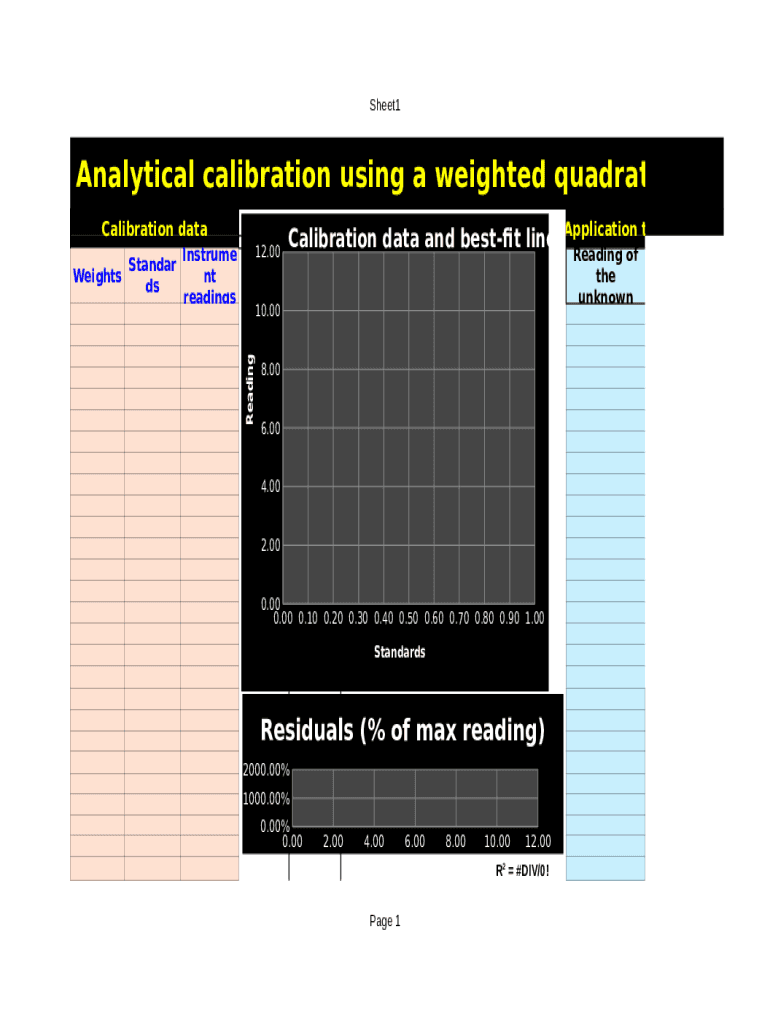
Sheet1Analytical calibration using a weighted quadratic curve fit Calibration data 12.00Instrume Standar Weights nt ds readingsCalibration data and bestfit lineReading10.00 8.00 6.00 4.00 2.00 0.00 0.00.

Open form follow the instructions

Easily sign the form with your finger

Send filled & signed form or save
How to fill out the Calibration Quadratic Weighted online
This guide provides clear, step-by-step instructions for completing the Calibration Quadratic Weighted form online. Whether you are new to digital document management or have some experience, this guide supports your understanding of the process.
Follow the steps to effectively complete your Calibration Quadratic Weighted form
- Press the ‘Get Form’ button to access the Calibration Quadratic Weighted form and open it in your preferred online editing tool.
- Begin by entering the calibration data in the specified fields. In the ‘Calibration data’ section, input your expected measurements consistent with the standards you are comparing against.
- Fill in the ‘Weights’ field based on the importance of each calibration measurement. Make sure to use neutral numerical values that reflect the weighting you wish to assign.
- Complete the ‘Residuals (% of max reading)’ section by calculating and entering the percentage discrepancies observed in your readings after calibration.
- In the ‘Application to unknowns’ section, input the readings of the unknown samples you wish to analyze, ensuring they correspond correctly to the standards field.
- For weighted intermediate calculations, document the calculated concentrations clearly. This section may require specific values based on earlier inputs, so check your entries for accuracy.
- Review all the calculations that involve the coefficients a, b, and c derived for the best-fit quadratic curve. Enter necessary identifiers like sum values and other essential figures.
- Finalize by saving the completed form. Download the document for your records, print it for a physical copy, or share it directly with your colleagues as needed.
Take the next step in your calibration process by completing your Calibration Quadratic Weighted form online today.
Experience a faster way to fill out and sign forms on the web. Access the most extensive library of templates available.
Related content
A simple procedure for selecting the correct weighting factors for linear and quadratic...
Sep 26, 2017 — xls) and quadratic (CalibrationQuadraticWeighted.xls) templates. There is...
synthetic.pop() applies the calibration weights produced by GO to the survey to generate...
Get answers to your most pressing questions about US Legal Forms API.
What is the equation for calibration curve?
The calibration curve is a plot of instrumental signal vs. concentration. The plot of the standards should be linear, and can be fit with the equation y=mx+b.
Is calibration curve linear or quadratic?
Calibration curve in bioanalytical method is a linear relationship between concentration (inde- pendent variable) and response (dependent variable) using a least squares method. This relation- ship is built to predict the unknown concentrations of the analyte in a complicated matrix.
What is the quadratic equation for calibration curve?
There are several models for calibration curves that can be considered for instrument calibration. They fall into the following classes: Linear: Y = a + bX + \epsilon. Quadratic: Y = a + bX + cX^2 + \epsilon.
Can a calibration curve be quadratic?
Two most commonly used regression models for LC-MS/MS calibration curves are linear and quadratic regressions using nonweighted or weighted least-squares regression algorithm.
What is a weighted calibration?
Calibration weighting is a general technique for adjusting probability-sampling weights to increase the precision of estimates, account for unit nonresponse or frame errors, or force internal estimates to be consistent with external measures.
What are calibration equations?
A calibration equation expresses the quantitative relationship between the response of an analytical technique and the standard concentrations of the target.
Use professional pre-built templates to fill in and sign documents online faster. Get access to thousands of forms.
If you believe that this page should be taken down, please follow our DMCA take down process here.