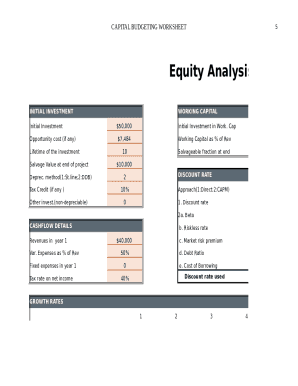
CAPITAL BUDGETING WORKSHEET5Equity Analysis of a Pro INITIAL INVESTMENT Initial Investment Opportunity cost (if any) Lifetime of the investment Salvage Value at end of project Deprec. method(1:St.line;2:DDB) Tax.
Open form follow the instructions
Easily sign the form with your finger
Send filled & signed form or save
How to fill out the Equity Analysis Capital Budget online
The Equity Analysis Capital Budget is a vital tool for assessing the financial viability of investment opportunities. This guide provides comprehensive, step-by-step instructions on effectively completing the form online, ensuring clarity and precision throughout the process.
Follow the steps to fill out the Equity Analysis Capital Budget
- Click the ‘Get Form’ button to obtain the form and open it in the editor.
- Provide the initial investment details. Enter the initial investment amount, opportunity cost (if applicable), the expected lifetime of the investment, and the salvage value at the end of the project. Select the appropriate depreciation method (1 for straight-line, 2 for double declining balance) and include any tax credits or non-depreciable investments.
- Next, fill in the working capital section. Enter the initial investment in working capital and calculate the working capital as a percentage of revenue. Also, include the salvageable fraction at the end.
- Proceed to the discount rate area. Input the discount rate, the risk-free rate, the market risk premium, and the debt ratio based on your financing mix. Ensure you provide the cost of borrowing if relevant.
- For the cash flow details, enter the projected revenues for the first year, variable expenses as a percentage of revenue, fixed expenses, and the tax rate on net income.
- Input growth rates if applicable. This section typically tracks expected revenue and expense growth over the project's duration.
- Review the investment measures at the end of the worksheet. Verify that the calculated net present value (NPV), internal rate of return (IRR), and return on capital (ROC) align with your expectations for the project.
- Finally, save your changes, download, print, or share the completed form as needed. Ensure all inputs are accurately captured before finalizing.
Start completing your Equity Analysis Capital Budget online today for an efficient budgeting process.
Experience a faster way to fill out and sign forms on the web. Access the most extensive library of templates available.
Related content
Jun 5, 2020 — 1 The following pages include an analysis of the FY21 capital budget using...
A capital budget can be used to analyze the economic viability of a business project...
In finance, equity is ownership of assets that may have debts or other liabilities...
Get answers to your most pressing questions about US Legal Forms API.
How do you calculate capital budgeting?
Step 1: Determine the total amount of the investment. ... Step 2: Determine the cash flows the investment will return. ... Step 3: Determine the residual/terminal value. ... Step 4: Calculate the annual cash flows of the investment. ... Step 5: Calculate the NPV of the cash flows.
What is capital budgeting and its methods?
Capital Budgeting refers to the decision-making process related to long term investments where different capital budgeting methods include the Payback Period, the accounting rate of return, the net present value, the discounted cash flow, the profitability Index, and the Internal Rate of Return method.
What is Capital analysis?
Capital investment analysis is a budgeting procedure that companies and government agencies use to assess the potential profitability of a long-term investment. Capital investment analysis assesses long-term investments, which might include fixed assets such as equipment, machinery, or real estate.
What is capital budgeting and why is it important?
Capital budgeting is important because it creates accountability and measurability. ... The capital budgeting process is a measurable way for businesses to determine the long-term economic and financial profitability of any investment project. A capital budgeting decision is both a financial commitment and an investment.
What is an example of capital budgeting?
Definition of Capital BudgetingCapital budgeting makes decisions about the long-term investment of a company's capital into operations. Planning the eventual returns on investments in machinery, real estate and new technology are all examples of capital budgeting.
What are the four steps of capital budgeting analysis?
What are the four steps of capital budgeting analysis? 1) estimate the project's expected cash flows, 2) assess the riskiness of those flows, 3) estimate the appropriate cost-of-capital discount rate, and 4) determine the project's profitability and breakeven characteristics.
What is the capital budgeting process?
Capital budgeting is the process that a business uses to determine which proposed fixed asset purchases it should accept, and which should be declined. This process is used to create a quantitative view of each proposed fixed asset investment, thereby giving a rational basis for making a judgment.
What is the meaning of capital budgeting?
What Is Capital Budgeting? Capital budgeting is the process a business undertakes to evaluate potential major projects or investments. Construction of a new plant or a big investment in an outside venture are examples of projects that would require capital budgeting before they are approved or rejected.
What is capital budgeting analysis?
Capital budgeting is the process of analyzing and ranking proposed projects to determine which ones are deserving of an investment. ... Uses a discount rate to determine the present value of all cash flows related to a proposed project.
Use professional pre-built templates to fill in and sign documents online faster. Get access to thousands of forms.
If you believe that this page should be taken down, please follow our DMCA take down process here.