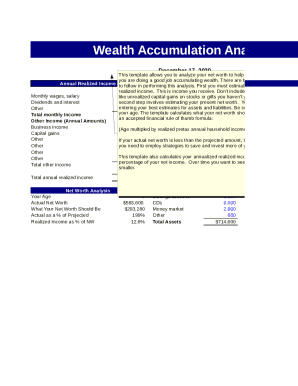
Wealth Accumulation Analysis December 17, 2020This template allows you to analyze your net worth to help you determine if you are doing a good job accumulating wealth. There are two basic steps Annual.
Open form follow the instructions
Easily sign the form with your finger
Send filled & signed form or save
How to fill out the Wealth Accumulation Analysis online
Filling out the Wealth Accumulation Analysis is an important step in understanding your financial health. This guide will walk you through the process step by step to ensure that you accurately analyze your wealth accumulation.
Follow the steps to complete the Wealth Accumulation Analysis efficiently.
- Press the ‘Get Form’ button to obtain the Wealth Accumulation Analysis template and open it in your online editor.
- Begin by estimating your annual realized income. This includes your monthly wages or salary, dividends, interest, other income, and any business income. Be sure to omit any unrealized gains or gifts not yet received.
- Next, complete the Net Worth Worksheet section. Enter your total assets, which should include your residence, vacation home, automobiles, jewelry, art, cash reserves, and any investments such as stocks, bonds, and mutual funds.
- After listing your assets, input your liabilities. This includes any mortgages, bank loans, auto loans, credit cards, or personal loans that you currently have.
- Once you have filled in all the required fields, the template will automatically calculate your actual net worth, what your net worth should be based on an accepted financial formula, and the percentage difference.
- Review the calculated results to assess your wealth accumulation progress. If your actual net worth is below the projected amount, consider adjusting your savings and investment strategies.
- Finally, save your changes, download a copy, print the form, or share it as needed for future reference.
Start analyzing your wealth accumulation online today by completing your Wealth Accumulation Analysis.
Experience a faster way to fill out and sign forms on the web. Access the most extensive library of templates available.
Related content
The issues above are addressed through an analysis based upon a unique ... In terms of...
by A Killewald · 2017 · Cited by 165 · Related articlesFeb 7, 2018 —...
Jump to Economic analysis — An individual who is considered wealthy, affluent, or rich...
Get answers to your most pressing questions about US Legal Forms API.
How is wealth inequality measured?
The most commonly used inequality measures are the Gini coefficient (based on the Lorenz curve) and the percentile or share ratios. These measures try to capture the overall dispersion of income; however, they tend to place different levels of importance on the bottom, middle and top end of the distribution.
What is wealth accumulation?
Wealth accumulation is simply building up your net worth and wealth over time. The U.S. has some of the most wealthy people in the world, with 7.7 million households having at least one million in assets, according to a 2019 study from marketing research firm Phoenix Marketing International.
What is the net worth of the top 5 %?
To be top . 5% in 2020, a household needed a net worth of $17,557,208.
What is the 90 10 income ratio?
For example, the 90/10 ratio takes the ratio of the top 10% of incomes (Decile 10) to the lowest 10% of incomes (Decile 1). A 90/10 ratio of five means that the richest 10% of the population earn five times more than the poorest 10%.
What does a Gini index of 40 mean?
Gini index < 0.2 represents perfect income equality, 0.2 0.3 relative equality, 0.3 0.4 adequate equality, 0.4 0.5 big income gap, and above 0.5 represents severe income gap. Therefore, the warning level of Gini index is 0.4.
How is wealth gap measured?
The U.S. Census Bureau publishes two measures of income inequality each year. ... The Census Bureau also reports the Gini index, a summary statistic that measures the dispersion of incomes on a scale of zero (everyone has exactly the same income) to one (one person has all the income).
How much wealth does the top 10 percent have?
To be in the top 10%, you need a net worth of at least $464,100.
How much wealth do the top 5% have?
The wealthiest families are also the only ones to have experienced gains in wealth in the years after the start of the Great Recession in 2007. From 2007 to 2016, the median net worth of the richest 20% increased 13%, to $1.2 million. For the top 5%, it increased by 4%, to $4.8 million.
What is income inequality and how is it measured?
We can measure income inequality by comparing what share of the total income each quintile earns. U.S. income distribution by quintile appears in (Figure).
What is a wealth accumulation plan?
An accumulation plan is a general financial strategy in which an investor attempts to build the value of a portfolio. ... By doing so, the investor accumulates a larger and larger investment in the mutual fund through regular contributions and the increase in the value of the fund's portfolio.
Use professional pre-built templates to fill in and sign documents online faster. Get access to thousands of forms.
If you believe that this page should be taken down, please follow our DMCA take down process here.