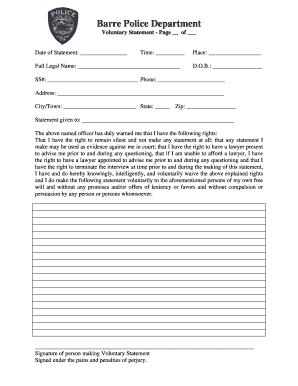
Ce: __________________ D.O.B.: _________________ SS#: _______________________________ Phone: _______________________ Address: _________________________________________________________ City/Town: _________________________ State: _____ Zip: _________________ Statement given to: ____________________________________________________ The above named officer has duly warned me that I have the following rights: That I have the right to remain silent and not make any statement at all; that any statement.
Open form follow the instructions
Easily sign the form with your finger
Send filled & signed form or save
How to fill out the MA Voluntary Statement online
The MA Voluntary Statement is an important legal document that individuals may need to complete when interacting with law enforcement. This guide will help you navigate the process of filling out the form online, ensuring that you complete each section correctly.
Follow the steps to successfully complete your Voluntary Statement
- Click ‘Get Form’ button to obtain the form and open it in the editor.
- Begin by filling in the date of your statement in the designated field. This ensures there is a clear record of when the statement was made.
- Enter the time of the statement in the appropriate field. Accurate timing is essential for documentation purposes.
- Complete the full legal name section with your full name as it appears on official documents. This is crucial for identification.
- Provide your place of residence. This can include the specific location where you are filling out the statement.
- Fill in your date of birth to verify your identity. Make sure to use the correct format.
- Enter your Social Security number. This information is sensitive, so ensure it's kept secure.
- Provide your phone number for contact purposes. This allows for any necessary follow-ups.
- Fill in your complete address, including city/town, state, and zip code. This provides your precise location.
- Indicate the name of the officer to whom the statement is given. This identifies the law enforcement officer involved.
- Review the rights section indicated on the form carefully. Acknowledge your understanding of these rights before proceeding.
- In the statement area, provide your voluntary statement as clearly and concisely as possible. Make sure it reflects your own words.
- Include your signature at the designated area to confirm that you are providing the statement willingly and understand its implications.
- At the end of the form, make sure to save your changes. You may then choose to download, print, or share the completed Voluntary Statement.
Complete your MA Voluntary Statement online today for a streamlined filing experience.
Experience a faster way to fill out and sign forms on the web. Access the most extensive library of templates available.
Related content
Voluntary administration is a simplified probate procedure for an estate with minimal...
by FI Lederer · 1976 · Cited by 29 — Massachusetts rule should not inform the jury...
Cost Statement and in column 3, the contractor number. See CMS Pub. 15-1 ... and “V”...
Get answers to your most pressing questions about US Legal Forms API.
What happens if a will is not filed in Massachusetts?
If a will is not filed in Massachusetts, the estate may be treated as if the deceased died intestate, meaning the state's laws dictate the distribution of their assets. This can lead to confusion and disputes among potential heirs. To avoid such issues, utilizing the MA Voluntary Statement can aid in properly filing a will and managing the estate.
How long does voluntary administration take in MA?
The duration of voluntary administration in Massachusetts can vary based on the estate's complexity. Generally, the process may take several months, as it involves verifying assets, settling debts, and distributing any remaining property. Having a clear understanding of the MA Voluntary Statement can assist in expediting this process.
What are letters of voluntary administration?
Letters of voluntary administration provide legal authority for individuals to manage an estate when no will exists. They are essential for settling debts and distributing assets appropriately. Utilizing the MA Voluntary Statement can help individuals understand and obtain these letters effectively.
Do wills have to be filed with the court in Massachusetts?
Indeed, wills must be filed with the court in Massachusetts after the individual passes away. This requirement ensures that the deceased's wishes, as outlined in their will, are legally recognized and executed. The MA Voluntary Statement can support families in managing this necessary step during a challenging time.
What is a letter of voluntary administration?
A letter of voluntary administration is a court document that allows an individual to manage an estate when there is no will. It grants the administrator certain rights and responsibilities to handle the deceased's affairs. When you consider the MA Voluntary Statement, it can help clarify the voluntary administration process in Massachusetts.
Do you need to file a will with the court in Massachusetts?
Yes, after a person’s death, their will must be filed with the probate court in Massachusetts. Filing the will initiates the probate process, which is critical for settling the estate. Utilizing tools such as the MA Voluntary Statement can simplify filing and ensure compliance with local regulations.
Does a will need to be recorded in Massachusetts?
In Massachusetts, a will does not need to be recorded prior to the individual's passing. However, once the person has died, it is important to file the will with the probate court. This is where the MA Voluntary Statement process can be beneficial, ensuring that all necessary documents are filed correctly.
How do I get a letter of testamentary in Massachusetts?
To obtain a letter of testamentary in Massachusetts, you must first file a petition with the probate court in the county where the deceased person resided. The petition contains various essential details about the decedent and the proposed executor. Once approved by the court, you will receive the letter, which grants you the authority to manage the estate in accordance with MA Voluntary Statement guidelines. It's advisable to consult legal resources or professionals for precise guidance throughout this process.
How long does it take to receive letters of testamentary?
The time it takes to receive letters of testamentary in Massachusetts can vary widely, depending on the complexity of the estate and the court's workload. Generally, it takes anywhere from several weeks to a few months after filing the probate petition. If there are no objections or complications, the process tends to be quicker. On the other hand, delays can occur if the court requires additional documentation.
What is another name for a letter of testamentary?
Another name for a letter of testamentary is a testamentary letter or probate letter. These terms refer to the same document, which signifies the authority granted to an executor to manage a deceased person’s estate. It is essential for fulfilling various duties, like paying bills and distributing assets. Understanding the different names can help you navigate conversations regarding estate management more effectively.
Use professional pre-built templates to fill in and sign documents online faster. Get access to thousands of forms.
If you believe that this page should be taken down, please follow our DMCA take down process here.