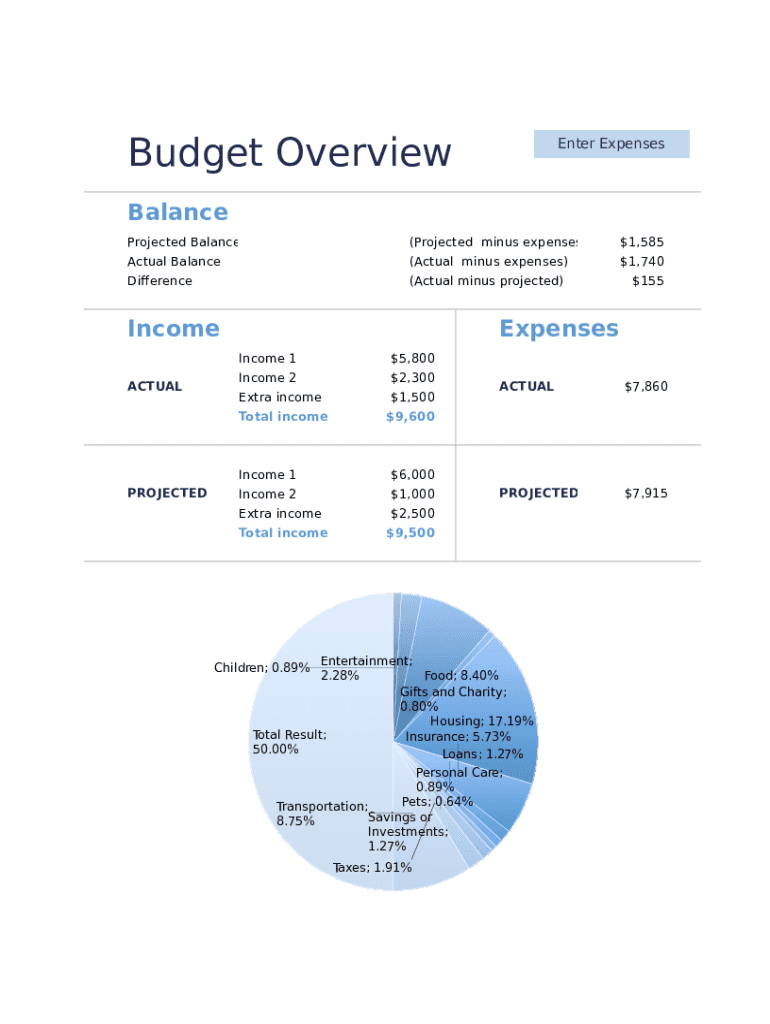
Budget OverviewEnter ExpensesBalance Projected Balance Actual Balance Difference(Projected minus expenses (Actual minus expenses) (Actual minus projected)Income ACTUALPROJECTED$1,585 $1,740 $155Expenses Income.

Open form follow the instructions

Easily sign the form with your finger

Send filled & signed form or save
How to fill out the Budget Overview & Summary online
Navigating the Budget Overview & Summary form is an essential step in managing personal finances. This guide provides clear, step-by-step instructions to help you effectively complete the form online, ensuring that your budget reflects accurate income and expense information.
Follow the steps to accurately complete your Budget Overview & Summary
- Click the ‘Get Form’ button to obtain the form and open it for editing.
- Begin by entering your projected income in the 'Income' section. List all sources of income, including wages and additional revenue streams. Carefully verify the amounts to ensure accurate projections.
- Next, move to the 'Expenses' section. Input your anticipated expenses, categorizing them into relevant groups such as housing, entertainment, and transportation. Be thorough in capturing all potential expenditures.
- Calculate and enter the actual expenses you have incurred for the same categories in the 'Actual' section. This comparison is vital for assessing your spending habits.
- Review the differences between your projected and actual income and expenses to identify areas of over or under-budgeting. This will be reflected in the 'Difference' field.
- For a comprehensive overview, utilize the summary and category sections to visualize your financial standing. Ensure that all figures accurately represent your financial situation.
- After double-checking all entries for accuracy, save your changes. You can then choose to download, print, or share the form as needed.
Get started with filling out your documents online to take control of your budgeting.
Experience a faster way to fill out and sign forms on the web. Access the most extensive library of templates available.
Related content
A more detailed analysis of revenue sources is provided in the “All Funds Summary” and...
The Budget Summary includes budgeted amounts, encumbrances, transaction ... Check out the...
A government budget is a document prepared by the government and/or other political entity...
Get answers to your most pressing questions about US Legal Forms API.
What are the 4 types of budgets?
Four Main Types of Budgets/Budgeting Methods. There are four common types of budgets that companies use: (1) incremental, (2) activity-based, (3) value proposition, and (4) zero-based. These four budgeting methods each have their own advantages and disadvantages, which will be discussed in more detail in this guide.
What is budget summary?
In its simplest definition, a budget summary refers to an itemized summary of expected revenue as well as expenditure of a given project, business, or company. Usually, a budget summary often highlights some essential information that is related to the significant revenues and expenses of an organization.
What is budget and its importance?
budgeting estimates revenue, plans expenditure and restricts any spending that is not part of the plan. budgeting ensures that money is allocated to those things that support the strategic objectives of the business. a well communicated budget helps everyone understand the priorities of the business.
What are the 5 basic elements of a budget?
All basic budgets have the same elements: income, fixed expenses, variable expenses, discretionary expenses and personal financial goals. By combining these elements, a person can create a simple monthly budget.
What is budget explain with example?
A budget is defined as a plan or estimate of the amount of money needed for cost of living or to be used for a specific purpose. An example of budget is how much a family spends on all expenses in a month. An example of budget is how much a person plans on spending on a new bed.
What is a budget statement?
Budgeted financial statements are usually limited to a summary-level income statement and balance sheet, and are compiled within the budget model. Once finalized, the budget information is carried over into the budget field for each line item in the financial statements within a company's accounting software.
How do you explain budgeting?
Budgeting is the process of creating a plan to spend your money. This spending plan is called a budget. Creating this spending plan allows you to determine in advance whether you will have enough money to do the things you need to do or would like to do. than they earn and slowly sink deeper into debt every year.
What is Budget Budget type?
Four Main Types of Budgets/Budgeting Methods. There are four common types of budgets that companies use: (1) incremental, (2) activity-based, (3) value proposition, and (4) zero-based.
How do you explain budgeting to a child?
Start With Goals, Wants and Needs. Talk with your child about money and how to use it wisely. ... Save. When your child earns money, they should first set aside a portion for savings. ... Share. Teaching children about charity at a young age is also useful. ... Spend. The remainder of their earnings can go toward spending.
What is budget explain?
A budget is an estimation of revenue and expenses over a specified future period of time and is usually compiled and re-evaluated on a periodic basis. Budgets can be made for a person, a group of people, a business, a government, or just about anything else that makes and spends money.
Use professional pre-built templates to fill in and sign documents online faster. Get access to thousands of forms.
If you believe that this page should be taken down, please follow our DMCA take down process here.