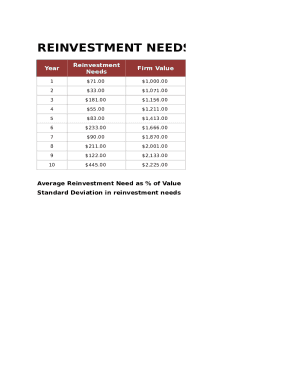
REINVESTMENT NEEDS YearReinvestment NeedsFirm Value1$71.00$1,000.002$33.00$1,071.003$181.00$1,156.004$55.00$1,211.005$83.00$1,413.006$233.00$1,666.007$90.00$1,870.008$211.00$2,001.009$122.00$2,133.0010$445.00$2,225.00Average.

How it works
  • Open form

    Open form follow the instructions

  • Easily sign form

    Easily sign the form with your finger

  • Share form

    Send filled & signed form or save

How to fill out the Value Of Financial Flexibility online

Understanding the value of financial flexibility is crucial for businesses evaluating their financial strategies. This guide will provide you with step-by-step instructions on how to properly fill out the Value Of Financial Flexibility form online, ensuring you capture all necessary information accurately and effectively.

Follow the steps to complete the Value Of Financial Flexibility form online.

  1. Press the ‘Get Form’ button to retrieve the form and open it in your chosen online editor.
  2. Begin with the section labeled 'Reinvestment Needs.' Enter the annual reinvestment needs for each year, as indicated in the provided data.
  3. Next, move to the 'Firm Value' field. Fill in the corresponding firm value for each year next to the reinvestment needs.
  4. Proceed to the section concerning average reinvestment needs. Calculate and input the average as a percentage of firm value.
  5. Now, assess and enter the standard deviation in reinvestment needs, which offers insight into the variability of financial requirements.
  6. In the inputs relating to the option, specify the reinvestment needs that can be financed without financial flexibility.
  7. Enter the maximum reinvestment that can be financed with flexibility to establish a baseline for your calculations.
  8. Input the riskless interest rate that corresponds to the life of the option, ensuring you select an accurate figure based on current market conditions.
  9. Add the current cost of capital required for your firm, which is crucial for assessing financial decisions.
  10. Finally, review all entered information for accuracy. Once confirmed, you can save your changes, download the form, print it, or share it as needed.

Start completing your Value Of Financial Flexibility form online today.

Get form

Experience a faster way to fill out and sign forms on the web. Access the most extensive library of templates available.

Related content

EX-99.1 - SEC.gov

Aug 24, 2020 — ... enhanced financial flexibility to deliver long-term shareholder value...

Learn more
Financial Flexibility, Firm Size and Capital...

by S Byoun · ‎2007 · ‎Cited by 7 · ‎Related articlesIn order to examine the...

Learn more
THE INSTITUTE OF CPA A2.1 STRATEGIC CORPORATE ...

Also, finance must be adequately rewarded and its market value maintained, ... Extra...

Learn more
Questions & Answers

Get answers to your most pressing questions about US Legal Forms API.

Contact support

What is financial flexibility?

Financial flexibility is the ability to react and adapt to changing financial conditions. ... But perhaps the most important factor of financial flexibility is working capital. Working capital is simply defined as the difference between current assets and current liabilities.

Financial flexibility gives a business the ability to adapt, pivot, and evolve with relative ease. There's far less friction involved in the process, and you're able to do more with less. Less volatility. ... But when a firm is financially flexible, there's far less volatility.

Financial structure refers to the mix of debt and equity that a company uses to finance its operations. This composition directly affects the risk and value of the associated business. ... In general, the financial structure of a company can also be referred to as the capital structure.

Financial capital is the money, credit, and other forms of funding that build wealth. Individuals use financial capital to invest, by making a down payment on a home, or creating a portfolio for retirement. Businesses use capital to increase revenue.

For businesses, debt is one of two common ways to raise money for growth and development. The other is to take on equity investment from shareholders. Compared to investments, debt financing offers some flexibility but also presents some restrictions.

By drawing insights from these studies and noting that firms can attain financial flexibility through alternative routes (e.g. by accumulating cash, adopting a conservative leverage policy or adjusting simultaneously their cash and leverage levels), we classify firms into several groups of financial flexibility on the ...

To assess long-term financial flexibility, financial statement users use the Debt Ratio to evaluate the firm's debt levels. The debt ratio shows the percentage of total assets provided by debt finance (outside borrowings).

Short-term debt provides a more flexible form of financing than long-term debt.

Get This Form Now!

Use professional pre-built templates to fill in and sign documents online faster. Get access to thousands of forms.

If you believe that this page should be taken down, please follow our DMCA take down process here.

Get Value Of Financial Flexibility