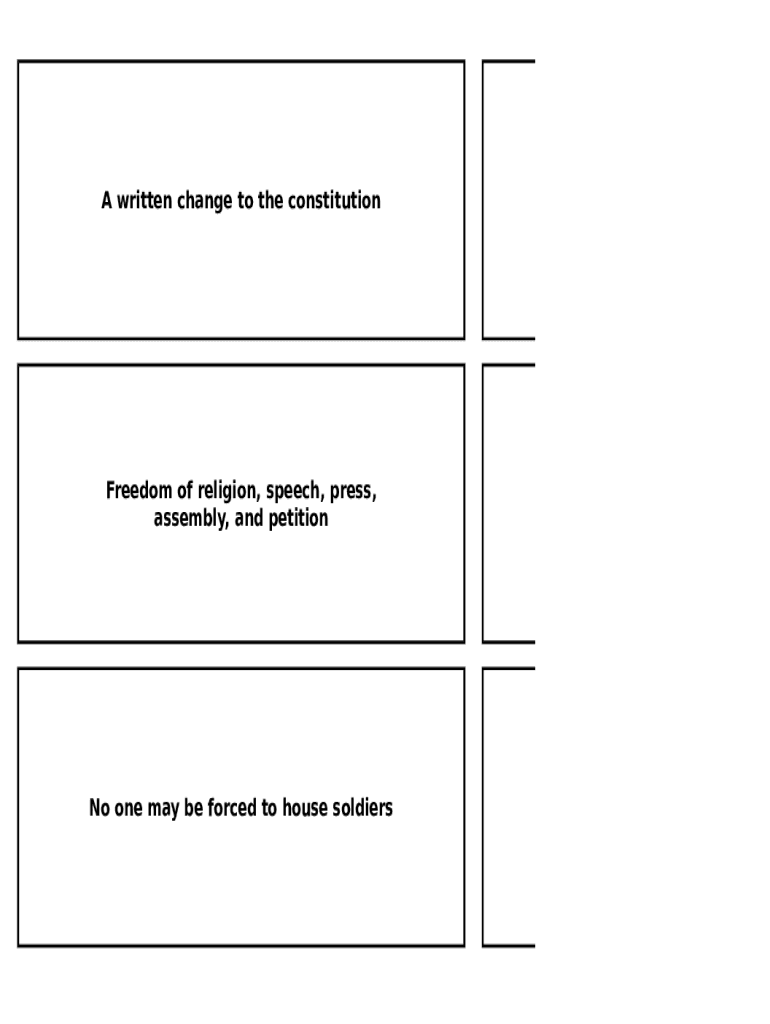
A written change to the constitutionFreedom of religion, speech, press, assembly, and petitionNo one may be forced to house soldiersAmendmentAmendment 1Amendment 3Rights of the criminally accused (indictment.
Loading

Open form follow the instructions

Easily sign the form with your finger

Send filled & signed form or save
How to fill out the Cases Against A State online
This guide provides clear instructions on how to fill out the Cases Against A State form online. Whether you have experience with legal documents or are new to the process, the following steps will help you complete the form efficiently and accurately.
Follow the steps to successfully complete the Cases Against A State form.
- Use the ‘Get Form’ button to access the Cases Against A State form. This will open the form in your browser, allowing you to begin the process.
- Start by filling out your personal information in the designated fields. This typically includes your name, address, and contact information. Ensure that all details are accurate and up-to-date.
- Move on to the section that requires you to provide details about the state you are filing against. Include the state’s name and any relevant specifics about your case.
- In the next section, outline the reasons for your case against the state. Be as detailed as possible, providing any supporting facts and evidence that can substantiate your claims.
- Review the next fields, which may require you to list any witnesses or individuals who can provide testimony in your case. Include their contact information if applicable.
- Complete any additional sections as instructed within the form, which could involve signing and dating the document to certify its accuracy.
- Once you have filled out all the required fields, review your entries carefully to ensure there are no mistakes. This step is crucial to avoid delays in processing your case.
- After confirming that all information is correct, you can save your changes. Options typically will include downloading the form, printing it, or sharing it electronically as needed.
Start filling out the Cases Against A State form online today to take the next step in your case.
Experience a faster way to fill out and sign forms on the web. Access the most extensive library of templates available.
Related content
It was not long before federal judges were asked to interpret federal court jurisdiction...
In other cases, the Eleventh Amendment does not apply because the procedural posture is...
A lawsuit is a proceeding by a party or parties against another in the civil court of law...
Get answers to your most pressing questions about US Legal Forms API.
Which court handles disputes between states?
' In the early drafts of the Constitution provision was made giving to the Supreme Court 'jurisdiction of controversies between two or more states, except such as shall regard territory or jurisdiction,' and also that the Senate should have exclusive power to regulate the manner of deciding the disputes and ...
When can a state sue another state?
WASHINGTON (AP) The Supreme Court decided Monday that one state cannot unwillingly be sued in the courts of another, overruling a 40-year precedent and perhaps, foreshadowing an argument over the viability of other high court decisions.
Can a state sue a state?
State Immunity: The Eleventh Amendment. The Eleventh Amendment limits private actions brought against states in federal court. ... A state may not be sued in federal court by its own citizen or a citizen of another state, unless the state consents to jurisdiction.
What court deals with disputes between states?
It all came from a very simple provision in the Judiciary Article of the Constitution, giving to the Court jurisdiction over "controversies between two or more states," and requiring that such suits should be begun originally in the Supreme Court and not in any lower court. 1787.
Does the Supreme Court hear state cases?
The United States Supreme Court is a federal court, meaning in part that it can hear cases prosecuted by the U.S. government. (The Court also decides civil cases.) The Court can also hear just about any kind of state-court case, as long as it involves federal law, including the Constitution.
What is the 11 Amendment in simple terms?
What is this amendment in simple terms? The Eleventh Amendment says that U.S. courts can't hear cases and make decisions against a state if the state is sued by a citizen who lives in another state or by a person who lives in another country.
What is the 11th Amendment in simple words?
What is this amendment in simple terms? The Eleventh Amendment says that U.S. courts can't hear cases and make decisions against a state if the state is sued by a citizen who lives in another state or by a person who lives in another country.
Which court hears cases between states?
The extension of federal judicial power to controversies between states and the vesting of original jurisdiction in the Supreme Court of suits to which a state is a party had its origin in experience.
Which court hears disputes between states?
Federal courts generally have exclusive jurisdiction in cases involving (1) the Constitution, (2) violations of federal laws, (3) controversies between states, (4) disputes between parties from different states, (5) suits by or against the federal government, (6) foreign governments and treaties, (7) admiralty and ...
Who has original jurisdiction of a state sues another state?
There is a special drama when a state sues another state invoking the original jurisdiction of the Supreme Court of the United States.
Use professional pre-built templates to fill in and sign documents online faster. Get access to thousands of forms.
If you believe that this page should be taken down, please follow our DMCA take down process here.