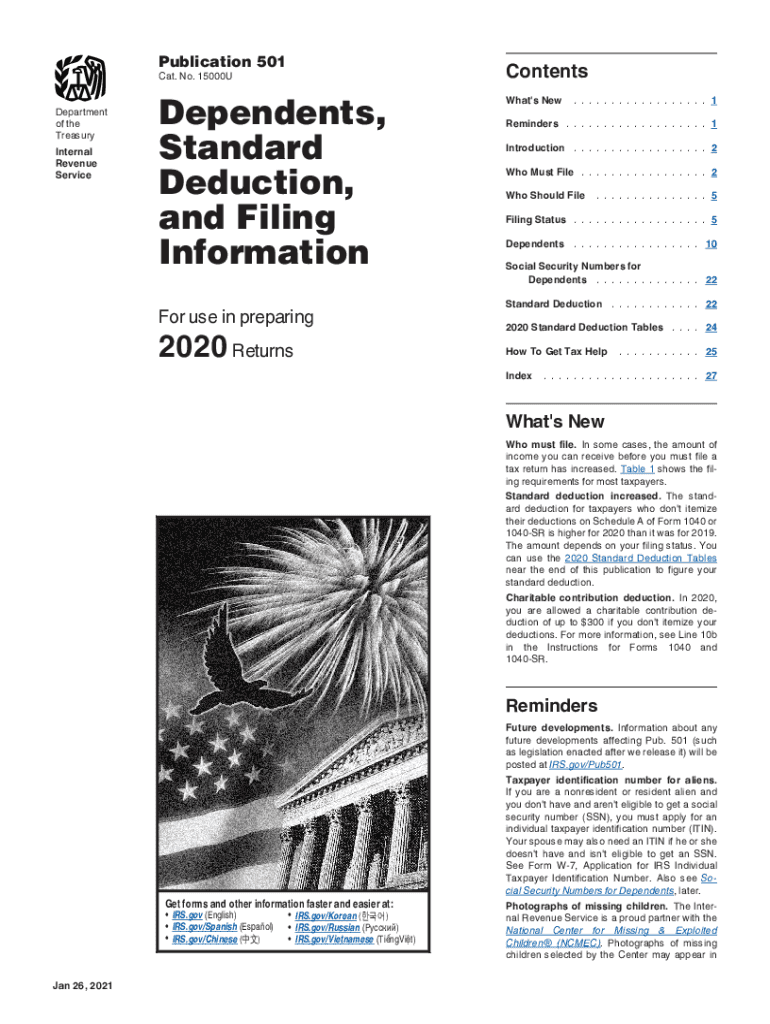
Publication 501 Contents Dependents Standard Deduction and Filing Information What s New Cat. No. 15000U Department of the Treasury Internal Revenue Service For use in preparing 2018 Returns. 1 Reminders. 1 Introduction. 2 Who Must File. 2 Who Should File Filing Status. 5 Dependents. 10 Social Security Numbers for Standard Deduction. 22 2018 Standard Deduction Tables. 23 How To Get Tax Help Index. 25 Who must file. In some cases the amount of income you can receive before you must file a tax return has increased* Table 1 shows the filing requirements for most taxpayers. Personal exemption suspended* For 2018 you can t claim a personal exemption deduction for yourself your spouse or your dependents. their deductions on Schedule A of Form 1040 is higher for 2018 than it was for 2017. The amount depends on your filing status. You can use the 2018 Standard Deduction Tables near the end of this publication to figure your standard deduction* Forms 1040A and 1040EZ no longer available. Forms ....
Loading

Open form follow the instructions

Easily sign the form with your finger

Send filled & signed form or save
How to fill out the IRS Publication 501 online
This guide provides a comprehensive overview of how to complete the IRS Publication 501 online. It is designed to help users understand the form's components, including who must file, their filing status, dependents, and the standard deduction.
Follow the steps to fill out the IRS Publication 501 online.
- Press the ‘Get Form’ button to access the IRS Publication 501. This will allow you to retrieve the online form for completion.
- Read through the introduction section of the form to familiarize yourself with what the publication covers. This section includes important notes on who must file and changes for the current tax year.
- Determine your filing status by reviewing the 'Filing Status' section. You should select one of the options: single, married filing jointly, married filing separately, head of household, or qualifying widow(er). Each status has different implications on your taxes.
- Identify any dependents you might claim. Navigate to the 'Dependents' section, where you will find definitions for qualifying children and qualifying relatives. Make sure to have their Social Security numbers ready.
- Calculate your standard deduction, which will depend on your filing status and age (if applicable). Refer to the ‘Standard Deduction’ table provided in the publication to find your applicable amount.
- Once you have completed all sections of the form, make sure to review your entries for accuracy. Correct any mistakes you might have.
- Save your changes. You may also download, print, or share the completed form as required.
Start completing your IRS Publication 501 online to ensure your tax information is accurate and filed on time.
Experience a faster way to fill out and sign forms on the web. Access the most extensive library of templates available.
Related content
Jan 7, 2019 - Publication 501 (2018), Dependents, Standard Deduction, and Filing...
This IRS publication discusses some tax rules that affect every person who may have to...
Get answers to your most pressing questions about US Legal Forms API.
Can I claim my child if he works?
Even if your child had a job last year, you can still claim her as a dependent on your income taxes, provided the child is still considered a qualifying child based on IRS guidelines. However, depending on how much income your child earned, she may have to file her own tax return, too.
How much money can a child make and still be claimed as a dependent?
If the dependent is a qualifying child, then you can claim him or her regardless of earnings. For the 2018 tax year, other qualifying relatives need to make under $4,150 a year to be claimed as dependents.
How much can my child make and still be claimed as a dependent?
A child who has only earned income must file a return only if the total is more than the standard deduction for the year. For 2019, the standard deduction for a dependent child is total earned income plus $350, up to a maximum of $12,200. Thus, a child can earn up to $12,200 without paying income tax.
Can I claim myself as a dependent?
No. You cannot claim yourself as a dependent on taxes. Dependency exemptions are applicable to your qualifying dependent children and qualifying dependent relatives only. You can, however, claim a personal exemption for yourself on your return.
Can I claim an adult as a dependent?
Regardless of their age, these individuals can be a qualifying child. The next test requires that the adult reside with you for the entire tax year. ... This is because you can't claim an adult dependent if their gross income which is the total of all income that isn't tax-exempt is $3,700 ($4,050 in 2018) or more.
Who can be claimed as a dependent in 2019?
Your relative cannot have a gross income of more than $4,150 in 2018 and be claimed by you as a dependent. Do you financially support them? You must provide more than half of your relative's total support each year.
What qualifies someone as a dependent?
First and foremost, a dependent is someone you support: You must have provided at least half of the person's total support for the year food, shelter, clothing, etc. If your adult daughter, for example, lived with you but provided at least half of her own support, you probably can't claim her as a dependent.
What qualifies as a dependent?
A dependent is a person other than the taxpayer or spouse who entitles the taxpayer to claim a dependency exemption. Each dependency exemption decreases income subject to tax by the exemption amount. A taxpayer cannot claim a dependency exemption for a person who can be claimed as a dependent on another tax return.
What is a qualifying dependent?
A Qualifying Relative is a person who meets the IRS requirements to be your dependent for tax purposes. If someone is your Qualifying Relative, then you can claim them as a dependent on your tax return. Despite the name, a Qualifying Relative does not necessarily have to be related to you.
Who can be claimed as a dependent 2019?
The child has to have lived with you for at least half of the year. The child has to be related to you as a son, daughter, stepchild, foster child, brother, sister, stepbrother, stepsister, or a descendant of any of those. The child must be 18 or younger at the end of the year, or under 24 if a student.
Use professional pre-built templates to fill in and sign documents online faster. Get access to thousands of forms.
If you believe that this page should be taken down, please follow our DMCA take down process here.