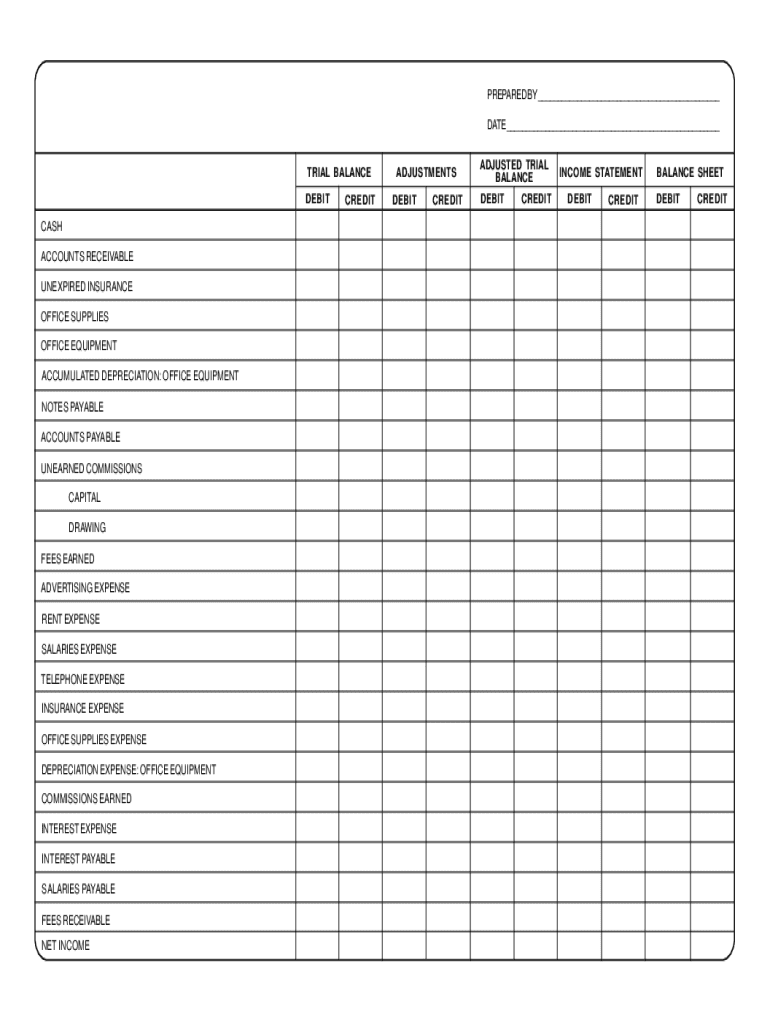
OTES PAYABLE ACCOUNTS PAYABLE UNEARNED COMMISSIONS CAPITAL DRAWING FEES EARNED ADVERTISING EXPENSE RENT EXPENSE SALARIES EXPENSE TELEPHONE EXPENSE INSURANCE EXPENSE OFFICE SUPPLIES EXPENSE DEPRECIATION EXPENSE: OFFICE EQUIPMENT COMMISSIONS EARNED INTEREST EXPENSE INTEREST PAYABLE SALARIES PAYABLE FEES RECEIVABLE NET INCOME CREDIT TRIAL BALANCE DEBIT CREDIT ADJUSTMENTS DEBIT PREPARED BY DEBIT CREDIT INCOME STATEMENT DEBIT CREDIT BALANCE SHE.
Loading

Open form follow the instructions

Easily sign the form with your finger

Send filled & signed form or save
How to fill out the Debit Credit Fill In Form online
Filling out the Debit Credit Fill In Form online can be a straightforward process if you follow the right steps. This guide will help you navigate through each section of the form, ensuring that you understand what is required for accurate completion.
Follow the steps to effectively complete the form.
- Click 'Get Form' button to obtain the form and open it in the editor.
- Begin by filling out the date at the top of the form where indicated. This helps in identifying the timeframe for the financial entries.
- In the section for cash, accounts receivable, unexpired insurance, and office supplies, enter the relevant amounts in the 'Debit' column as these are asset entries.
- For liabilities such as notes payable and accounts payable, enter the applicable amounts in the 'Credit' column. These entries represent the amounts owed by the business.
- Input the income and expense figures, beginning with fees earned in the income section and various expense categories. Use the corresponding debit and credit columns as appropriate.
- Complete the income statement and balance sheet sections by recording any additional adjustments or calculations identified while working on your entries.
- After accurately filling in all the sections, review the form for completeness and accuracy.
- Finally, you can save your changes, download, print, or share the completed form as needed.
Begin filling out your document online today for seamless financial management.
Experience a faster way to fill out and sign forms on the web. Access the most extensive library of templates available.
Related content
Attach this form to your document, certificate or other written request. The Name of the...
Breadcrumb Navigation. Home; Debit / Credit Card Refund Request Form. Debit / Credit Card...
A credit card is a payment card issued to users (cardholders) to enable the cardholder to...
Get answers to your most pressing questions about US Legal Forms API.
What is debit and credit examples?
For example, you would debit the purchase of a new computer by entering the asset gained on the left side of your asset account. A credit is an entry made on the right side of an account. It either increases equity, liability, or revenue accounts or decreases an asset or expense account.
Are loans credit or debit?
When you're entering a loan payment in your account it counts as a debit to the interest expense and your loan payable and a credit to your cash. Your lender's records should match your liability account in Loan Payable.
What is a debit credit analysis?
A debit is an accounting entry that either increases an asset or expense account, or decreases a liability or equity account. ... A credit is an accounting entry that either increases a liability or equity account, or decreases an asset or expense account. It is positioned to the right in an accounting entry.
What is the debit?
A debit is an accounting entry that results in either an increase in assets or a decrease in liabilities on a company's balance sheet. In fundamental accounting, debits are balanced by credits, which operate in the exact opposite direction. ... The abbreviation for debit is sometimes "dr," which is short for "debtor."
What is debit & credit?
A debit increases asset or expense accounts, and decreases liability, revenue or equity accounts. A credit is always positioned on the right side of an entry. It increases liability, revenue or equity accounts and decreases asset or expense accounts.
Which account typically carries a credit balance?
Liabilities/Revenues/Equity These accounts normally carry a credit balance.
What accounts typically carry a credit balance?
Liabilities, revenues and sales, gains, and owner equity and stockholders' equity accounts normally have credit balances. These accounts will see their balances increase when the account is credited. Their balances will decrease when they debited.
How do you do debit and credit in accounting?
A debit increases asset or expense accounts, and decreases liability, revenue or equity accounts. A credit is always positioned on the right side of an entry. It increases liability, revenue or equity accounts and decreases asset or expense accounts.
Are expenses debit or credit?
Expenses normally have debit balances that are increased with a debit entry. Since expenses are usually increasing, think "debit" when expenses are incurred. (We credit expenses only to reduce them, adjust them, or to close the expense accounts.)
What is meant by credit balance in accounts?
A credit balance on your billing statement is an amount that the card issuer owes you. Credits are added to your account each time you make a payment. ... If the total of your credits exceeds the amount you owe, your statement shows a credit balance. This is money the card issuer owes you.
Use professional pre-built templates to fill in and sign documents online faster. Get access to thousands of forms.
If you believe that this page should be taken down, please follow our DMCA take down process here.