With the county board of health to install a new private sewage disposal system on this property within an agreed upon time period. A copy of the binding acknowledgment is provided with this form. There is a building served by private sewage disposal system on this property. The building to which the sewage disposal system is connected will be demolished without being occupied. The buyer has executed a binding acknowledgment with the county board of health to demolish the building within an agre.
Open form follow the instructions
Easily sign the form with your finger
Send filled & signed form or save
How to fill out the IA DNR 542-0960 online
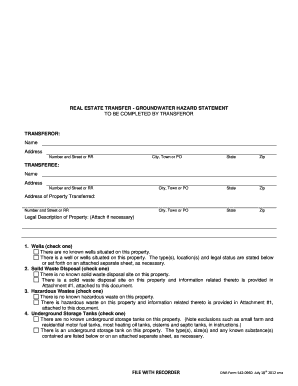
Filling out the IA DNR 542-0960 form is essential for anyone involved in real estate transactions related to groundwater hazard statements. This guide will walk you through each section of the form, providing clear and concise instructions to ensure a smooth and efficient experience.
Follow the steps to successfully complete the IA DNR 542-0960 form.
- Click ‘Get Form’ button to obtain the form and access it in the online editor.
- Begin by entering the transferor's name and complete the address fields, including number and street or rural route, city or town, state, and zip code.
- Next, provide the transferee's name and their complete address details in the designated fields.
- Indicate the address of the property being transferred by filling in the number and street or rural route in the specified section.
- For the legal description of the property, attach additional documents as necessary for proper detailing.
- Proceed to section 1, where you will choose the appropriate option regarding wells on the property, either stating there are none or providing details of existing wells.
- In section 2, check the relevant box regarding solid waste disposal sites, noting if any exist and including any relevant information in Attachment #1 if applicable.
- For section 3, indicate if there is any hazardous waste present, and provide corresponding information in Attachment #1 if necessary.
- Proceed to section 4 to indicate whether underground storage tanks are present, noting the type and contents if applicable.
- In section 5, check whether there are private burial sites on the property and provide any relevant identification information.
- Move to section 6 to delineate the status of the sewage disposal system. You may need to check multiple options depending on the conditions present and attach any certification or acknowledgment documents.
- In the final part of the form, provide any additional information required by the statements checked above or attach separate sheets as necessary.
- Finally, ensure that you sign and date the form, entering a contact telephone number to complete the submission process.
- After all information is entered correctly, you can save changes, download, print, or share the completed form as needed.
Start completing the IA DNR 542-0960 form online now for a streamlined experience.
Experience a faster way to fill out and sign forms on the web. Access the most extensive library of templates available.
Related content
DNR Form 542-0960 Instructions. INSTRUCTIONS FOR COMPLETING GROUNDWATER HAZARD STATEMENT...
Get answers to your most pressing questions about US Legal Forms API.
Do DNR orders need to be notarized?
In most cases, DNR orders do not require notarization in Iowa. However, certain forms or specific situations might necessitate a notarized signature, depending on the type of document involved. It is always advisable to check the requirements stated in the IA DNR 542-0960 form to confirm any notarization needs. By doing so, you can avoid delays in processing your DNR.
How do I set up a DNR?
Setting up a DNR involves completing the necessary application forms and submitting them to the Iowa Department of Natural Resources. You can start this process by accessing the IA DNR 542-0960 form on their website or through local offices. Be sure to gather all required documentation to ensure a smooth application process. This approach allows you to establish a compliant and effective DNR in Iowa.
Can anyone get a DNR form?
Yes, anyone can request a DNR form in Iowa, as they are available to the public. This accessibility allows residents, businesses, and investors to engage with DNR processes. It's important to check the specific requirements connected to the IA DNR 542-0960 form, as some forms may have eligibility criteria. After that, you can easily obtain the needed documents from online or local sources.
How to get a DNR form in Iowa?
To obtain a DNR form in Iowa, you can visit the Iowa Department of Natural Resources website. They offer a variety of forms, including the IA DNR 542-0960, which you may need for specific applications. Additionally, you can request forms directly from local offices or service centers if you prefer in-person assistance. This way, you can ensure you have the correct forms to meet your specific needs.
What is a groundwater hazard statement in Iowa?
A groundwater hazard statement in Iowa is a document required during real estate transactions. It helps identify potential risks to groundwater from certain activities or projects. Understanding this statement is essential for homeowners and investors to protect their water sources. The IA DNR 542-0960 provides guidance on how to obtain and interpret this important document.
What are the hazards of groundwater?
Most of the time, U.S. groundwater is safe to use. However, groundwater sources can become contaminated with germs, such as bacteria, viruses, and parasites, and chemicals, such as those used in fertilizers and pesticides. Contaminated groundwater can make people sick.
What are 4 examples of groundwater contamination?
Industrial discharges, urban activities, agriculture, groundwater pumpage, and disposal of waste all can affect groundwater quality. Contaminants can be human-induced, as from leaking fuel tanks or toxic chemical spills.
What is an example of ground water contamination?
Examples of this are road salt, petroleum products leaking from underground storage tanks, nitrates from the overuse of chemical fertilizers or manure on farmland, excessive applications of chemical pesticides, leaching of fluids from landfills and dumpsites, and accidental spills.
What are 4 threats to groundwater?
Stressors that affect ground water condition include application of pesticides and fertilizers to the land, waste from livestock and other animals, landfills, mining operations, and unintentional releases such as chemical spills or leaks from storage tanks.
What is a ground water hazard?
The definition of groundwater pollution hazard is the interac- tion between aquifer pollution vulnerability and the contaminant load applied on the subsurface environment as a result of human activity at the land-surface.
Use professional pre-built templates to fill in and sign documents online faster. Get access to thousands of forms.
If you believe that this page should be taken down, please follow our DMCA take down process here.