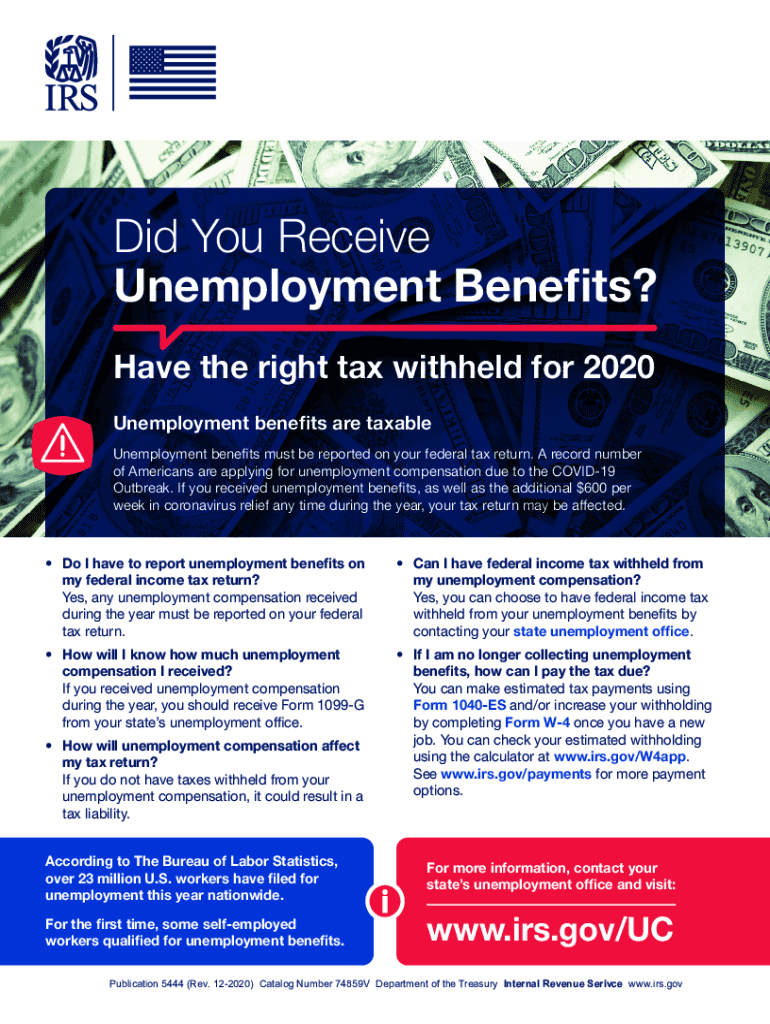
Americans are applying for unemployment compensation due to the COVID-19 Outbreak. If you received unemployment benefits, as well as the additional $600 per week in coronavirus relief any time during the year, your tax return may be affected. Do I have to report unemployment benefits on my federal income tax return? Yes, any unemployment compensation received during the year must be reported on your federal tax return. Can I have federal income tax withheld from my unemployment compen.
Loading

Open form follow the instructions

Easily sign the form with your finger

Send filled & signed form or save
How to fill out the IRS Publication 5444 online
Filling out IRS Publication 5444 is essential for accurately reporting unemployment benefits received during the tax year. This guide will walk you through the online process of completing the form, ensuring you understand each component to file correctly.
Follow the steps to complete IRS Publication 5444 online.
- Click ‘Get Form’ button to access the form and open it in the editor.
- Review the form introduction to understand the purpose of IRS Publication 5444 and ensure you have your unemployment records handy, including Form 1099-G.
- Provide your personal information in the designated fields, including name, address, and taxpayer identification number.
- Report the total amount of unemployment compensation received during the tax year. Refer to Form 1099-G for accurate figures.
- If you opted for federal income tax withholding from your unemployment benefits, indicate the amount withheld based on your records.
- Review additional sections regarding how unemployment compensation may affect your overall tax return and consult resources if necessary.
- Once completed, you can save changes, download, print, or share the form as required.
Start completing IRS Publication 5444 online today to ensure your tax return is accurate and timely.
Experience a faster way to fill out and sign forms on the web. Access the most extensive library of templates available.
Related content
Publication 5444 (Rev. 12-2020) Catalog Number 74859V Department of the Treasury Internal...
Oct 29, 2020 — right tax withheld for 2020.” Publication 5444 (8-2020), Catalog Number...
Dec 15, 2016 — Low Income Taxpayer Clinics (LITCs) are independent from the IRS. ... You...
Get answers to your most pressing questions about US Legal Forms API.
What is the IRS Code 544?
Publication 544 explains the tax rules that apply when you dispose of property. It discusses: How to figure a gain or loss. Whether it is ordinary or capital.
Do I have to file form 8949 with Schedule D?
You and your spouse may list your transactions on separate forms or you may combine them. However, you must include on your Schedule D the totals from all Forms 8949 for both you and your spouse. Corporations and partnerships.
What is form 8949 and a Schedule D?
Use Form 8949 to reconcile amounts that were reported to you and the IRS on Form 1099-B or 1099-S (or substitute statement) with the amounts you report on your return. The subtotals from this form will then be carried over to Schedule D (Form 1040), where gain or loss will be calculated in aggregate.
What is Schedule D Form 1040?
Use Schedule D (Form 1040) to report the following: The sale or exchange of a capital asset not reported on another form or schedule. Gains from involuntary conversions (other than from casualty or theft) of capital assets not held for business or profit.
What is the capital gains tax rate for Schedule D?
Capital gains and qualified dividends. For tax year 2022, the 20% maximum capital gain rate applies to estates and trusts with income above $13,700. The 0% and 15% rates continue to apply to certain threshold amounts. The 0% rate applies up to $2,800. The 15% rate applies to amounts over $2,800 and up to $13,700.
What is the difference between 1040 and Schedule D?
Schedule D is a form provided by the IRS to help taxpayers compute their capital gains or losses and the corresponding taxes due. The calculations from Schedule D are combined with individual tax return form 1040, which will affect the adjusted gross income amount.
Who must file Schedule D?
Who Files Schedule D: Capital Gains and Losses? In general, taxpayers who have short-term capital gains, short-term capital losses, long-term capital gains, or long-term capital losses must report this information on Schedule D, an IRS form that accompanies form 1040.
Where does 8949 go on 1040?
File Form 8949 with the Schedule D for the return you are filing. This includes Schedule D of Forms 1040, 1040-SR, 1041, 1065, 8865, 1120, 1120-S, 1120-C, 1120-F, 1120-FSC, 1120-H, 1120-IC-DISC, 1120-L, 1120-ND, 1120-PC, 1120-POL, 1120-REIT, 1120-RIC, and 1120-SF; and certain Forms 990-T.
What is the meaning of total taxable income?
The term taxable income refers to any gross income earned that is used to calculate the amount of tax you owe. Put simply, it is your adjusted gross income less any deductions. This includes any wages, tips, salaries, and bonuses from employers. Investment and unearned income are also included.
Use professional pre-built templates to fill in and sign documents online faster. Get access to thousands of forms.
If you believe that this page should be taken down, please follow our DMCA take down process here.