Loading
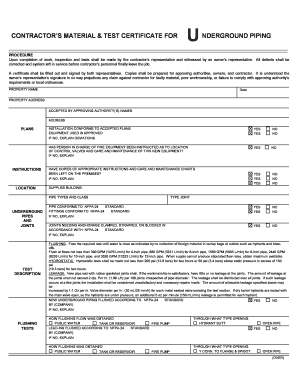
Get Contractor's Material & Test Certificate For Underground Piping
How it works
-

Open form follow the instructions
-

Easily sign the form with your finger
-

Send filled & signed form or save
How to fill out the Contractor's Material & Test Certificate For Underground Piping online
Filling out the Contractor's Material & Test Certificate For Underground Piping is an essential step in documenting the quality and compliance of underground piping installations. This guide provides a clear, step-by-step approach to completing the form online effectively.
Follow the steps to successfully complete the form
- Click the ‘Get Form’ button to acquire the form and open it in your chosen editing platform.
- Fill in the 'Property Name' field with the official name of the property where the underground piping has been installed.
- Enter the 'Date' when the certificate is being filled out to document the completion accurately.
- Provide the 'Property Address' where the work was performed to establish clear location details.
- List the names and addresses of the approving authorities in the designated field to ensure all relevant parties are informed.
- Indicate the status of the installation against accepted plans by checking 'Yes' or 'No' and provide explanations as necessary for any deviations from the plans.
- Confirm whether the person in charge of firefighting equipment has been instructed about control valves and maintenance procedures. Again, clarify any 'No' responses.
- Document the test descriptions, including flushing and hydrostatic tests, following the specific instructions provided on the form to ensure compliance with standards.
- Ensure all installations conform to the necessary NFPA-24 standards, and record whether joints are properly anchored; provide explanations for any 'No' answers.
- Finalize the section regarding leakage tests and ensure all piping systems have been thoroughly tested and any observations documented.
- Complete the signature sections for both the installing contractor and property owner to validate the document.
- After completing all fields, review your entries for accuracy. Save your changes, then download, print, or share the completed form as needed.
Complete your Contractor's Material & Test Certificate For Underground Piping online today!
The requirements and procedures to properly flush underground water supplies are found in NFPA 24. This standard requires all piping from the water supply point of connection to the incoming fire pump suction lead-in to be flushed at a minimum velocity of 15 feet/second before connection with the fire pump.