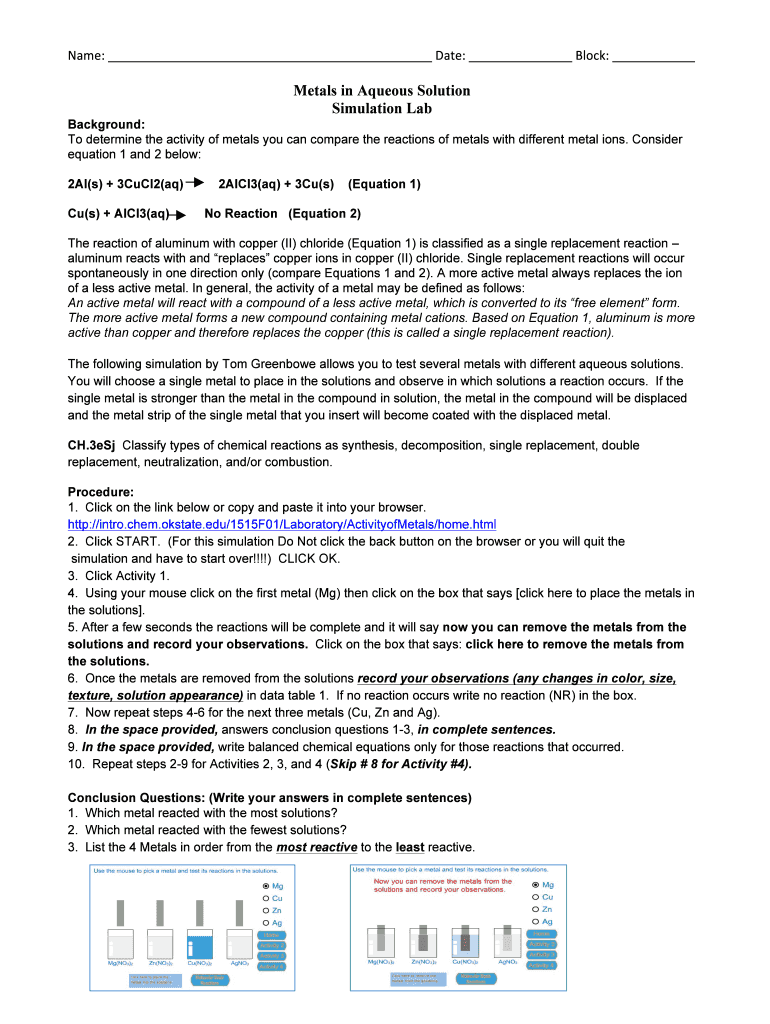
Name: Date: Block: Metals in Aqueous Solution Simulation Lab Background: To determine the activity of metals you can compare the reactions of metals with different metal ions. Consider equation 1.

Open form follow the instructions

Easily sign the form with your finger

Send filled & signed form or save
How to fill out the Mr Palermo Flipped Chemistry Classroom online
This guide provides detailed instructions on how to effectively complete the Mr Palermo Flipped Chemistry Classroom form online. Whether you are familiar with digital document management or new to the process, this guide will support you in filling out the form with ease.
Follow the steps to successfully complete the form.
- Click the ‘Get Form’ button to access the form and open it in your preferred editor.
- Begin by filling in your name in the designated area on the form. Ensure accurate spelling of your name for record-keeping.
- Next, enter the date of your experiment in the date section. Use the format MM/DD/YYYY for consistency.
- Specify your block or class designation in the corresponding field to identify your group.
- In the 'Data/Results' section, record your observations from the simulation after conducting each activity. Be detailed in your descriptions of any observed changes.
- Answer the conclusion questions in complete sentences based on your findings during the activities. Ensure clarity and thoroughness in your responses.
- Write balanced chemical equations for all reactions that occurred, placing them in the designated area on the form.
- Once all sections are completed, review the entire form for accuracy and completeness.
- Finally, save your changes, and choose to download, print, or share the completed form as required.
Start completing your Mr Palermo Flipped Chemistry Classroom form online today!
Experience a faster way to fill out and sign forms on the web. Access the most extensive library of templates available.
Related content
Virtual Lab Conductivity Mr. Palermo s Flipped Chemistry. 3 Sodium chloride is an ionic...
Drawing Bohr Diagrams-2 - Mr. Palermo's Flipped Chemistry ... Emission Spectroscopy Lab...
Get answers to your most pressing questions about US Legal Forms API.
What is the flipped classroom in chemistry?
“Flipped classroom” is when students and teachers swap their roles (teaching methods and focus of teaching changes) and students become the driving mechanism in the lesson. Recently, this pedagogi- cal method has become increasingly popular as it promotes deeper understanding of more complex concepts.
What is a flipped classroom examples?
A typical example of a flipped class is one in which the instructor pre-records the lectures, posts the recordings to Canvas for students to watch before class, and then assists the students as they work through assignments during class time.
Does flipped classroom in organic chemistry has significant effect on students grades?
Difference is also significant for average students, who show a grade average of 7% higher in flipped classroom than in the control group (69 vs. 76%), with a moderate-to-large effect size (d = 0.73); high achievers have also slightly better grades in flipped classroom (86 vs.
What is the concept of the flipped classroom?
A flipped classroom is a pedagogical model that flips traditional lectures and homework. The traditional lecture is viewed at home before class and homework activities are done in the classroom with the instructor present to guide students in their endeavors.
What is the flipped classroom approach in science?
The flipped classroom is a blended learning instructional model that reverses the traditional construct of content being delivered in the classroom and then followed by activities or exercises conducted outside the classroom.
Use professional pre-built templates to fill in and sign documents online faster. Get access to thousands of forms.
If you believe that this page should be taken down, please follow our DMCA take down process here.