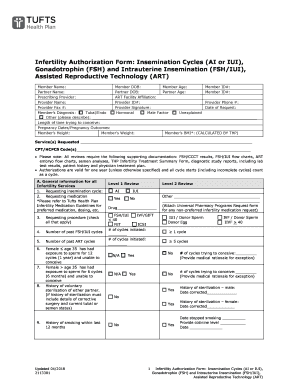
Infertility Authorization Form: Insemination Cycles (AI or IUI), Gonadotrophin (FSH) and Intrauterine Insemination (FSH/IUI), Assisted Reproductive Technology (ART) Member Name: Member DOB: Member.

How it works
  • Open form

    Open form follow the instructions

  • Easily sign form

    Easily sign the form with your finger

  • Share form

    Send filled & signed form or save

How to fill out the Infertility Authorization Form: Insemination Cycles (AI or IUI) online

Completing the Infertility Authorization Form for Insemination Cycles can be an essential step in your fertility journey. This guide provides clear and supportive instructions to help you navigate filling out the form accurately and efficiently.

Follow the steps to successfully complete your form online.

  1. Click ‘Get Form’ button to obtain the Infertility Authorization Form and open it in the online editor.
  2. Begin with the member's information. Fill in the member's name, date of birth, age, and ID number accurately to ensure proper identification.
  3. Provide your partner's information in the designated fields. Include their name, date of birth, age, and ID number.
  4. Complete the prescribing provider's section. This includes entering the provider's name, ID number, phone number, and fax number.
  5. Date the request and describe the member's diagnosis by checking any relevant boxes, including tubal/endometriosis, hormonal issues, male factor, unexplained infertility, or other. If selecting 'Other,' please provide a description.
  6. Indicate the length of time you and your partner have been trying to conceive and document any pregnancy dates or outcomes if applicable.
  7. Fill in the member’s height, weight, and BMI, which may be calculated as required.
  8. Specify the services requested by checking the appropriate boxes for insemination cycles, requested medications, and any procedures.
  9. Detail the number of past FSH/IUI cycles and ART cycles accurately. This helps assess previous interventions.
  10. Fill out any additional medical history questions to provide context for your case, including smoking history and surgical history.
  11. Once all sections are complete, review your entries for accuracy. Make necessary corrections.
  12. After verifying all information, you can save changes, download a copy, print the form, or share it as needed.

Take charge of your fertility journey by completing the Infertility Authorization Form online today.

Get form

Experience a faster way to fill out and sign forms on the web. Access the most extensive library of templates available.

Related content

Artificial insemination history: hurdles and...

Artificial insemination with homologous (AIH) or donor semen (AID) is nowadays a ... In a...

Learn more
Infertility: Medical and Social Choices...

May 20, 1988 — options available to help infertile couples form a family. Still, most...

Learn more
Questions & Answers

Get answers to your most pressing questions about US Legal Forms API.

Contact support

What is the difference between AI and IUI?

Intrauterine insemination (also called IUI) is a fertility treatment where a doctor uses special medical tools to place sperm directly inside a woman's uterus. It's also known as artificial insemination (AI).

For example, AI may aid in selecting the best oocyte and sperm combination as well as predicting embryo quality. Furthermore, AI may assist the clinician in developing an optimal patient-specific treatment regimen to improve IVF success.

Artificial insemination success rates: what are the chances? ing to the Human Fertilisation and Embryology Authority (HFEA), artificial insemination success rates per individual cycle vary between 15.8% for women under 35, 11% for women aged 35 to 39 and 4.7% for women aged 40 to 42.

The main difference between artificial insemination and IVF is that in the former, fertilisation takes place inside the woman's body; in the latter, fertilisation takes place in the laboratory.

Artificial insemination involves the insertion of sperm into a woman's cervix during times of ovulation. Artificial insemination is also called intrauterine insemination (IUI), donor insemination, or alternative insemination. The procedure is used to help women unable to get pregnant after a year of trying.

More than 9 out of 10 couples will get pregnant within 2 years. For women under 40 who are using artificial insemination rather than sexual intercourse to conceive, more than half of women will get pregnant within 6 cycles of intrauterine insemination. Within 12 cycles, more than 3 out of 4 women will become pregnant.

For this reason, artificial insemination is only attempted once per cycle. To determine if ovulation is occurring, doctor's use both blood and urine tests and at-home ovulation test kits.

Intrauterine insemination (IUI) — a type of artificial insemination — is a procedure for treating infertility. Sperm that have been washed and concentrated are placed directly in your uterus around the time your ovary releases one or more eggs to be fertilized.

Get This Form Now!

Use professional pre-built templates to fill in and sign documents online faster. Get access to thousands of forms.

If you believe that this page should be taken down, please follow our DMCA take down process here.

Get Infertility Authorization Form: Insemination Cycles (AI Or IUI ...