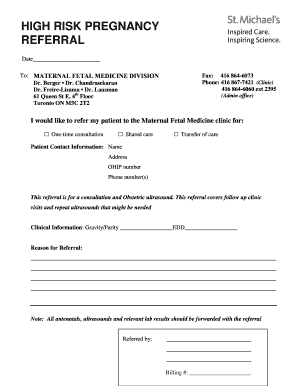
HIGH RISK PREGNANCY REFERRAL Date To: MATERNAL FETAL MEDICINE DIVISION Dr. Berger Dr. Chandrasekaran Dr. FreireLizama Dr. Lausman 61 Queen St E, 4th Floor Toronto ON M5C 2T2Fax: 416 8646073 Phone:.
Open form follow the instructions
Easily sign the form with your finger
Send filled & signed form or save
How to fill out the High Risk Pregnancy Form online
Completing the High Risk Pregnancy Form online is a crucial step in ensuring proper care for individuals experiencing high-risk pregnancies. This guide provides clear, step-by-step instructions to help you accurately fill out each section of the form, ensuring all necessary information is submitted for consultation.
Follow the steps to successfully complete the online form.
- Click ‘Get Form’ button to obtain the form and open it in the editor.
- Enter the date at the top of the form to document when the referral is being made.
- Specify the recipient by including both the name of the Maternal Fetal Medicine Division and the doctors to whom the referral is directed.
- Fill in the contact information section, which includes providing the patient's name, address, OHIP number, and phone number(s) to facilitate communication.
- Indicate the reason for referral. Under the 'Reason for Referral' section, provide details in the space provided about why the consultation is necessary.
- Select the type of referral by marking one of the three options: one-time consultation, shared care, or transfer of care, to clarify the intended service.
- Complete the clinical information section by filling in gravity/parity and estimated due date (EDD) to give the receiver essential background about the pregnancy.
- Ensure to attach all relevant antenatal records, ultrasound results, and lab results with the referral, if required, to provide comprehensive context.
- Sign the form in the 'Referred by' section, ensuring your name and billing number appear where needed for identification and reimbursement purposes.
- Finalize your submission by saving the form, downloading it for your records, printing it as necessary, or sharing it with the relevant clinic.
Complete your High Risk Pregnancy Form online today to ensure timely care.
Experience a faster way to fill out and sign forms on the web. Access the most extensive library of templates available.
Related content
Nov 8, 2019 — is eligible for 17P treatment. Care Management for High-Risk. Pregnancies...
If your pregnancy is considered high-risk or you have complications, this advanced care...
Preterm birth, also known as premature birth, is the birth of a baby at fewer than 37...
Get answers to your most pressing questions about US Legal Forms API.
What makes a woman high-risk pregnancy?
Smoking cigarettes, drinking alcohol and using illegal drugs can put a pregnancy at risk. Maternal health problems. High blood pressure, obesity, diabetes, epilepsy, thyroid disease, heart or blood disorders, poorly controlled asthma, and infections can increase pregnancy risks.
What are 5 examples of a high-risk pregnancy?
Risk factors for a high-risk pregnancy can include: Existing health conditions, such as high blood pressure, diabetes, or being HIV-positive. Overweight and obesity. Obesity increases the risk for high blood pressure, preeclampsia, gestational diabetes, stillbirth, neural tube defects, and cesarean delivery.
What are the criteria for a high-risk pregnancy?
Risk factors for a high-risk pregnancy can include: Existing health conditions, such as high blood pressure, diabetes, or being HIV-positive. Overweight and obesity. Obesity increases the risk for high blood pressure, preeclampsia, gestational diabetes, stillbirth, neural tube defects, and cesarean delivery.
When does high-risk pregnancy start?
At what age is a pregnancy considered high risk? People who get pregnant for the first time after age 35 have high-risk pregnancies. Research suggests they're more likely to have complications than younger people.
What type of pregnancy is considered high risk?
A high-risk pregnancy is one in which a woman and her fetus face a higher-than-normal chance of experiencing problems. These risks may be due to factors in the pregnancy itself, or they may stem from preexisting maternal medical conditions, such as cancer, diabetes, or lupus.
What are the 4 categories of high-risk pregnancy?
Types of High-Risk Pregnancies 1) Preterm or Premature Labor. If you experience regular contractions before reaching the 37th week of your pregnancy, then you are in preterm or premature labor. ... 2) Preeclampsia. ... 3) Gestational Diabetes. ... 4) Placenta Previa.
What are signs of high-risk pregnancy?
High-Risk Pregnancy Signs & Symptoms Abdominal pain (ongoing) Chest pain. Decreased or no fetal movement. Extreme fatigue. Fainting or lightheaded. Heart palpitations. Nausea and vomiting. Trouble breathing.
What qualifies as high-risk pregnancy?
A high-risk pregnancy is one in which a woman and her fetus face a higher-than-normal chance of experiencing problems. These risks may be due to factors in the pregnancy itself, or they may stem from preexisting maternal medical conditions, such as cancer, diabetes, or lupus.
Use professional pre-built templates to fill in and sign documents online faster. Get access to thousands of forms.
If you believe that this page should be taken down, please follow our DMCA take down process here.