Loading
Get Symptom Checklist For Senior Cats -
How it works
-

Open form follow the instructions
-

Easily sign the form with your finger
-

Send filled & signed form or save
How to use or fill out the SYMPTOM CHECKLIST FOR SENIOR CATS - online
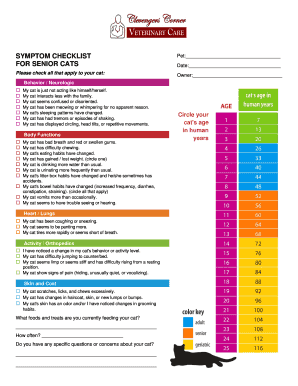
The symptom checklist for senior cats is a valuable tool designed to help pet owners monitor and document their feline companions' health and behavior changes. By filling out this form online, you can ensure that all relevant information is collected efficiently for your veterinarian's review.
Follow the steps to complete the form accurately.
- Press the ‘Get Form’ button to access the symptom checklist for senior cats and open it in your preferred online document editor.
- Begin by filling in your cat's name in the 'Pet' field. This helps to personalize the form and gives clarity to the information provided.
- Next, input your name as the owner in the respective 'Owner' field, followed by the date on which you are completing the form.
- Move on to the 'Behavior / Neurologic' section. Carefully review each statement and check all that accurately describe your cat's behavior. These include observations like increased confusion or changes in interaction with family.
- Continue to the 'Body Functions' section. Similarly, check all applicable statements regarding your cat's physical functions, such as eating and drinking habits, as well as any changes in litter-box behavior.
- Next, review the 'Heart / Lungs' section for any symptoms related to your cat's respiratory health or physical endurance. Check any boxes that pertain to your cat's condition.
- Proceed to the 'Activity / Orthopedics' section and note any changes in your cat's activity level or signs of pain, ensuring all relevant observations are marked.
- In the 'Skin and Coat' section, check any statements that apply to your cat's grooming habits or skin conditions. This information can be crucial in assessing overall health.
- Further down the form, document the foods and treats currently fed to your cat, along with the frequency of feeding, to provide a complete dietary overview.
- Lastly, if you have specific questions or concerns about your cat, write them in the provided space to communicate any important information that should be discussed with your veterinarian.
- After completing all sections, ensure that all information is accurate, and then save your changes. You can also download, print, or share the completed form as needed.
Start filling out the SYMPTOM CHECKLIST FOR SENIOR CATS online today for a better understanding of your cat's health.
Older cats tend to be less active and playful, they may sleep more, gain or lose weight, and have trouble reaching their favorite places. Don't chalk up health or behavior changes - often gradual - to old age, however.