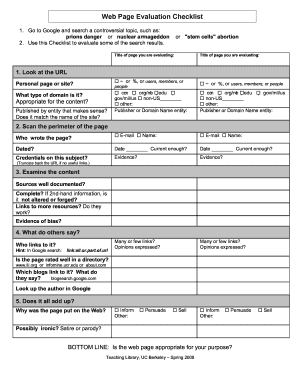
Ls" abortion Title of page you are evaluating: Title of page you are evaluating: 1. Look at the URL Personal page or site? ~ or %, or users, members, or What type of domain is it? co org/ne du m t e gov/mil/us non-US________ other: Publisher or Domain Name entity: co org/ne du gov/mil/us m t e non-US________ other: Publisher or Domain Name entity: Who wrote the page? E-mail Name: E-mail Name: Dated? .
Open form follow the instructions
Easily sign the form with your finger
Send filled & signed form or save
How to fill out the UC Berkeley Library Web Page Evaluation Checklist online
This guide provides a clear and supportive approach to filling out the UC Berkeley Library Web Page Evaluation Checklist online. By following these detailed instructions, users can effectively evaluate web pages, ensuring they gather accurate and reliable information.
Follow the steps to complete the evaluation checklist effectively.
- Press the ‘Get Form’ button to access the UC Berkeley Library Web Page Evaluation Checklist online. Make sure to open the checklist in your preferred web browser.
- Begin by entering the title of the web page you are evaluating in the designated field. This is crucial for referencing the specific content you are assessing.
- Examine the URL of the page. Determine if it belongs to a personal page or an organization by checking its domain type. Mark the appropriate box.
- Identify the publisher or domain name entity by checking the options provided, such as 'com' or 'org', and record the relevant information.
- Research who authored the page by inputting the name or email of the author into the checklist. This can help clarify the credibility of the content.
- Check the date of publication to see if it is current enough for your evaluation. Document this date in the form.
- Review the content for well-documented sources and check for any evidence of bias. Make notes in the appropriate sections of the checklist.
- Investigate external opinions by seeing who links to the page and if it receives ratings in directories. Use the provided tools mentioned in the checklist.
- Assess the purpose of the web page by selecting the appropriate reasons it may have been published, such as to inform or persuade.
- Once you have completed all sections of the checklist, ensure all entries are accurate. You can save, download, print, or share your evaluation for future reference.
Start your evaluation by filling out the checklist online today.
Experience a faster way to fill out and sign forms on the web. Access the most extensive library of templates available.
Related content
Use this Checklist to try to evaluate systematically some of the search results. Title of...
Aug 14, 2024 — The questions on this page should help you explain why a particular...
In the absence of the perfect method, we recommend that multiple evaluation criteria be...
Get answers to your most pressing questions about US Legal Forms API.
How to evaluate library resources?
Evaluating library resources involves applying the principles found in the UC Berkeley Library Web Page Evaluation Checklist. Start by checking the author’s qualifications and the resource's publication date to assess authority and currency. Next, look for objectivity, ensuring the resource presents information fairly without bias. Finally, evaluate the depth and breadth of coverage to confirm the resource meets your research needs.
What are 5 rules or criteria that can be used to evaluate sources?
Five essential rules for evaluating sources are outlined in the UC Berkeley Library Web Page Evaluation Checklist: authority, accuracy, objectivity, currency, and coverage. These criteria guide you in determining whether the source is trustworthy and relevant. They help you critically assess the reliability of the information you find. By following these rules, you can enhance the quality of your research.
What are the 5 criteria for evaluating sources?
When evaluating sources, refer to the UC Berkeley Library Web Page Evaluation Checklist, which emphasizes five key criteria: authority, accuracy, objectivity, currency, and coverage. Authority highlights the relevance of the author's expertise. Accuracy confirms the data is correct, while objectivity looks at potential biases. Currency ensures you have the latest information, and coverage assesses the depth of the topic.
What are the 5 criteria used to ensure that a source is credible?
The UC Berkeley Library Web Page Evaluation Checklist provides five criteria to ensure source credibility: authority, accuracy, reliability, objectivity, and currency. It's essential to verify the author's qualifications and background for authority. Accuracy checks for factual correctness, while reliability focuses on the source's reputation. Objectivity considers bias, and currency assesses how current the information is.
What are the 5 criteria for evaluation of information sources?
The five criteria for evaluation outlined in the UC Berkeley Library Web Page Evaluation Checklist include authority, accuracy, objectivity, currency, and coverage. Authority ensures the author is knowledgeable in the subject area. Accuracy verifies that the information is correct, while objectivity assesses the neutrality of the source. Currency checks if the information is up to date, and coverage evaluates the depth of the topic discussed.
How to do a source evaluation?
To conduct a source evaluation, begin by consulting the UC Berkeley Library Web Page Evaluation Checklist. Examine the author's credentials, assess the accuracy of the content, and consider the publication date. It’s also crucial to check for bias in the information presented. Following these steps will help you identify credible and valuable sources.
What are the 5 criteria of evaluation?
The UC Berkeley Library Web Page Evaluation Checklist outlines five essential criteria for evaluation: authority, accuracy, objectivity, currency, and coverage. By applying these criteria, you can determine the reliability of a source. Each aspect plays a critical role in assessing the overall quality of the information. Use this checklist to ensure you make informed decisions about your sources.
How do you write a good source evaluation?
To write a good source evaluation, focus on presenting your findings coherently while addressing the criteria of evaluation. Use evidence from the source to support your claims about its credibility and relevance. The UC Berkeley Library Web Page Evaluation Checklist is a valuable tool in making your evaluation comprehensive, thorough, and persuasive.
How to start a source evaluation essay?
To start a source evaluation essay, begin with a clear introduction that outlines the source's background and your thesis statement. Present the main points you will address in your evaluation. Utilizing the UC Berkeley Library Web Page Evaluation Checklist will guide you in structuring your essay effectively and ensuring you provide a balanced perspective on the source.
What is a source evaluation?
A source evaluation is a critical analysis of a source's credibility, relevance, and accuracy in relation to your research needs. It helps you determine if the information is trustworthy and suitable for your work. Integrating the UC Berkeley Library Web Page Evaluation Checklist into your evaluation process enhances your ability to meticulously assess and utilize various sources.
Use professional pre-built templates to fill in and sign documents online faster. Get access to thousands of forms.
If you believe that this page should be taken down, please follow our DMCA take down process here.