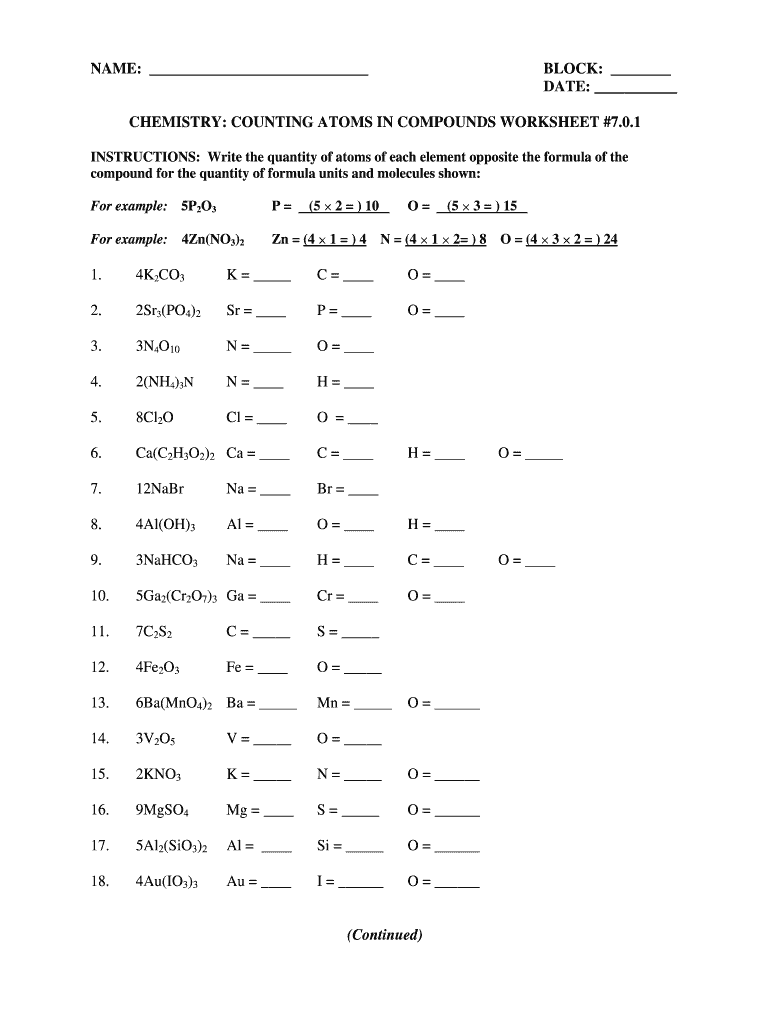
= ____ C = ____ 10. 5Ga2(Cr2O7)3 Ga = ____ Cr = ____ O = ____ 11. 7C2S2 C = _____ S = _____ 12. 4Fe2O3 Fe = ____ O = _____ 13. 6Ba(MnO4)2 Ba = _____ Mn = _____ 14. 3V2O5 V = _____ O = _____ 15. 2KNO3 K = _____ N = _____ O = ______ 16. 9MgSO4 Mg = ____ S = _____ O = ______ 17. 5Al2(SiO3)2 Al = ____ Si = _____ O = ______ 18. 4Au(IO3)3 Au = ____ I = ______ O = ______ O = (4 H 3 H 2 = ) 24 H = ____ O = ______ (Continued) O = _____ O = ____ - 2INSTRUCTI.
Loading

Open form follow the instructions

Easily sign the form with your finger

Send filled & signed form or save
How to fill out the Chemistry: Counting Atoms in Compounds Worksheet #7.0.1 online
This guide provides detailed instructions on how to effectively complete the Chemistry: Counting Atoms in Compounds Worksheet #7.0.1 online. By following these steps, users can accurately document the number of atoms in various chemical compounds with clarity and precision.
Follow the steps to complete the worksheet successfully.
- Click the ‘Get Form’ button to obtain the form and open it in your preferred editor.
- Begin by identifying the first chemical formula provided on the worksheet. For example, for 4K2CO3, you will need to enter the quantity of atoms for each element: K, C, and O.
- Enter the quantity of potassium (K) atoms opposite the formula. Based on the coefficient and subscript, calculate K = 4 x 2 = 8.
- Next, document the quantity of carbon (C) atoms. Since there is no subscript associated with C, it equals 4 x 1 = 4.
- For oxygen (O), count the atoms accordingly, which results in O = 4 x 3 = 12.
- Proceed to the next chemical formula, 2Sr3(PO4)2, and repeat the process of calculating quantities for each element: Sr, P, and O.
- Continue this method for all compounds listed in the worksheet, ensuring you account for coefficients and subscripts where applicable.
- Once all atom quantities are filled in for each chemical formula, review your entries for accuracy.
- Finally, once completed, you can save your changes, download, print, or share the worksheet as needed.
Complete your Chemistry: Counting Atoms in Compounds Worksheet online today!
Experience a faster way to fill out and sign forms on the web. Access the most extensive library of templates available.
Related content
Nov 27, 2020 — Organic Compounds for which Residues must be Analyzed. ... atoms. 3.5.5.9...
The text provides a comprehensive overview of various aspects of clinical chemistry...
Get answers to your most pressing questions about US Legal Forms API.
How many atoms are there in 7c2s2?
In the expression 7c2s2, you can find the total number of atoms by multiplying the coefficients with the subscripts. Here, you work out the groups, where '7' indicates seven groups of two carbon and two sulfur atoms. This translates to 14 carbon and 14 sulfur atoms, leading to a total of 28 atoms in the compound. Utilize the Chemistry: Counting Atoms in Compounds Worksheet #7.0.1 to refine your skills in counting atoms.
How many atoms does Na2CO3 have?
The compound Na2CO3 contains a total of five atoms. Specifically, there are two sodium atoms, one carbon atom, and three oxygen atoms. To find the total, simply add these numbers together: 2 sodium + 1 carbon + 3 oxygen equals 6 atoms in total. You can practice similar problems using the Chemistry: Counting Atoms in Compounds Worksheet #7.0.1 for a deeper understanding.
How many atoms are in 7c2s2?
In the compound 7c2s2, you determine the number of atoms by multiplying the subscripts by the coefficient. The '7' in front means you have seven groups of the compound. Each group has two carbon atoms and two sulfur atoms, totaling 14 carbon atoms and 14 sulfur atoms. Hence, the entire compound has 28 atoms, which you can explore further in the Chemistry: Counting Atoms in Compounds Worksheet #7.0.1.
How to count the number of atoms in a compound?
To count the number of atoms in a compound, you first need to identify the elements within it. Next, you look at the subscript numbers, which indicate how many of each atom are present. For instance, in the formula H2O, the '2' indicates there are two hydrogen atoms and one oxygen atom. Using the Chemistry: Counting Atoms in Compounds Worksheet #7.0.1 can further guide you in practicing this essential skill.
How to count atoms in compounds?
To count atoms in compounds, begin by identifying the elements in the chemical formula. Each element's subscript indicates how many atoms of that element are present. Additionally, when there is no subscript, it means there is one atom of that element. Utilizing the Chemistry: Counting Atoms in Compounds Worksheet #7.0.1 can provide you with practical exercises to master this counting technique.
How many atoms are in a compound?
The total number of atoms in a compound is determined by adding up all the atoms represented in its chemical formula. For example, in the formula C6H12O6, there are six carbon atoms, twelve hydrogen atoms, and six oxygen atoms, leading to a total of twenty-four atoms. Using resources like the Chemistry: Counting Atoms in Compounds Worksheet #7.0.1 can enhance your understanding of this concept.
How to count atoms of a compound?
Counting atoms in a compound is a straightforward process. Start by examining the chemical formula, which indicates the number of each type of atom. For instance, if you see H2O, it means there are two hydrogen atoms and one oxygen atom. Tools like the Chemistry: Counting Atoms in Compounds Worksheet #7.0.1 can help you practice this skill effectively.
What is the ratio of atoms in a compound?
A compound consists of atoms of two or more elements combined in a small, whole-number ratio. In a given compound, the numbers of atoms of each of its elements are always present in the same ratio (Figure 2).
How do you tell if a compound is made of atoms?
Every combination of atoms is a molecule. A compound is a molecule made of atoms from different elements. All compounds are molecules, but not all molecules are compounds. Hydrogen gas (H2) is a molecule, but not a compound because it is made of only one element.
How do you count atoms in compounds?
It also represents the number of molecules of that compound. has 4 sodium atoms, 2 sulphur atoms, and 8 oxygen atoms. When you count atoms, remember to multiply the coefficient number and the subscript number to find the number of atoms of that element.
Use professional pre-built templates to fill in and sign documents online faster. Get access to thousands of forms.
If you believe that this page should be taken down, please follow our DMCA take down process here.