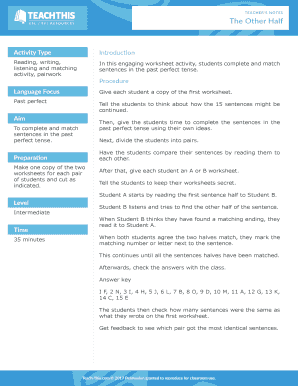
TEACHER 'S NOTESThe Other HalfESL / EFL RESOURCESActivity TypeIntroductionReading, writing, listening and matching activity, pairworkIn this engaging worksheet activity, students complete and match sentences.
Open form follow the instructions
Easily sign the form with your finger
Send filled & signed form or save
How to fill out the Teach This Com online
This guide provides detailed instructions on how to complete the Teach This Com form online. Whether you are a teacher or an individual seeking to utilize this educational resource, following these steps will ensure that you fill out the form efficiently and accurately.
Follow the steps to fill out the Teach This Com form online.
- Press the ‘Get Form’ button to obtain the Teach This Com document and open it in your preferred editor.
- Begin by reviewing the sections of the form, ensuring that you understand each component. The form typically includes information on activity type, level, time, and necessary preparation.
- Fill in the required fields. For instance, specify the activity type, which may include reading, writing, listening, and matching exercises tailored for ESL/EFL students.
- Indicate the language focus of the activity. This section informs users about the specific language skills that students will engage with while completing the tasks.
- Provide instructions that reflect the procedure for conducting the activity. Include any necessary steps for the students to follow, such as pairing them for certain exercises and the desired outcomes from the activity.
- Once all fields are filled out, review the content for clarity and completeness. Make any necessary adjustments before proceeding.
- Save your changes by downloading the form to your device, or choose to print it for physical distribution. You may also share it directly with other educators if needed.
Complete your documents online with confidence by following these steps.
Experience a faster way to fill out and sign forms on the web. Access the most extensive library of templates available.
Related content
This article discusses issues related to pragmatics in general as well as ... (Adapted...
English for University http://englishforuniversity.com/ This site if FULL of info, from...
Get answers to your most pressing questions about US Legal Forms API.
What are functional language examples?
Some examples of language functions include describe, explain, discuss, advise, suggest, warn, inform, predict, clarify, apologize, list, compare, contrast, persuade, argue, justify, defend, blame, critique, compliment, recount, retell, narrate, question, request, agree, and disagree.
What is functional language in teaching?
Functional language is language that we use to perform various functions, such as making requests, giving advice, complaining, agreeing, asking permission, etc. Learning functional language gives students of English the skills to communicate effectively in various everyday situations.
How to make ESL class fun?
What are some creative ways to make your ESL lessons engaging and interactive? Use games and activities. Incorporate multimedia and technology. Use realia and props. Use cooperative learning strategies. Use differentiation and personalization. Here's what else to consider.
What is the situational function of language?
Situational language comprises expressions we use in specific situations, for example: at a restaurant, shopping for clothes or asking for tourist information. Clearly, there is overlap between the two. In the situation of a doctor's appointment, different functions will be used.
How to teach this and that for kindergarten?
1:46 3:00 How to teach "This" "That" to kids | This That for kindergarten - YouTube YouTube Start of suggested clip End of suggested clip मैट इज़ नियर टू मी और क्लोज़ टू मी सो आई विल. राइट. दिस इज़ अ. मैट एंड दैट स्टार दिस इज़ नॉट क्लोज़Moreमैट इज़ नियर टू मी और क्लोज़ टू मी सो आई विल. राइट. दिस इज़ अ. मैट एंड दैट स्टार दिस इज़ नॉट क्लोज़ टू मी सो वी कैन राइट दैट इज़ . स्टार.
What is considered a functional language?
"Functional language" is language that we use to perform various "functions" such as giving advice or apologizing. Functional language typically uses fixed expressions for each function–for example "if I were you" or "my suggestion is" in giving advice, and "it was my fault" or "please forgive me" in apologizing.
What is functional language in EAL?
Functional language is language that we use to perform various functions, such as making requests, giving advice, complaining, agreeing, asking permission, etc. Learning functional language gives students of English the skills to communicate effectively in various everyday situations.
What are functional language situations?
Functional language is language that you need in different day-to-day situations. For example: greeting, introducing yourself, asking for or giving advice, explaining rules, apologising, or agreeing and disagreeing. Any one of these functions can have a number of different exponents, or fixed expressions.
Use professional pre-built templates to fill in and sign documents online faster. Get access to thousands of forms.
If you believe that this page should be taken down, please follow our DMCA take down process here.