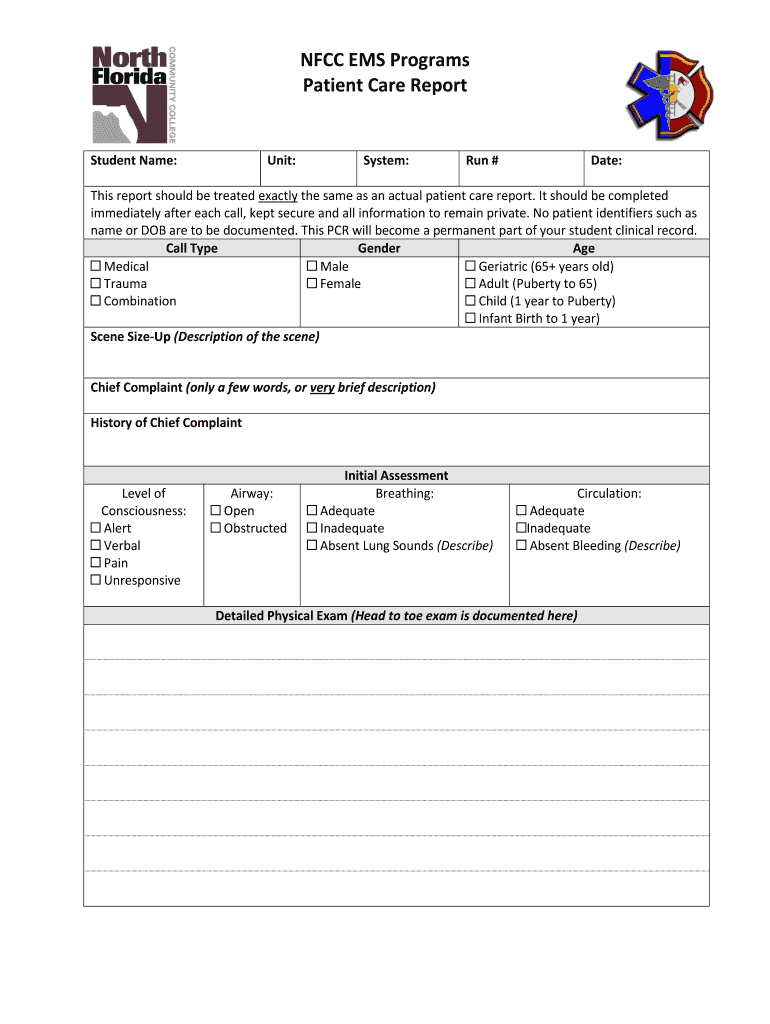
Atient care report. It should be completed immediately after each call, kept secure and all information to remain private. No patient identifiers such as name or DOB are to be documented. This PCR will become a permanent part of your student clinical record. Call Type Gender Age Medical Male Geriatric (65+ years old) Trauma Female Adult (Puberty to 65) Combination Child (1 year to Puberty) Infant Birth to 1 year) Scene Size-Up (Description of the scene) Chief Complaint (only a few words, or ver.
Loading

Open form follow the instructions

Easily sign the form with your finger

Send filled & signed form or save
How to fill out the FL NFCC EMS Programs Patient Care Report online
Completing the FL NFCC EMS Programs Patient Care Report is an essential task for documenting patient interactions accurately. This guide provides you with step-by-step instructions to fill out the report efficiently and securely online.
Follow the steps to complete the patient care report online.
- Press the 'Get Form' button to access the online version of the FL NFCC EMS Programs Patient Care Report.
- Begin filling out the form by entering the student name in the designated field. Ensure that the name is accurate, as this will be part of your clinical record.
- Input the unit and system information as specified. This helps in identifying the specific team and system involved in the patient care experience.
- Record the run number and date of the call. These details are important for tracking and cataloging.
- Describe the scene size-up in the provided section. This should be a brief overview of the environment where the incident took place.
- Outline the chief complaint with a few words or a brief description. This segment should capture the main reason for the call.
- Provide history for the chief complaint, detailing any relevant background information.
- Assess and document the level of consciousness using the provided options (alert, verbal, pain, unresponsive).
- Check and record the airway status as open or obstructed.
- Evaluate and note the breathing status as adequate, inadequate, or absent, including lung sounds description.
- Document circulation findings as adequate, inadequate, or absent, and describe any bleeding if applicable.
- Conduct a detailed physical exam and document findings from a head-to-toe assessment.
- Complete the SAMPLE (Signs, Allergies, Medications, Past Medical History, Last Oral Intake, Events Prior, and Time) section elaborating on each component thoroughly.
- Fill out the treatment section by recording vital signs such as blood pressure, pulse, resp, and world saturation levels.
- Provide a narrative detailing the ongoing assessment and any critical observations made during patient care.
- Provide your signature as a student to validate the document's authenticity.
- Lastly, ensure that any additional documentation such as ECGs is attached by referencing it in the report.
- After completing all sections of the report, review your entries for accuracy. Save the changes, and choose to download, print, or share the completed report as necessary.
Complete your FL NFCC EMS Programs Patient Care Report online today!
Experience a faster way to fill out and sign forms on the web. Access the most extensive library of templates available.
Related content
by T Nutbeam · 2022 · Cited by 11 — To explore patient's experience of entrapment and...
Emergency Medical Services provides care for individuals who are in need of immediate...
Get answers to your most pressing questions about US Legal Forms API.
How to write a patient report example?
To write a patient report example, start by outlining key sections such as patient identification, incident specifics, and assessment details. Clearly state the patient's chief complaint, the findings from your evaluation, and the treatment rendered. Additionally, referencing the FL NFCC EMS Programs Patient Care Report can guide you in structuring your example accurately, showcasing a thorough and compliant format that meets all necessary reporting standards.
What is included in a patient care report?
A patient care report typically includes the patient’s personal information, medical history, condition on arrival, and the care provided during transport. Furthermore, it documents vital signs, medications administered, and any significant changes observed. By utilizing the FL NFCC EMS Programs Patient Care Report, you ensure that all critical information is captured and presented in a clear, organized manner, facilitating effective communication among healthcare providers.
How to write a patient care report in EMS?
Writing a patient care report in EMS involves clearly documenting essential details about the patient's condition, treatment provided, and any actions taken. Begin by collecting all relevant information during the call, including patient demographics and time of arrival. Next, use a structured format to articulate the assessment findings, interventions performed, and the patient's response to treatment. Utilizing the FL NFCC EMS Programs Patient Care Report ensures you meet the legal standards and provide comprehensive care documentation.
How do I get an EMS report in Florida?
To obtain an EMS report in Florida, you can request the report from the applicable EMS agency that responded to your incident. Many agencies, including those utilizing the FL NFCC EMS Programs Patient Care Report, have online platforms where you can submit your request easily. It’s important to provide specific details about the incident, such as date and time, to help facilitate the retrieval process efficiently.
How to write a patient report?
Writing a patient report begins with a thorough assessment of the patient, noting all relevant details about their condition and treatment. You should clearly outline the sequence of events during the EMS response and treatment, ensuring you include vital signs and any interventions performed. By using established frameworks such as the FL NFCC EMS Programs Patient Care Report, you can streamline the documentation process and enhance communication between various healthcare professionals.
How do I write an EMS patient care report?
To write an EMS patient care report, start by gathering all pertinent patient information, including demographics, medical history, and vital signs. Next, document the circumstances of the incident, treatment provided, and any changes in the patient's condition during transport. Utilizing a clear structure and standardized language, like that found in the FL NFCC EMS Programs Patient Care Report, will facilitate communication among medical teams and improve patient outcomes.
What is the most widely used format for creating patient care reports in EMS?
The most widely used format for creating patient care reports in EMS is the standardized template that aligns with the National Fire Protection Association (NFPA) and the National Emergency Medical Services Information System (NEMSIS). These standards ensure interoperability and consistency across different EMS agencies. By utilizing these formats, EMS professionals can provide clear and accurate reports, which are critical for patient care and data collection. The FL NFCC EMS Programs Patient Care Report follows these guidelines to enhance the quality of emergency medical services.
Who regulates EMS in Florida?
In Florida, the Department of Health’s Bureau of Emergency Medical Services is responsible for regulating Emergency Medical Services. They set standards for training, licensing, and operational procedures to ensure that EMS providers meet necessary safety and quality requirements. Understanding these regulations is essential for proper completion of the FL NFCC EMS Programs Patient Care Report.
Do EMTs have to write reports?
Yes, EMTs are required to write reports for every patient they attend to. This documentation serves as a critical tool for communication with other healthcare providers and helps maintain accurate medical records. Properly completing a FL NFCC EMS Programs Patient Care Report ensures that important information is not lost and that patient care remains a priority.
What is an EMS report?
An EMS report is a documented account of the patient’s condition and the care provided by emergency medical services. This report typically includes details about the patient's injury or illness, treatment given, and transport information. Understanding the FL NFCC EMS Programs Patient Care Report is essential for ensuring continuity of care in clinical settings.
Use professional pre-built templates to fill in and sign documents online faster. Get access to thousands of forms.
If you believe that this page should be taken down, please follow our DMCA take down process here.