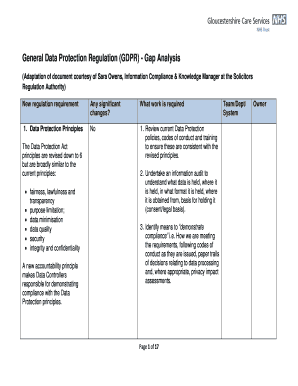
General Data Protection Regulation (GDPR) Gap Analysis (Adaptation of document courtesy of Sara Owens, Information Compliance & Knowledge Manager at the Solicitors Regulation Authority) New regulation.

How it works
  • Open form

    Open form follow the instructions

  • Easily sign form

    Easily sign the form with your finger

  • Share form

    Send filled & signed form or save

How to fill out the General Data Protection Regulation (GDPR) - Gap Analysis online

Completing the General Data Protection Regulation (GDPR) - Gap Analysis online is an essential step for organizations to ensure compliance with evolving data protection laws. This guide provides straightforward, step-by-step instructions for filling out the form accurately.

Follow the steps to successfully complete the form.

  1. Press the ‘Get Form’ button to obtain the form and access it in the editor.
  2. Begin by reviewing the first section on Data Protection Principles. Ensure that existing data protection policies are aligned with the revised principles outlined in the GDPR.
  3. In the section concerning the Lawfulness of Processing, clarify the grounds for lawful data processing. Check that these grounds remain applicable under the GDPR.
  4. Assess and update the Consent section. Confirm that all consent processes adhere to new GDPR requirements, ensuring that consent is explicit, informed, and freely given.
  5. Review and update your processes for Sensitive Data and ensure compliance with new GDPR categorizations for data types, particularly genetic and biometric data.
  6. For Subject Access Requests, review processes and procedures to ensure compliance with the one-month response requirement.
  7. Finally, conclude by reviewing the Governance Obligations. Assign responsibility for GDPR compliance and ensure all relevant procedures are in place.

Start filling out the General Data Protection Regulation (GDPR) - Gap Analysis online today to ensure compliance and enhance your data protection practices.

Get form

Experience a faster way to fill out and sign forms on the web. Access the most extensive library of templates available.

Related content

The Policy Effect of the General Data Protection...

Mar 25, 2019 — The GDPR aims to overhaul previous data protection laws in Europe [3]...

Learn more
UC Privacy Paradigm Exemplifies GDPR Compliance |...

Sep 4, 2019 — European Union's (EU) General Data Protection Regulation logo ... paradigm...

Learn more
Privacy by design - Wikipedia

Privacy by design is an approach to systems engineering initially developed by Ann...

Learn more
Questions & Answers

Get answers to your most pressing questions about US Legal Forms API.

Contact support

What are the three 3 fundamental components of a gap analysis?

The three fundamental components of a gap analysis are the current state, desired state, and the gap. The current state is how business procedures and processes are being used. The desired state is where the company wants to be in the future. This usually includes improved efficiency and effectiveness.

Common elements for gap analysis templates include: the item (or process or team member) being analyzed, the item's current state, the item's desired state, existing gaps, action items, task assignee(s), priorities, dependencies, task status, and other considerations.

Data protection gap analysis It compares your organisation or its activities to specific identified compliance requirements, and finds gaps that you need to correct. A gap analysis is usually forward-looking, helping you to set out your actions before you implement controls. It is about planning and direction.

A GDPR gap analysis is a process that helps organisations identify areas where their data protection practices do not align with the requirements of the GDPR. By conducting a gap analysis, organisations can develop a plan to address any areas of non-compliance and improve their overall data protection programme.

Now let's drill down further and consider the specific types of gap analysis and how you can apply them in a business setting. Product or market gap analysis. ... HR/recruitment/skills gap analysis. ... Needs gap analysis. ... Performance gap analysis. ... Healthcare gap analysis. ... IT gap analysis. ... Financial gap analysis. ... Retail gap analysis.

The four steps of a gap analysis are: Identify the current situation. Define what is important for you in your department or organization. ... Set S.M.A.R.T goals of where you want to end up. S.M.A.R.T. ... Analyze gaps from where you are to where you want to be. ... Establish a plan to close existing gaps.

WHAT IS A GRC GAP ASSESSMENT? The purpose of a GRC (governance, risk, and compliance) Gap Assessment is to identify missing elements of a security program as compared to a specific framework.

A gap analysis report is a comprehensive document that outlines the existing gaps between the current and ideal future state of an organization. This report also elaborates on the strategies that must be executed to achieve organizational goals and objectives in the most efficient way possible.

Get This Form Now!

Use professional pre-built templates to fill in and sign documents online faster. Get access to thousands of forms.

If you believe that this page should be taken down, please follow our DMCA take down process here.

Get General Data Protection Regulation (GDPR) - Gap Analysis