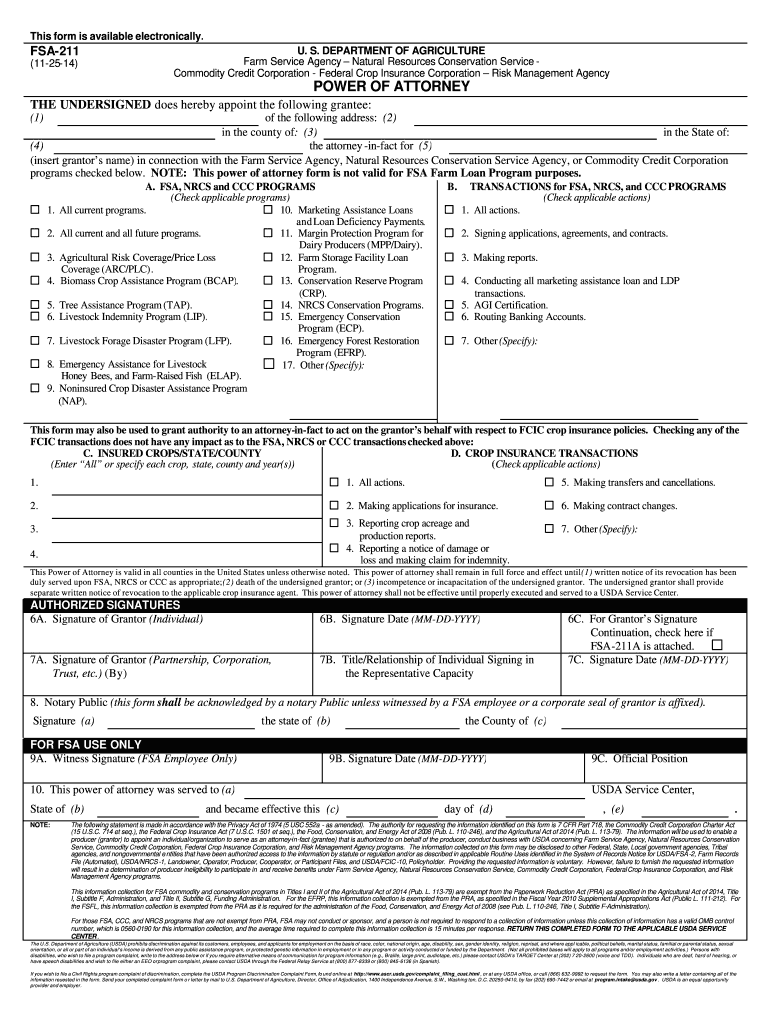
RES 6A. Signature of Grantor (Individual) 6B. Signature Date (MM-DD-YYYY) 7A. Signature of Grantor (Partnership, Corporation, Trust, etc.) (By) 7B. Title/Relationship of Individual Signing in the Representative Capacity 6C. For Grantor’s Signature Continuation, check here if FSA-211A is attached. 7C. Signature Date (MM-DD-YYYY) 8. Notary Public (this form shall be acknowledged by a notary Public unless witnessed by a FSA employee or a corporate seal of grantor is affixed). Signature (a) .

Open form follow the instructions

Easily sign the form with your finger

Send filled & signed form or save
How to fill out the USDA FSA-211 online
The USDA FSA-211 is a vital form used to appoint an attorney-in-fact for various programs managed by the U.S. Department of Agriculture. This guide provides comprehensive, step-by-step instructions on how to complete the form online, ensuring clarity for all users.
Follow the steps to complete the USDA FSA-211 online.
- Click ‘Get Form’ button to obtain the form and open it for editing.
- Start by entering the name of the attorney-in-fact in the designated field. This is the individual who will be acting on behalf of the grantor.
- Fill in the address of the attorney-in-fact, including the street, city, county, and state, ensuring accuracy in the details.
- In the next fields, specify the name of the grantor. This is typically the person granting the power of attorney.
- Select the applicable USDA programs by checking the boxes next to each program that the attorney-in-fact is authorized to act upon.
- Proceed to the Transactions section. Here, check the actions that the attorney-in-fact is empowered to take, which may include signing applications and making reports.
- If applicable, specify any insured crops, including the state, county, and years associated with those crops in the designated area.
- Complete the signatures. The grantor must sign and date the form in the spaces provided. If needed, have the document notarized.
- Review all entries for correctness and completeness. Make necessary adjustments to any field as needed.
- Once finalized, you can save changes, download, print, or share the completed form as needed.
Complete your USDA FSA-211 form online to ensure proper authorization!
Experience a faster way to fill out and sign forms on the web. Access the most extensive library of templates available.
Related content
... with crop-share leases. Many of those leasing land may need to update FSA's Power of...
... FSA. Entrar a correta informação nos campos FSA Farm (Fazenda) #, Field. (Talhão)...
Get answers to your most pressing questions about US Legal Forms API.
What is a farm number for FSA?
A farm number for FSA is a unique identifier assigned to agricultural operations registered with the USDA Farm Service Agency. This number is important for accessing programs and benefits, including payments and assistance. To obtain a farm number, you must register your farm with the FSA, which is a straightforward process. If you plan to fill out a USDA FSA-211 form, having your farm number ready is essential.
What is a FSA 211?
The FSA 211 is a specific form used by the USDA Farm Service Agency to collect data regarding farm operations. This form captures crucial information for program eligibility and payment calculations. Understanding the USDA FSA-211 is vital for farmers to ensure they meet the necessary requirements and receive the benefits they deserve. You can find resources on USLegalForms to help you fill out this form correctly.
Are USDA FSA payments taxable?
Yes, USDA FSA payments are generally considered taxable income. This includes payments received from programs like the Conservation Reserve Program and others under the USDA FSA. It's essential to keep accurate records for tax purposes and consult a tax professional for your specific situation. Using the USDA FSA-211 form can help clarify your payment details and tax implications.
What is the USDA FSA CRP program?
The USDA FSA CRP program, or Conservation Reserve Program, encourages landowners to convert environmentally sensitive land into vegetative cover. This initiative aims to improve water quality, reduce soil erosion, and enhance wildlife habitats. By participating, you can contribute to these environmental benefits while receiving annual rental payments. For managing your participation, understanding forms like the USDA FSA-211 can be beneficial.
Is FSA and USDA the same?
While FSA and USDA are closely related, they are not the same. The USDA is a broader umbrella organization that encompasses several agencies, including the Farm Service Agency (FSA), which focuses specifically on supporting farmers through programs and services. When exploring resources like USDA FSA-211, understanding their connection helps you take full advantage of available programs.
What does FSA stand for USDA?
FSA stands for Farm Service Agency within the USDA. This agency plays a crucial role in implementing agricultural policies and providing various forms of financial assistance to farmers and landowners. Understanding the USDA FSA-211 helps clarify the agency's offerings and how they can benefit agricultural practices.
How to qualify for the CRP program?
To qualify for the CRP program, landowners must meet specific criteria set by the USDA, which include having land that is eligible for conservation practices, along with a commitment to maintain those practices. Additionally, your land must meet minimum environmental thresholds to qualify. Consider using the USDA FSA-211 application guidelines to ensure you meet these requirements and to enhance your chances of acceptance.
What is the purpose of the CRP program?
The CRP program's primary purpose is to promote environmental health by taking highly erodible and environmentally sensitive land out of agricultural production. This initiative helps improve air and water quality while providing habitats for various wildlife species. By participating in the USDA FSA-211, landowners can contribute to these goals while receiving financial payments.
What is the downside to CRP?
The downside to the Conservation Reserve Program (CRP) primarily includes the loss of agricultural land for a set period, which can affect short-term income from farming activities. Participants may also face restrictions on land use, which could limit future farming opportunities. It's essential to weigh these factors carefully when considering options like the USDA FSA-211.
How do I establish eligibility for USDA programs?
To establish eligibility for USDA programs like the USDA FSA-211, you need to meet certain criteria, which typically include specific income limits, residency requirements, and farm size. You should gather necessary documentation that proves your eligibility and present it at your local USDA office. Additionally, it's helpful to explore resources online or seek assistance from platforms like uslegalforms to streamline your application process.
Use professional pre-built templates to fill in and sign documents online faster. Get access to thousands of forms.
If you believe that this page should be taken down, please follow our DMCA take down process here.