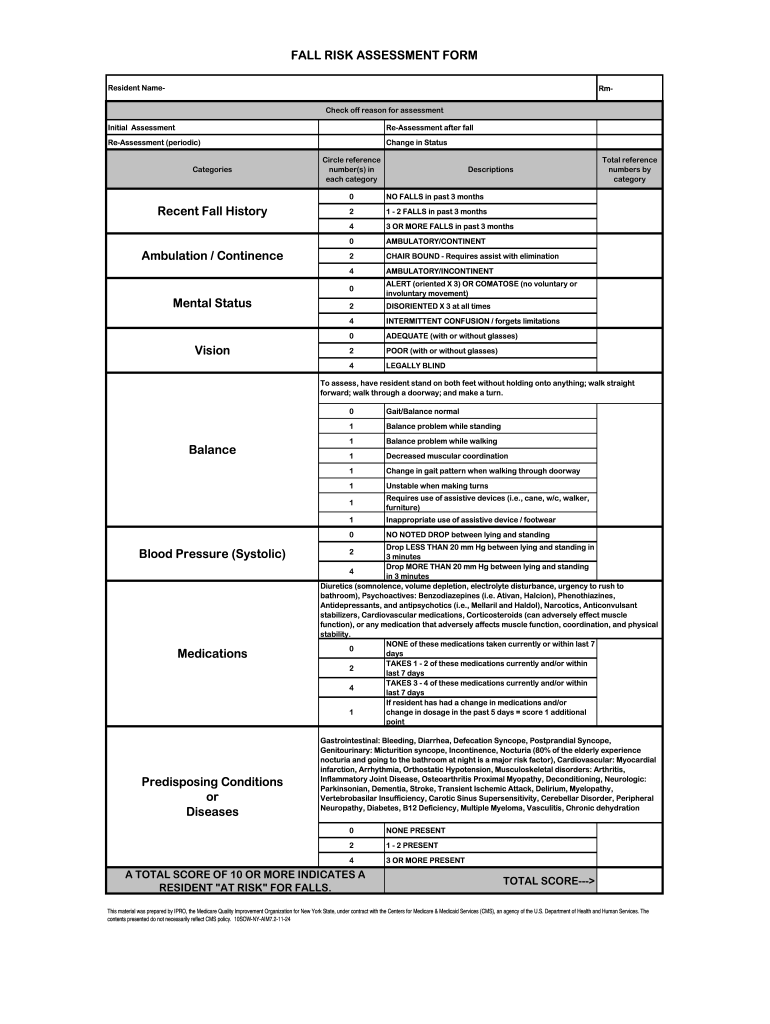
Chronic dehydration 0 NONE PRESENT 2 1 - 2 PRESENT 4 3 OR MORE PRESENT A TOTAL SCORE OF 10 OR MORE INDICATES A RESIDENT "AT RISK" FOR FALLS. TOTAL SCORE---> This material was prepared by IPRO, the Medicare Quality Improvement Organization for New York State, under contract with the Centers for Medicare & Medicaid Services (CMS), an agency of the U.S. Department of Health and Human Services. The contents presented do not necessarily reflect CMS policy. 10SOW-NY-AIM7.2-11-24 .
Loading

Open form follow the instructions

Easily sign the form with your finger

Send filled & signed form or save
How to fill out the HHS Fall Risk Assessment Form online
The HHS Fall Risk Assessment Form is an essential tool designed to evaluate a person's risk of falling. This guide will provide you with clear instructions on how to complete the form online effectively and accurately.
Follow the steps to successfully complete the form
- Click ‘Get Form’ button to obtain the form and open it in the editor.
- Begin by entering the resident’s name in the designated field at the top of the form.
- Check off the appropriate reason for the assessment in the provided box, selecting either 'Initial Assessment,' 'Re-Assessment after fall,' or 'Re-Assessment (periodic)'.
- For each category listed (Recent Fall History, Ambulation / Continence, Mental Status, Vision, Change in Status), circle the corresponding reference number according to the resident's status in that category.
- In the 'Descriptions' section, assess and circle the total reference numbers for each category to summarize the resident's status.
- Move to the 'Balance' and 'Blood Pressure' sections. Assess the resident's balance while they stand and walk, scoring accordingly. Document any changes in blood pressure as necessary.
- List all medications the resident is currently taking, scoring accordingly based on the categories provided.
- For any predisposing conditions or diseases, indicate the presence of conditions using the specified scoring guide.
- Once all sections are filled out, calculate the total score. A score of 10 or more indicates a resident is at risk for falls.
- Finally, review the completed form for accuracy. Users can save changes, download, print, or share the form as needed.
Start filling out the HHS Fall Risk Assessment Form online today to enhance safety and care.
Experience a faster way to fill out and sign forms on the web. Access the most extensive library of templates available.
Related content
Each person living in a nursing facility (NF) should be assessed for fall risk within 24...
Dec 8, 2022 — A: The Medicare Health Risk Assessment Form is designed to identify...
Feb 8, 2019 — Submit a report under section 90SO)(l) (Abbreviated Report) that includes...
Get answers to your most pressing questions about US Legal Forms API.
How do you do a risk assessment example?
To perform a risk assessment example, use the HHS Fall Risk Assessment Form as a template. Evaluate a hypothetical scenario by looking at various factors such as age, health history, and living conditions. Document your findings based on the answers you would expect to receive. This example can serve as a valuable learning tool for future assessments.
How to fill a risk assessment form?
Filling a risk assessment form requires attention and clarity. Start by following the questions listed on the HHS Fall Risk Assessment Form. Provide honest and detailed answers based on your best knowledge. This approach helps ensure that the assessment accurately reflects the individual's needs and risks.
How do I file a risk assessment?
To file a risk assessment, start by completing the HHS Fall Risk Assessment Form thoroughly. Make sure all relevant details are filled in accurately. After the form is completed, follow your organization’s guidelines to store or submit the assessment. This ensures that the data is easily retrievable for future reference, enhancing the care process.
What do you write in a risk assessment?
In a risk assessment, it is important to record observations clearly and comprehensively. Utilize the HHS Fall Risk Assessment Form to specify key factors such as mobility limitations, cognitive status, and details about the living environment. Include any prior fall incidents and potential hazards that could affect safety. Such information is crucial for a well-rounded assessment.
Can you bill for fall risk assessment?
Yes, billing for fall risk assessments is possible under specific circumstances. Many insurers recognize the value of using the HHS Fall Risk Assessment Form as part of preventive health services. Ensure you document the assessment accurately to justify the billing. Consult with your insurance provider for specific guidelines on coverage.
How do you answer a risk assessment form?
When answering a risk assessment form, take your time to respond thoughtfully to each question. Use the HHS Fall Risk Assessment Form as a guide to assess the individual's health and safety needs. Be as detailed as possible, providing context for your answers. This diligence ensures the assessment accurately reflects the individual’s fall risk.
How do you fill out a risk assessment sheet?
To fill out a risk assessment sheet, start by clearly reading the HHS Fall Risk Assessment Form to understand each section. Provide honest answers based on observations and knowledge of the individual’s health and environment. Focus on filling in all relevant fields such as medical history, mobility issues, and previous fall incidents. A thorough completion of the form helps to create a reliable assessment.
How do you complete a falls risk assessment?
Completing a falls risk assessment involves gathering necessary information about the individual’s medical history, physical condition, and environmental factors. You will use the HHS Fall Risk Assessment Form to systematically evaluate these areas. Ensure you engage with the individual to obtain accurate responses, as this will provide a comprehensive view. After collecting the data, analyze it to determine the overall risk and necessary interventions.
How do I get a falls risk assessment?
To get a falls risk assessment, you should consult with your healthcare provider. They can utilize the HHS Fall Risk Assessment Form to evaluate your risk based on your medical history and current health status. If you are part of a healthcare facility, they often have standardized procedures for conducting these assessments. Being proactive about your health helps ensure that you receive the best possible care.
What is the best fall risk assessment tool?
Choosing the best fall risk assessment tool often comes down to the specific needs of the healthcare facility. However, the HHS Fall Risk Assessment Form stands out due to its comprehensive nature and user-friendly design. It allows for easy integration into existing healthcare practices and enhances the accuracy of assessments. By leveraging this tool, healthcare providers can foster a safer environment for their patients.
Use professional pre-built templates to fill in and sign documents online faster. Get access to thousands of forms.
If you believe that this page should be taken down, please follow our DMCA take down process here.