Form 8822 Change of Address (For Individual, Gift, Estate, or Generation-Skipping Transfer Tax Returns) Please type or print. See instructions on back. Do not attach this form to your return. (Rev.
Open form follow the instructions
Easily sign the form with your finger
Send filled & signed form or save
How to fill out the NCAA D3 Self-Release Form online
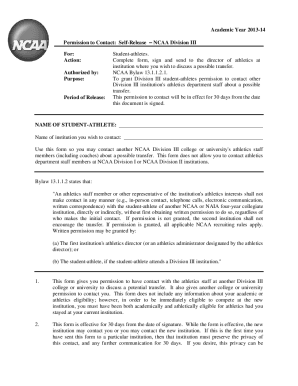
The NCAA D3 Self-Release Form is essential for student-athletes seeking to explore transfer options within NCAA Division III institutions. This guide aims to ensure that you fill out the form accurately and effectively, enabling you to communicate with other collegiate athletic programs.
Follow the steps to complete the NCAA D3 Self-Release Form online
- Click 'Get Form' button to obtain the NCAA D3 Self-Release Form and open it in the editor.
- Enter your full name as the student-athlete in the designated field.
- Specify the name of the institution you wish to contact in the corresponding field.
- Review the information within the 'Permission to Contact' section, understanding that this allows communication between you and the athletics staff of another NCAA Division III school regarding a potential transfer.
- Check the appropriate boxes confirming if this is your first release to the selected institution and if you allow that institution to notify your current institution of this permission.
- Provide your contact information, including telephone number, email address, or physical address, to facilitate communication.
- Sign and date the form to validate your permission, ensuring you use a scanned signature if sending it via email.
- Submit the completed form to the director of athletics at the institution you wish to contact, using facsimile, email, or standard mail, ensuring your signature is included.
- After submitting the form, be aware that the permission is effective for 30 days from the signing date. If you decide not to pursue the transfer, the new institution cannot notify your current institution of this contact.
- Once your changes are saved, you have the option to download, print, or share the form as needed.
Complete your NCAA D3 Self-Release Form online today to ease your transfer process.
Experience a faster way to fill out and sign forms on the web. Access the most extensive library of templates available.
Related content
Apr 30, 2015 — The self-release applies only to transfers from a Division III school to...
Completing this form gives you permission to have contact with the athletics staff at...
Jan 8, 2013 — Listing of All Files from GEnie Apple II Roundtable Bulletin Boards. File:...
Get answers to your most pressing questions about US Legal Forms API.
How do you know if you are NCAA eligible?
To determine your NCAA eligibility, you must assess your academic and athletic qualifications against NCAA standards. Start by checking your GPA, standardized test scores, and compliance with amateurism rules. Additionally, the NCAA D3 Self-Release Form can help clarify your status by ensuring you meet the eligibility requirements established by your current institution.
Who is eligible for NCAA waiver?
Eligibility for an NCAA waiver varies based on specific circumstances. Generally, student-athletes who face extenuating situations, such as a serious injury or personal issues, may qualify. To pursue a waiver, it is crucial to understand the requirements set by the NCAA and consult resources like the NCAA D3 Self-Release Form for guidance on the process.
How do you transfer out of D3?
Transferring out of NCAA D3 involves a few steps. First, you need to complete the NCAA D3 Self-Release Form, which officially allows your current institution to release your academic and athletic eligibility. After submitting this form, make sure to follow the specific guidelines set by both your current and prospective schools to ensure a smooth transition.
What is the NCAA permission to contact self-release form?
The NCAA permission to contact self-release form is a document you complete to indicate your desire to leave your current team and seek opportunities elsewhere. For athletes in D3, this form is vital as it notifies your institution of your intentions and permits communication with other schools. Utilizing this form efficiently can greatly enhance your transfer process, helping you discover new paths in your athletic career. Consider platforms like uslegalforms to simplify the form-filling experience.
What is permission to contact NCAA?
Permission to contact is a formal request that athletes submit to allow NCAA coaches to reach out regarding scholarship offers or recruitment. For D3 athletes, this often necessitates the completion of a NCAA D3 Self-Release Form, which signals your intent to explore other programs. This permission opens doors to new opportunities and ensures that the recruitment process remains compliant with NCAA regulations. Understanding this can facilitate smooth transitions between institutions.
Does D3 have NLI?
No, NCAA Division III does not offer National Letter of Intent (NLI) scholarships, which sets it apart from other divisions. Instead, D3 institutions focus on providing financial aid based on academic performance and need. If you are considering transferring or exploring your options, a NCAA D3 Self-Release Form can be crucial in communicating your intent to other colleges. This process can help you find the right fit without the constraints of an NLI.
What is the 40-60-80 rule?
The 40-60-80 rule involves a guideline for when athletes can anticipate scholarships and financial aid at NCAA institutions. In this context, the percentages represent different stages of the recruitment season. Understanding these guidelines is critical for D3 athletes, especially when considering the completion of a NCAA D3 Self-Release Form, as it impacts your options for potential offers. This rule helps you align your expectations as you navigate your transfer journey.
When can NCAA coaches contact you?
NCAA coaches can contact you at specified times throughout the recruiting calendar, depending on your division and the recruiting rules in place. For D3 athletes, initial evaluations occur during designated periods, after which coaches can reach out. However, remember that submitting a NCAA D3 Self-Release Form can enhance your visibility, allowing coaches to connect more easily. Staying informed about these timelines ensures you do not miss opportunities.
How do D3 athletes transfer?
D3 athletes transfer primarily by filling out the NCAA D3 Self-Release Form, which informs their current school of their intent to leave. After this, they can reach out to potential new schools to understand their transfer policies. This process emphasizes clear communication and proper planning, ensuring a positive transition to the next chapter of their athletic careers.
Does D3 use a transfer portal?
NCAA Division III does not utilize a formal transfer portal system like Division I. Instead, the focus is on communication through the NCAA D3 Self-Release Form. This form serves as the primary method for athletes to express their intention to transfer, helping maintain a constructive dialogue with their current school.
Use professional pre-built templates to fill in and sign documents online faster. Get access to thousands of forms.
If you believe that this page should be taken down, please follow our DMCA take down process here.