Er harmful contaminant exposing employees to a hazard. B. Adequate precautions taken to protect employees from exposure to an atmosphere containing less than 19.5% oxygen and/or to other hazardous atmospheres. C. Ventilation provided to prevent employee exposure to an atmosphere containing flammable gas in excess of 10% of the lower explosive limit of the gas. D. Testing conducted often to ensure that the atmosphere remains safe. E. Emergency equipment, such as breathing apparatus, safety harnes.
Open form follow the instructions
Easily sign the form with your finger
Send filled & signed form or save
How to fill out the Workforce Safety & Insurance Excavation Checklist online
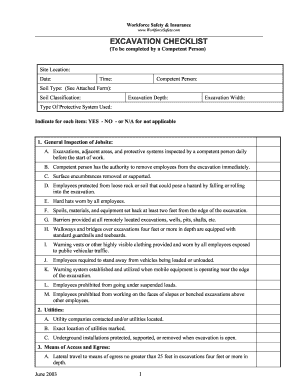
Completing the Workforce Safety & Insurance Excavation Checklist online is essential for ensuring safety during excavation projects. This guide provides a clear and systematic approach to filling out the checklist accurately and comprehensively.
Follow the steps to complete the Excavation Checklist effectively.
- Click ‘Get Form’ button to obtain the form and open it in the editor.
- Begin by entering the site location, date, time, and the name of the competent person responsible for overseeing the excavation work.
- Specify the soil type and classification, as these details are vital for assessing excavation safety.
- Fill in the excavation depth and width, ensuring accurate measurements to facilitate proper safety evaluations.
- Indicate the type of protective system used. Refer to the project's safety protocols for guidance on appropriate systems.
- Evaluate each item listed under the general inspection section. Use 'YES', 'NO', or 'N/A' to indicate compliance or applicability.
- For the utilities section, confirm whether utility companies have been contacted and the exact locations of utilities marked.
- Address the means of access and egress, ensuring that travel distance is within the required limits. Provide details on ladder and ramp safety.
- Complete the wet conditions section by indicating measures taken to manage water accumulation and the monitoring of water removal equipment.
- Assess the hazardous atmosphere section, documenting any testing conducted and precautions taken to ensure employee safety.
- Review and fill out the support systems section, confirming the proper materials and methods used for excavation safety.
- Finally, ensure all sections of the daily trenching log are filled accurately, and finish by saving your changes. You can download, print, or share the completed form as needed.
Start filling out your Workforce Safety & Insurance Excavation Checklist online today to enhance safety in your excavation projects.
Experience a faster way to fill out and sign forms on the web. Access the most extensive library of templates available.
Related content
The purpose of this training is to raise awareness of construction excavation and...
Guidelines: This checklist covers regulations issued by the U.S. Department of Labor...
The competent person needs to know the key points of the OSHA Excavation Standard...
Get answers to your most pressing questions about US Legal Forms API.
What is the 6 foot fall protection rule?
The 6 foot fall protection rule requires that workers must be provided with fall protection when working at heights of six feet or more above lower levels. This rule is critical in preventing fall-related injuries in construction and excavation settings. To enhance safety, consider using a Workforce Safety & Insurance Excavation Checklist, which can help ensure that fall protection measures are properly implemented.
What are the safety requirements for excavation?
Safety requirements for excavation include ensuring proper support systems, maintaining safe entry and exit points, and monitoring for hazardous conditions like gas or water accumulation. Regular training on excavation safety for workers also plays an essential role in risk reduction. A Workforce Safety & Insurance Excavation Checklist can act as a valuable tool to verify compliance with these requirements.
What is the OSHA 6 foot rule for excavation?
The OSHA 6 foot rule for excavation mandates that all trenches deeper than six feet require protective systems to prevent collapses. This guideline is vital for safeguarding workers involved in excavation tasks. Additionally, utilizing a Workforce Safety & Insurance Excavation Checklist helps reinforce these safety requirements, ensuring that all essential protective measures are in place.
What is the 6 foot rule for excavation?
The 6 foot rule for excavation refers to the guideline stating that no excavation deeper than six feet should occur without proper protective measures. This rule is crucial in preventing accidents, such as cave-ins, which can lead to injuries or fatalities. By integrating a Workforce Safety & Insurance Excavation Checklist, you can ensure compliance with this essential safety standard.
What is the 5 4 3 2 1 rule for excavation?
The 5 4 3 2 1 rule for excavation focuses on the depth of the excavation and slope requirements. It emphasizes that for every five feet of depth, a four-foot setback from the edge is needed, along with a two-foot clearance from underground utilities. This approach helps in maintaining a safe working environment. Using a comprehensive Workforce Safety & Insurance Excavation Checklist can safeguard your team and equipment.
What is the 5 4 3 2 1 excavation rule?
The 5 4 3 2 1 excavation rule outlines crucial safety measures during excavation work. Specifically, it states that for every five feet of digging, four feet of side and two feet from any underground utilities should be respected. This rule prevents cave-ins and other hazards. Incorporating a Workforce Safety & Insurance Excavation Checklist ensures you follow these guidelines effectively.
What are the OSHA requirements for excavation?
OSHA requirements for excavation focus on preventing accidents by establishing safety measures for workers. Key requirements include conducting hazard assessments, providing protective systems, and ensuring worker training. The Workforce Safety & Insurance Excavation Checklist can streamline these processes and help maintain compliance with OSHA's standards.
What is OSHA Regulation 29 CFR 1926.651 D?
OSHA Regulation 29 CFR 1926.651 D focuses on the requirements related to excavation safety, particularly concerning protective systems. It specifies the need for adequate measures to prevent cave-ins, which is a significant risk during excavation. The Workforce Safety & Insurance Excavation Checklist can help ensure compliance with this regulation, promoting a safer work environment.
What does OSHA require before excavation work begins?
Before commencing excavation work, OSHA requires that employers evaluate the worksite for potential hazards. This includes identifying utilities and ensuring that safety plans are in place. The Workforce Safety & Insurance Excavation Checklist can assist employers in meeting these obligations efficiently.
What is required to be placed when an employer requires an employee to cross an excavation?
When employees need to cross an excavation, employers must provide safe access methods, such as bridges or ladders. This measure not only ensures safety but also aligns with OSHA requirements. By following the Workforce Safety & Insurance Excavation Checklist, you can ensure that you meet these critical safety needs.
Use professional pre-built templates to fill in and sign documents online faster. Get access to thousands of forms.
If you believe that this page should be taken down, please follow our DMCA take down process here.