Loading
Get App C Hemocue Qc Log Dch-1488 0811.doc - Michigan
How it works
-

Open form follow the instructions
-

Easily sign the form with your finger
-

Send filled & signed form or save
How to fill out the App C HemoCue QC Log DCH-1488 0811.doc - Michigan online
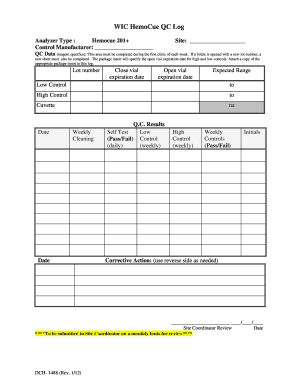
This guide provides step-by-step instructions for filling out the App C HemoCue QC Log DCH-1488 0811.doc online. Understanding each component of this form is essential for ensuring accurate quality control in your facility.
Follow the steps to successfully complete the QC log
- Press the ‘Get Form’ button to access the form and open it in your browser.
- In the 'Control Manufacturer' field, enter the name of the manufacturer for your HemoCue control.
- Fill in the 'Site' section with the appropriate location where the quality control is being performed.
- Complete the 'QC Data' section during the first clinic of each week, entering details for the reagent specifics.
- If a new lot number is in use due to a newly opened bottle, make sure to document it by completing a new sheet as well.
- Refer to the package insert to fill out the 'Close vial expiration date' and 'Open vial expiration date', as well as the 'Expected Range' for both low and high controls.
- In the 'Cuvette' field, enter any necessary data, and ensure that the 'Date' field reflects the current date of completion.
- Indicate the weekly cleaning date in the specified field to maintain compliance.
- Fill in the 'Q.C. Results' for both low and high controls, marking 'Pass/Fail' for daily and weekly assessments.
- Initial your entries to confirm accuracy and completeness.
- Document any corrective actions that may be necessary, utilizing the reverse side of the log as needed.
- Ensure that the Site Coordinator reviews the log, making a note of the review date.
- Finally, save your changes, download, print, or share the completed form as required.
Complete your documentation effectively by filling out the form online today.
HemoCue thus underestimates the Hb concentration by 2-5% and exhibits a 8-10 times higher variability with only 86.4% of HbHC being within +/- 10% of HbCOOX.