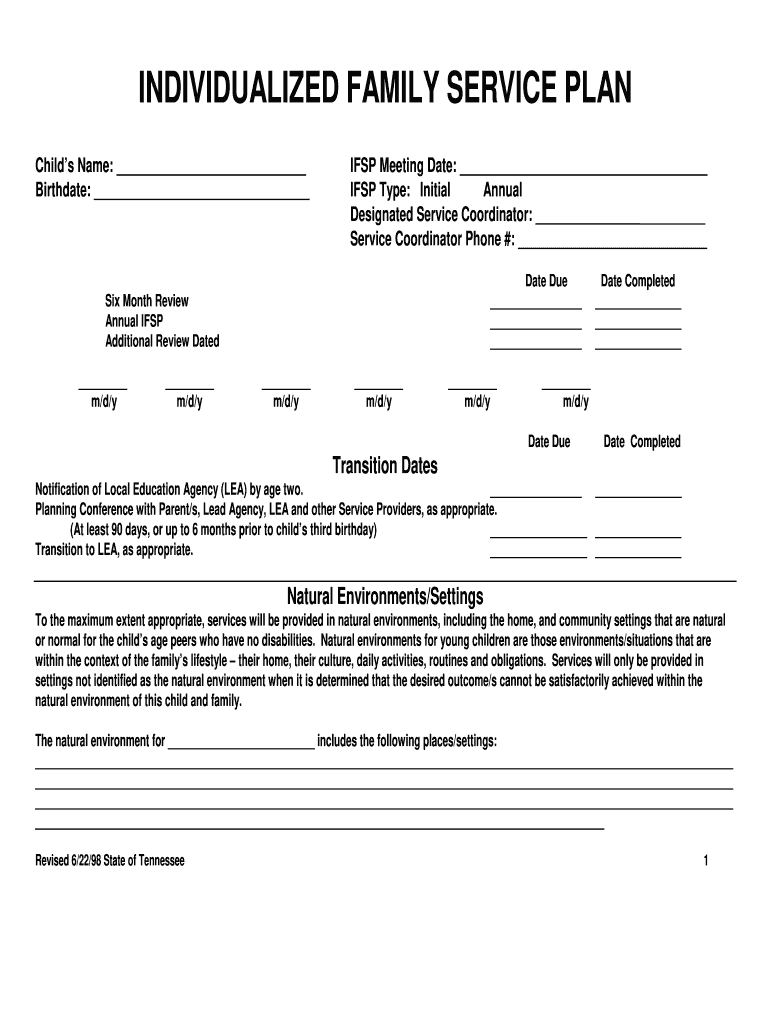
Itial Annual Designated Service Coordinator: __________________________ Service Coordinator Phone #: _____________________________ Date Due _________________ _________________ _________________ Six Month Review Annual IFSP Additional Review Dated _________ m/d/y _________ m/d/y _________ m/d/y _________ m/d/y _________ m/d/y Date Completed ________________ ________________ ________________ _________ m/d/y Date Due Date Completed Transition Dates Notification of Local Education Agency (L.

Open form follow the instructions

Easily sign the form with your finger

Send filled & signed form or save
How to fill out the TN IFSP online
The Tennessee Individualized Family Service Plan (TN IFSP) is a vital document that outlines the services and support necessary for a child with developmental delays. This guide provides step-by-step instructions on completing the TN IFSP form online to ensure a smooth and efficient process.
Follow the steps to successfully complete the TN IFSP online.
- Click the ‘Get Form’ button to access the TN IFSP document and open it in the editor.
- Fill in the child's name and birthdate at the top of the cover page, along with the IFSP meeting date and type. Indicate whether this is an initial or annual plan.
- Identify and enter the designated service coordinator's name and phone number, along with the due dates for six-month reviews and annual IFSPs.
- Document the transition dates such as notification to the Local Education Agency and planning conferences, filling in the corresponding due dates.
- For 'Natural Environments/Settings', describe appropriate locations for the services that align with the family’s lifestyle and the child’s age.
- On the identifying information page, enter the child's full name, date of birth, social security number, address, and parents’ names, along with their contact details.
- Check the appropriate Part C eligibility criteria the child meets and document the referral information.
- Ensure that all members of the IFSP team sign the documentation, including any team members who contributed but did not attend.
- Complete the Present Levels of Development section, detailing the child’s strengths and needs in various developmental areas, recorded by the professional who conducted assessments.
- Summarize family resources, priorities, and concerns regarding the child’s development, including participation in any voluntary assessments.
- Identify major outcomes and action steps based on discussions from the IFSP meeting, specifying responsible individuals and timelines.
- Document the needed services, the providers, and categorize them as required or non-required, alongside the expected duration and intensity.
- At the end of the process, review the entire document for accuracy, save changes, and prepare to download, print, or share the completed TN IFSP.
Complete the TN IFSP online today to ensure your child receives the necessary support and resources.
Experience a faster way to fill out and sign forms on the web. Access the most extensive library of templates available.
Related content
Planned Six Month Review date and Annual IFSP date – enter the approximate Date Due and...
by LK Bhushan · 1996 — This study was conducted to explore the initial IFSP process...
Special Education Support: Support includes participation in the IEP, IFSP, and/or ITP...
Get answers to your most pressing questions about US Legal Forms API.
At what age can a child refuse visitation in TN?
In Tennessee, children do not have a specific age at which they can legally refuse visitation, but their preferences are more likely to be respected by the court as they mature. Judges typically consider the child's maturity level and ability to understand the situation. The TN IFSP can inform parents about how to approach these discussions with their children and clarify the legal landscape surrounding visitation rights.
What happens if my child doesn't want to see his father?
If a child expresses a desire not to see their father, it is essential to consider the reasons behind these feelings. Open communication and exploration of the child's emotions can lead to healthy resolutions. Engaging with the TN IFSP can help families address these issues while ensuring the child's welfare remains the top priority.
What is the child only grant in TN?
The child-only grant in Tennessee provides financial assistance specifically for families with children who are not living with a parent. This grant is designed to support basic needs, including food and housing costs. The TN IFSP can guide families through the application process and help them understand their options.
What age can a child stop going to the other parent?
In Tennessee, there is no set age when a child can completely stop visiting a parent, as each case is individually assessed by the court. However, older children may have their preferences taken into account. Utilizing the TN IFSP can help families navigate visitation issues and secure the best outcome for their children.
Who is eligible for early intervention in Tennessee?
Eligibility for early intervention services in Tennessee requires that children display developmental delays or disabilities. Typically, children under the age of three are assessed for these early services, which aim to support their growth and development. The TN IFSP is a vital resource for families in need of these crucial early intervention programs.
Can a 14-year-old decide which parent to live with in Tennessee?
While a 14-year-old in Tennessee can share their preference regarding living arrangements, the final decision rests with the court. The judge will consider the child's input alongside other factors such as parental capability and child welfare. It's helpful to involve TN IFSP services to ensure that your family receives the necessary support during this process.
At what age can a child decide not to see a parent in TN?
In Tennessee, a child can express their preferences regarding visitation, but there is no specific age when they can legally decide not to see a parent. Courts often consider the child's wishes, especially as they grow older and demonstrate the ability to understand the situation. The TN IFSP can provide additional support and guidance in navigating these complex family matters.
Who qualifies for family first in TN?
In Tennessee, Family First mainly supports families involved with the Department of Children's Services. To qualify, families must demonstrate a need for services that promote safety, stability, and support for children. This program targets families facing issues like neglect, abuse, or instability. For more specific guidance, you can consult resources on the TN IFSP.
Which is a required component of the individualized family service plan?
A required component of the TN IFSP is the family's description of their strengths, concerns, and resources. This information is vital for tailoring services to the family's unique situation. Moreover, including measurable outcomes for the child helps track progress effectively across the individualized family service plan.
What is required in an IFSP?
An effective TN IFSP must include family involvement, service coordination, assessment results, and a summary of the child's strengths and needs. Additionally, it should specify the services required and timeline for delivery. These requirements ensure that the individualized plan is tailored to meet the unique needs of each child and family.
Use professional pre-built templates to fill in and sign documents online faster. Get access to thousands of forms.
If you believe that this page should be taken down, please follow our DMCA take down process here.