Loading
Get Pediatric Septic Shock Collaborative Triage Trigger Tool - Childrens-mercy
How it works
-

Open form follow the instructions
-

Easily sign the form with your finger
-

Send filled & signed form or save
How to fill out the Pediatric Septic Shock Collaborative Triage Trigger Tool - Childrens-mercy online
This guide provides clear and concise instructions for effectively completing the Pediatric Septic Shock Collaborative Triage Trigger Tool. Users will gain an understanding of each section and the necessary steps to ensure accurate information is provided.
Follow the steps to complete the triage trigger tool with ease.
- Click 'Get Form' button to access the tool and open it in the online editor.
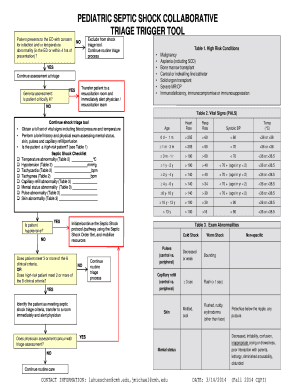
- Begin by noting if the patient presents with concerns of infection and/or temperature abnormality. If not, exclude from shock triage and continue with the routine triage process.
- Conduct a general assessment to determine if the patient is critically ill. If the patient is critically ill, transfer them to a resuscitation room and alert the physician/resuscitation team immediately.
- Obtain a complete set of vital signs including blood pressure and temperature. Perform a brief history and physical exam, assessing mental status, skin condition, pulses, and capillary refill/perfusion.
- Determine if the patient is considered high-risk by referring to Table 1. If the patient has high-risk conditions such as malignancy or asplenia, continue with special considerations.
- Document the patient's vital signs and relevant abnormalities as listed in Tables 2 and 3. This includes temperature, heart rate, respiratory rate, skin, and mental status.
- Assess whether the patient is hypotensive. If the answer is yes, initiate or continue the Septic Shock protocol/pathway using the Septic Shock Order Set and mobilize resources.
- Finally, identify whether the patient meets the septic shock triage criteria based on clinical assessments and transfer them to a room while alerting the physician if they do.
- If necessary, ensure that the physician's assessment aligns with the triage assessment. If not, continue routine triage procedures.
Start completing your Pediatric Septic Shock Collaborative Triage Trigger Tool online today to ensure timely and effective patient care.
TIME stands for Temperature, Infection, Mental decline and Extremely ill. These are not the only signs and symptoms of sepsis, of course, but these are the most common symptoms that people are able to recognize.