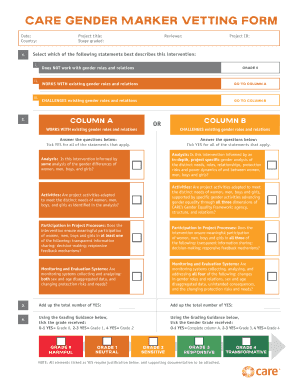
The CARE Gender Marker comprises guidance notes and a vetting form to beapplied at each stage of the programme cycle. It is important to note that it is notintended to be a standalone tool to integrate.

How it works
  • Open form

    Open form follow the instructions

  • Easily sign form

    Easily sign the form with your finger

  • Share form

    Send filled & signed form or save

How to fill out the CARE Gender Marker Vetting Form online

Filling out the CARE Gender Marker Vetting Form is an essential step in assessing the gender sensitivity of projects. This guide provides clear and systematic instructions to help users navigate the form effectively.

Follow the steps to complete the form with ease.

  1. Use the ‘Get Form’ button to access the CARE Gender Marker Vetting Form and open it in your online platform.
  2. Begin by entering the project details in the specified fields, including the project ID and project title.
  3. For the grading section, assess the intervention against the criteria provided. Check the box that aligns with how the project interacts with existing gender roles: either it does not work, works with, or challenges these roles.
  4. Depending on your selection, navigate to either Column A or Column B, and answer all relevant questions by ticking 'YES' for those statements that apply to your project’s intervention.
  5. After answering the questions, count the total number of 'YES' responses. Use the Grading Guidance to determine the appropriate grade based on how many statements received 'YES.'
  6. For each 'YES' answer, provide a justification in the designated area, ensuring supporting documentation is attached if applicable.
  7. Reflect on lessons learned from integrating gender into your project design. Document the main insights and outline potential changes to improve gender integration in future interventions.
  8. Once all sections are complete, review your entries for accuracy. You can then save changes, download, print, or share the form as needed.

Complete the CARE Gender Marker Vetting Form online to enhance your project’s gender responsiveness.

Get form

Experience a faster way to fill out and sign forms on the web. Access the most extensive library of templates available.

Related content

The Perioperative Care of the Transgender Patient...

Aug 1, 2018 — Collection of Gender Identity on a Patient Intake Form ... Adapted from...

Learn more
The inclusion of transgender and gender diverse...

May 19, 2020 — and intake forms of gender specialists were coded for use of affirming...

Learn more
Workforce 2020 white paper - Cisco

In addition to generational shifts, a gender shift has been building in the global ... Not...

Learn more
Questions & Answers

Get answers to your most pressing questions about US Legal Forms API.

Contact support

What is the International Agreement on gender equality?

On 18 December 1979, the Convention on the Elimination of All Forms of Discrimination against Women was adopted by the United Nations General Assembly. It entered into force as an international treaty on 3 September 1981 after the twentieth country had ratified it.

Gender equality in health means that women and men have equal conditions for realizing their full rights and potential to be healthy, contribute to health development, and benefit from the results.

It is a strategy for making women's as well as men's concerns and experiences an integral dimension in the design, implementation, monitoring, and evaluation of policies and programs in all political, economic, and social spheres, such that inequality between men and women is not perpetuated.

A gender marker represents an individual's gender identity, most commonly in the abbreviations F (female), M (male), or X (non-binary, intersex, or gender non-conforming). Some of UB's data systems have the ability to capture gender identity information in addition to legal sex demographic data.

Working with others, CARE seeks to promote equal realization of dignity and human rights for all people, and the elimination of poverty and injustice. CARE recognizes that gender is not binary, and that terms and definitions related to gender and sexuality are diverse and continue to evolve.

What is the Gender Marker? The IASC Gender Marker is a tool that codes, on a 2-0 scale, whether or not a humanitarian project is designed well enough to ensure that women/girls and men/boys will benefit equally from it or that it will advance gender equality in another way.

We put women and girls at the heart of our work. Gender equality is CARE's central organising principle. We cannot achieve women's economic justice, climate justice, health equity, the right to food, water, and nutrition, or equal access to humanitarian assistance without addressing gender inequality.

Get This Form Now!

Use professional pre-built templates to fill in and sign documents online faster. Get access to thousands of forms.

If you believe that this page should be taken down, please follow our DMCA take down process here.

Get CARE Gender Marker Vetting Form