Loading
Form preview
  • US Legal Forms
  • Form Library
  • Industry Forms
  • Industry Academic Forms
  • Worksheet: Interpreting Graphs

Get Worksheet: Interpreting Graphs

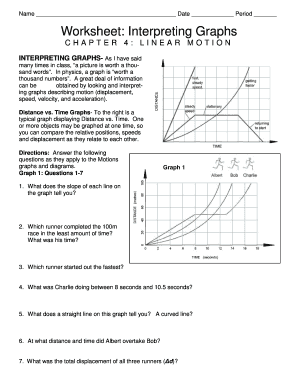
“a picture is worth a thousand words”. In physics, a graph is “worth a thousand numbers”. A great deal of information can be obtained by looking and interpreting graphs describing motion (displacement, speed, velocity, and acceleration). Distance vs. Time Graphs- To the right is a typical graph displaying Distance vs. Time. One or more objects may be graphed at one time, so you can compare the relative positions, speeds and displacement as they relate to each other. Directions: Answer t.

How it works

  1. Open form

    Open form follow the instructions

  2. Easily sign form

    Easily sign the form with your finger

  3. Share form

    Send filled & signed form or save

How to fill out the Worksheet: Interpreting Graphs online

This guide provides clear instructions on how to complete the Worksheet: Interpreting Graphs online. By following these steps, you will be able to navigate the various sections of the worksheet effectively, ensuring you understand the graphs and their implications.

Follow the steps to successfully complete the worksheet.

  1. Click the ‘Get Form’ button to access the worksheet and open it in your preferred online editing tool.
  2. Begin by entering your name, date, and period at the top of the worksheet. This information helps identify your submission.
  3. Proceed to the first graph entitled 'Graph 1' and read the provided questions. These queries are designed to help you interpret the graph's information regarding motion.
  4. Answer questions 1 to 7 based on your analysis of Graph 1. Be sure to consider the slope of the lines and what they convey about the runners' speeds and displacements.
  5. Move on to 'Graph 2'. Carefully review questions 8 to 13, reflecting on the bicyclist's motion between different time intervals.
  6. Once you've interpreted Graph 2, document your answers to the respective questions, ensuring clarity and accuracy.
  7. Finally, analyze 'Graph 3' and respond to questions 14 to 17, focusing on velocity changes and calculating average velocity.
  8. After completing all questions, review your answers for completeness and correctness. Edit any necessary portions if you realize any mistakes.
  9. Once satisfied with your responses, choose to save your changes, download the completed worksheet, print it, or share it as instructed.

Complete your Worksheet: Interpreting Graphs online today to enhance your understanding of motion!

Get form

Experience a faster way to fill out and sign forms on the web. Access the most extensive library of templates available.
Get form

Related content

Communicating Clearly with Charts and Graphs
Focus on users and the message by choosing the right type of graph for the data. Main user...
Learn more
Interpreting Graphs And Tables Worksheets
A: Interpreting graphs and tables worksheets are designed to help students develop skills...
Learn more
Pearson Physics 11 New South Wales Skills and...
Sep 10, 2017 — WORKSHEET 3.3 Interpreting graphs of waves 103. WORKSHEET 3.4 The speed...
Learn more

Related links form

OH An Exploratory Study of Court-Referred Batterer Intervention Programs 2006 Odadas Approved Forms OH Counseling Progress Notes 2010 OH Deer Park Community City Schools Student Emergency Medical Form 2015

Questions & Answers

Get answers to your most pressing questions about US Legal Forms API.

Contact support

To analyze data from a graph effectively, start by identifying the main trends and any outliers. Consider both the overall shape of the graph and specific points that stand out. Using a structured approach, such as that found in our Worksheet: Interpreting Graphs, will help clarify your analysis and improve accuracy.

Analyzing data from a bar graph begins with comparing the lengths of the bars to understand relative values. Take note of any trends over time or differences between categories. Your Worksheet: Interpreting Graphs can guide you in making these comparisons clearer and more straightforward.

Interpreting data in a chart involves analyzing the elements presented visually. Focus on the titles, legends, and labels as they provide crucial context. By utilizing a Worksheet: Interpreting Graphs, you can systematically assess each aspect of the chart, ensuring a comprehensive understanding of the data.

Extracting data from a graph requires careful observation of the plotted points or lines. Use the axes to read values accurately and note any labeled data points. Incorporating tools designed for worksheets, such as our Worksheet: Interpreting Graphs, can streamline this process and help you collect data efficiently.

To effectively analyze data from graphs, start by identifying the key trends and patterns. Look for significant changes, peaks, and lows that may indicate important information. Additionally, consider the context of the data and the specific questions you aim to answer in your Worksheet: Interpreting Graphs.

When using the Worksheet: Interpreting Graphs, consider the type of data you have. For instance, line graphs are excellent for showing trends over time, while bar graphs work well for comparing categories. Choose a graph that directly aligns with your data's purpose to enhance clarity and understanding.

Graphs are visual representations that organize and illustrate data clearly. They serve as tools to facilitate comparisons, trends, and patterns that might be overlooked in raw data. By understanding graphs, you can translate numerical information into insightful visuals for better analysis. Our Worksheet: Interpreting Graphs can help clarify this concept further.

To explain data from a graph, focus on key trends, anomalies, and overall patterns revealed by the visual. Describe how the data correlates with the subject matter, providing context for better comprehension. Make your explanation user-friendly to ensure everyone can gain insights from the information presented. A Worksheet: Interpreting Graphs can enhance your ability to communicate these insights effectively.

Interpreting a graph function involves analyzing how changes in one variable affect the other. Identify the function's characteristics, such as its trends, and any shifts in direction. Assessing these elements allows for a deeper understanding of the relationship depicted. Our Worksheet: Interpreting Graphs can provide structured guidance in this analysis.

In a graph description, include the purpose of the graph, a summary of the data presented, and any significant observations. It is essential to mention the variables being compared and what the data indicates about those variables. A well-crafted description enhances the viewer’s understanding, making the Worksheet: Interpreting Graphs an excellent tool for refining your skills.

Get This Form Now!

Use professional pre-built templates to fill in and sign documents online faster. Get access to thousands of forms.
Get form
If you believe that this page should be taken down, please follow our DMCA take down processhere.

Industry-leading security and compliance

US Legal Forms protects your data by complying with industry-specific security standards.
  • In businnes since 1997
    25+ years providing professional legal documents.
  • Accredited business
    Guarantees that a business meets BBB accreditation standards in the US and Canada.
  • Secured by Braintree
    Validated Level 1 PCI DSS compliant payment gateway that accepts most major credit and debit card brands from across the globe.
Get Worksheet: Interpreting Graphs
Get form
  • Adoption
  • Bankruptcy
  • Contractors
  • Divorce
  • Home Sales
  • Employment
  • Identity Theft
  • Incorporation
  • Landlord Tenant
  • Living Trust
  • Name Change
  • Personal Planning
  • Small Business
  • Wills & Estates
  • Packages A-Z
  • Affidavits
  • Bankruptcy
  • Bill of Sale
  • Corporate - LLC
  • Divorce
  • Employment
  • Identity Theft
  • Internet Technology
  • Landlord Tenant
  • Living Wills
  • Name Change
  • Power of Attorney
  • Real Estate
  • Small Estates
  • Wills
  • All Forms
  • Forms A-Z
  • Form Library
  • Legal Hub
  • About Us
  • Help Portal
  • Legal Resources
  • Blog
  • Affiliates
  • Contact Us
  • Delete My Account
  • Site Map
  • Industries
  • Forms in Spanish
  • Localized Forms
  • State-specific Forms
  • Forms Kit
  • Real Estate Handbook
  • All Guides
  • Notarize
  • Incorporation services
  • For Consumers
  • For Small Business
  • For Attorneys
  • USLegal
  • FormsPass
  • pdfFiller
  • signNow
  • altaFlow
  • DocHub
  • Instapage
Form Packages
  • Adoption
  • Bankruptcy
  • Contractors
  • Divorce
  • Home Sales
  • Employment
  • Identity Theft
  • Incorporation
  • Landlord Tenant
  • Living Trust
  • Name Change
  • Personal Planning
  • Small Business
  • Wills & Estates
  • Packages A-Z
Form Categories
  • Affidavits
  • Bankruptcy
  • Bill of Sale
  • Corporate - LLC
  • Divorce
  • Employment
  • Identity Theft
  • Internet Technology
  • Landlord Tenant
  • Living Wills
  • Name Change
  • Power of Attorney
  • Real Estate
  • Small Estates
  • Wills
  • All Forms
  • Forms A-Z
  • Form Library
Customer Service
  • Legal Hub
  • About Us
  • Help Portal
  • Legal Resources
  • Blog
  • Affiliates
  • Contact Us
  • Delete My Account
  • Site Map
  • Industries
  • Forms in Spanish
  • Localized Forms
  • State-specific Forms
  • Forms Kit
Legal Guides
  • Real Estate Handbook
  • All Guides
Prepared for you
  • Notarize
  • Incorporation services
Our Customers
  • For Consumers
  • For Small Business
  • For Attorneys
Our Sites
  • USLegal
  • FormsPass
  • pdfFiller
  • signNow
  • altaFlow
  • DocHub
  • Instapage
Social Media
Call us now toll free:
+1 833 426 79 33
As seen in:
© Copyright 1999-2026 airSlate Legal Forms, Inc. 3720 Flowood Dr, Flowood, Mississippi 39232
  • Your Privacy Choices
  • Terms of Service
  • Privacy Notice
  • Content Takedown Policy
  • Bug Bounty Program