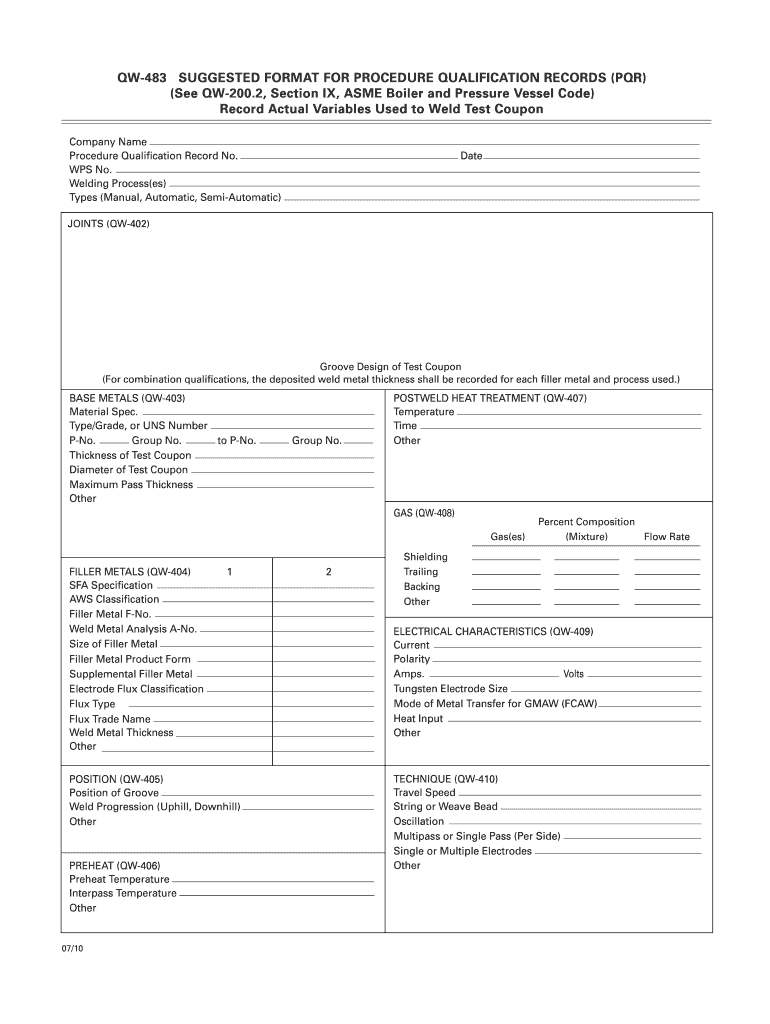
Qualification Record No. WPS No. Welding Process(es) Types (Manual, Automatic, Semi-Automatic) Date JOINTS (QW-402) Groove Design of Test Coupon (For combination qualifications, the deposited weld metal thickness shall be recorded for each filler metal and process used.) BASE METALS (QW-403) Material Spec. Type/Grade, or UNS Number P-No. to P-No. Group No. Thickness of Test Coupon Diameter of Test Coupon Maximum Pass Thickness Other Group No. POSTWELD HEAT TREATMENT (QW-407) Temperature T.

Open form follow the instructions

Easily sign the form with your finger

Send filled & signed form or save
How to fill out the QW-483 online
Filling out the QW-483 form online is an essential step in documenting procedure qualification records for welding processes. This guide will provide you with a clear, step-by-step approach to ensure you complete the form accurately and efficiently.
Follow the steps to successfully complete the QW-483 form:
- Press the ‘Get Form’ button to acquire the QW-483 form and open it in your browser for editing.
- Begin by entering the company name at the top of the form, followed by the procedure qualification record number and the WPS number. Ensure you have these identifiers correctly filled out as they are vital for record-keeping.
- Input the welding process used, specifying whether it was manual, automatic, or semi-automatic. Include the date of the qualification record to maintain accurate timelines.
- Move on to the 'Joints' section, where you will need to describe the groove design of the test coupon. If applicable, note the deposited weld metal thickness for each filler metal and process used.
- In the 'Base Metals' section, provide the material specification, type or grade, or UNS number. Include details about the P-No., group number, the thickness of the test coupon, diameter, and maximum pass thickness.
- Complete the post-weld heat treatment section by recording the temperature, time, and any other relevant details.
- Fill out the gas section by listing the gas or gases used in the welding process.
- In the 'Filler Metals' section, document the SFA specification, AWS classification, filler metal F-number, size, product form, and any other pertinent information.
- Provide details about the welding position, weld progression (uphill or downhill), and any other related information in the 'Position' section.
- Record your preheat temperatures and interpass temperatures in the preheat section, if applicable.
- Next, fill in the electrical characteristics, including current, polarity, amps, volts, tungsten electrode size, and details regarding heat input.
- Complete the technique section, documenting the travel speed, type of bead (string or weave), and whether you are using single or multiple electrodes.
- Proceed to the back of the form to input results from tests conducted, including tensile tests, guided-bend tests, toughness tests, and fillet-weld tests. Ensure you provide detailed results for each test.
- Finally, certify the document by inserting the manufacturer or contractor's name, date, and the certified person's signature.
- Once all sections are completed, you can save your changes, download the form, print it, or share it as needed.
Complete your documents online today and ensure your welding qualifications are properly recorded.
Experience a faster way to fill out and sign forms on the web. Access the most extensive library of templates available.
Related content
Nov 5, 2024 — QW-482 WELDING PROCEDURE SPECIFICATION (WPS)...
Suggested format for procedure qualification records (PQR) (See QW-200.2, Section IX, ASME...
A HELLA do Brasil Automotive Ltda., estabelecida na cidade de São Paulo, combina as...
Get answers to your most pressing questions about US Legal Forms API.
What document is used to qualify a welding procedure qualification?
The primary document used to qualify a welding procedure is the WPS, which outlines the specific steps and requirements for the welding process. Accompanying this is the PQR, which provides evidence that the selected technique produces satisfactory welds according to QW-483. Together, these documents form a comprehensive foundation for quality assurance in welding practices.
What is the process qualification record?
The process qualification record, often abbreviated as PQR, is a detailed account of the welding parameters and test results that demonstrate a welding procedure's effectiveness. This record is vital for proving that welding techniques conform to industry standards and the requirements set by QW-483. Maintaining a clear PQR enhances traceability and accountability in the welding industry.
How to qualify a welding procedure?
To qualify a welding procedure, you must document the welding techniques, materials, and test results according to recognized standards such as QW-483. This involves conducting tests, such as tensile or bend tests, to verify that the resulting welds meet necessary specifications. Proper training and documentation are crucial, and tools like USLegalForms can assist you in managing this process efficiently.
What is QW 483?
QW-483 refers to a clause in the ASME and AWS codes that outlines essential requirements and guidelines for qualifying welding procedures. Its purpose is to ensure that welder qualifications are consistent, reliable, and meet required standards. Familiarity with QW-483 not only enhances the quality of welding procedures but also instills confidence in the integrity of completed welds.
How do you get a welding qualification?
Obtaining a welding qualification typically involves completing an accredited training program, followed by passing practical and theoretical examinations. It is essential to gain hands-on experience under the supervision of certified professionals and ensure compliance with regulations such as those found in QW-483. Utilizing platforms like USLegalForms can facilitate the necessary documentation and process to achieve this qualification.
What is the difference between a WPS and a PQR welding document?
A WPS, or Welding Procedure Specification, outlines how a welding process should be performed, while a PQR, or Procedure Qualification Record, provides the evidence that a specific welding procedure can achieve desired results. In essence, the WPS serves as the recipe, whereas the PQR validates the successful execution of that recipe according to QW-483 protocols.
What is the qualification record of welding procedure?
The qualification record of a welding procedure serves as documentation that verifies the specific welding practices used were effective. This record includes details on the materials, techniques, and tests applied to substantiate the welds' performance. Included in this documentation can be the results that comply with QW-483 standards, helping to guarantee consistent quality.
How is a welding procedure qualified?
To qualify a welding procedure, welders must follow specific standards set forth by entities like AWS or ASME. This involves conducting tests on welds made using a particular welding technique and assessing their integrity through mechanical testing. Ultimately, the process ensures that the welding meets established safety and quality standards, including those outlined in QW-483.
What are the two types of WPS?
The two types of Welding Procedure Specifications (WPS) include standard WPS and tailor-made WPS. Standard WPS is based on general practices and applicable codes, ensuring uniformity across projects. Tailor-made WPS is customized to address specific project needs, allowing for flexibility and adaptability while still adhering to the core principles outlined in codes like QW-483.
What is QW 403 material?
QW-403 refers to the specifications regarding materials used in welding applications, particularly within the ASME code framework. This section outlines the properties and classifications essential for ensuring durability and performance in welds. Knowing the materials specified in QW-403, along with QW-483 guidelines, can enhance your project’s integrity and longevity.
Use professional pre-built templates to fill in and sign documents online faster. Get access to thousands of forms.
If you believe that this page should be taken down, please follow our DMCA take down process here.
This form is available in several versions. Select the version you need from the drop-down list below.