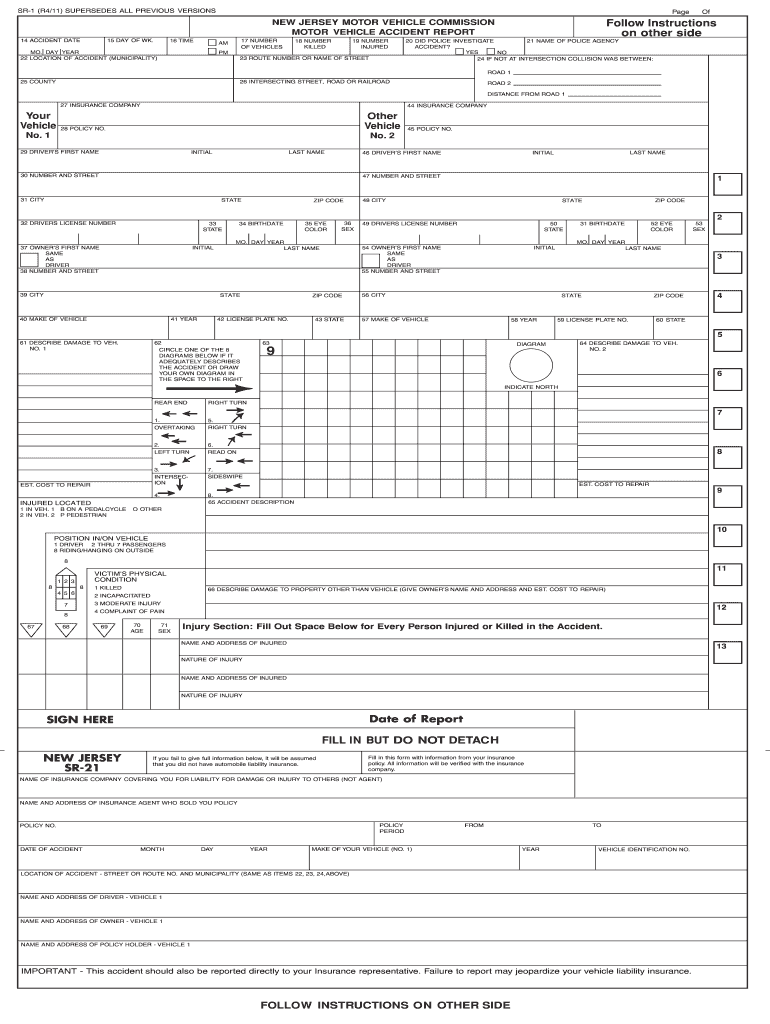
DENT (MUNICIPALITY) 18 NUMBER KILLED 19 NUMBER INJURED PM 23 ROUTE NUMBER OR NAME OF STREET Of Follow Instructions on other side NEW JERSEY MOTOR VEHICLE COMMISSION MOTOR VEHICLE ACCIDENT REPORT 20 DID POLICE INVESTIGATE 21 NAME OF POLICE AGENCY ACCIDENT? YES NO 24 IF NOT AT INTERSECTION COLLISION WAS BETWEEN: ROAD 1 25 COUNTY 26 INTERSECTING STREET, ROAD OR RAILROAD ROAD 2 DISTANCE FROM ROAD 1 27 INSURANCE COMPANY Your Vehicle 44 INSURANCE COMPANY Other Vehicle 28 POLICY NO. No.
Loading

Open form follow the instructions

Easily sign the form with your finger

Send filled & signed form or save
How to fill out the NJ SR-1 online
Filling out the NJ SR-1 form online is essential for reporting motor vehicle accidents in New Jersey. This guide provides comprehensive and user-friendly instructions to help you complete the form accurately and efficiently.
Follow the steps to successfully complete the NJ SR-1 online
- Click ‘Get Form’ button to obtain the NJ SR-1 form and open it in the online editor.
- Enter the accident date in the format of month, day, and year. Be sure to include the day of the week as well.
- Indicate the time of the accident by selecting either AM or PM and providing the exact hour and minutes.
- State the number of vehicles involved in the accident by entering the appropriate number in the designated field.
- Fill in the number of people killed and injured as a result of the accident. Use numeric values for accuracy.
- Provide the location of the accident by entering the municipality, route number, and name of the street where the incident occurred.
- Indicate whether the police investigated the accident by checking 'Yes' or 'No' and provide the name of the police agency if applicable.
- If the accident was not at an intersection, specify the two roads involved in the collision, including the distance from the first road.
- Fill in your insurance company details, including the policy number, and any other vehicle insurance information as required.
- Complete the driver’s information, including first name, initial, last name, address, date of birth, and license number.
- For each vehicle involved, enter the make, year, and license plate number.
- Describe the damage to each vehicle in detail and indicate the estimated cost for repairs.
- Complete the injury section with relevant details of all persons injured or killed in the accident, including their names and addresses.
- Once all sections are filled, review the information for accuracy, and save your changes.
- Download or print the completed form for your records, and share it with appropriate parties as necessary.
Complete your NJ SR-1 form online today to ensure timely reporting of your accident.
Experience a faster way to fill out and sign forms on the web. Access the most extensive library of templates available.
Related content
Sep 15, 2021 — The New Jersey Self-Reporting Crash form (SR-1) is used to report a crash...
NJ MVC Form SR-1 - Motor Vehicle Accident Report | NJ MVC Form Sample H-1B 240 Day...
O INTERIOR DESTE APARELHO NÃO CONTÉM QUALQUER. ITEM QUE DEVA SER AJUSTADO PELO USUÁRIO...
Get answers to your most pressing questions about US Legal Forms API.
Should I report an accident that wasn't my fault to my insurance?
Yes, you should report an accident to your insurance, even if it wasn’t your fault. Doing so provides your insurer with necessary information and may help protect your interests in future claims or disputes. For New Jersey residents, understanding the NJ SR-1 process can help you navigate insurance discussions more efficiently, facilitating the claims process.
What is the purpose of SR-1?
The primary purpose of the SR-1 is to serve as an official record of an accident for state authorities. It captures essential information that aids in investigations and clarifies liability for all parties involved. Understanding this purpose not only helps you navigate post-accident processes but also aligns with similar procedures like the NJ SR-1 in New Jersey.
Can you report an accident with just a license plate?
You cannot rely solely on a license plate to report an accident. While it may provide some information, an accident report requires detailed accounts of the event, including driver contact information and circumstances of the incident. Using a formal process such as the NJ SR-1 ensures that all pertinent details are documented effectively.
Who needs to fill out an SR-1 form?
Any driver involved in an accident that results in injury, death, or property damage typically needs to fill out an SR-1 form. This requirement applies regardless of fault, as having a record benefits everyone involved. By completing the SR-1 form, you ensure compliance with your state laws, resembling the process for NJ SR-1 in New Jersey.
What is the purpose of an SR-1 form?
The SR-1 form serves to document the details of a car accident for state reporting purposes. It helps establish the facts surrounding the incident, which can be vital for insurance claims and legal processes. Understanding the function of the SR-1, whether in California or NJ SR-1, can lead to smoother claims and clearer resolutions after an accident.
Who fills out the SR-1 form in California?
In California, the driver involved in the accident typically fills out the SR-1 form. This form is necessary to report the details of the accident to the Department of Motor Vehicles. It's important to provide complete and accurate information as it relates closely to your responsibility and the resolution of the incident, much like the requirements for the NJ SR-1 in New Jersey.
When or why must an accident be officially reported?
An accident must be officially reported to ensure accurate records, especially when there are injuries or significant property damage. Reporting provides a clear account for insurance purposes, and it helps to establish liability. By documenting the event officially, you protect yourself and comply with legal requirements in your state, especially concerning the NJ SR-1 documentation.
Who needs to file SR-1?
Anyone involved in a car accident in New Jersey that results in injury, death, or property damage must file the NJ SR-1 form. It applies to drivers, passengers, and even pedestrians depending on the circumstances of the accident. Completing this form is crucial for documenting the events accurately and protecting your rights. If you're uncertain about your need to file, it's always wise to consider seeking guidance.
Can I submit SR-1 form online?
Yes, you can submit the NJ SR-1 form online, which simplifies the reporting process. The New Jersey Division of Motor Vehicles provides an online portal where you can easily fill out and submit this form. By using this digital option, you save time and can expedite the processing of your accident report. It is a convenient way to fulfill your legal obligations without the hassle of visiting an office.
Do you have to report a car accident to your insurance company in NJ?
Yes, you must report a car accident to your insurance company in New Jersey. This requirement applies regardless of whether the accident was your fault. Reporting helps your insurer assist you with processing claims and provides insights into handling the aftermath of the accident. It is an essential step in securing any benefits or coverage you may be entitled to following an incident.
Use professional pre-built templates to fill in and sign documents online faster. Get access to thousands of forms.
If you believe that this page should be taken down, please follow our DMCA take down process here.