Loading
Get 5.3.7.2 Lab - Working With Cli Commands In Windows - Learn Acadnet
How it works
-

Open form follow the instructions
-

Easily sign the form with your finger
-

Send filled & signed form or save
How to fill out the 5.3.7.2 Lab - Working With CLI Commands In Windows - Learn Acadnet online
This guide provides step-by-step instructions for completing the 5.3.7.2 Lab - Working With CLI Commands in Windows. It aims to assist users in effectively managing folders, files, and programs using Windows Command Line Interface (CLI) commands.
Follow the steps to complete the lab exercise.
- Press the 'Get Form' button to access the form and open it for editing.
- Log onto the computer as an administrator. If you are using a different user account, substitute 'Administrator' with your account name when entering commands.
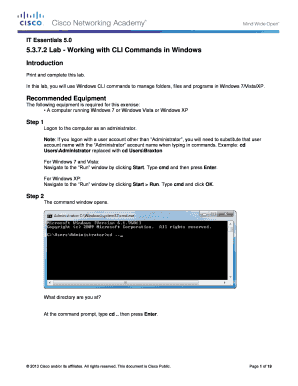
- Open the command window by navigating to 'Run'. For Windows 7 and Vista, click Start, type 'cmd', and hit Enter. For Windows XP, click Start > Run, type 'cmd', and click OK.
- At the command prompt, type 'cd ..' and press Enter to navigate directories. Repeat this to understand the current directory.
- Type 'help' at the command prompt to display a list of available commands.
- Begin navigating through folders using commands such as 'cd users', 'cd your_account_name', and 'cd desktop'. Make sure to substitute 'your_account_name' with the actual name of the user currently logged in.
- Create new folders on the Desktop by using the command 'md folder_name' replacing 'folder_name' with your desired folder name (e.g., ITEfolder1, ITEfolder2).
- Utilize 'edit' to create a file, and use the Alt key shortcuts as instructed to save your file into the created folders.
- Navigate through folders and lists of files using commands like 'dir' to manage files effectively.
- Manipulate files using commands such as 'copy', 'del', and 'xcopy' according to your curating needs.
- Define file attributes by using the 'attrib' command followed by the 'del' command to remove any files if needed.
- Remove directories using 'rd' followed by the directory name. Use the '/s' option to remove directories containing files.
- Start programs using the command 'start program_name' to further explore command line capabilities.
- Finally, save your work and consider options for downloading, printing, or sharing your completed lab results.
Complete your lab exercises online to enhance your learning experience.
Executing CLI Commands On a map, select Execute CLI Commands from the right-click menu, or select Actions > Execute CLI Commands from the map toolbar. Select the target devices. By default, this action applies to the existing devices on the map. ... Enter the CLI command. ... Click Run.