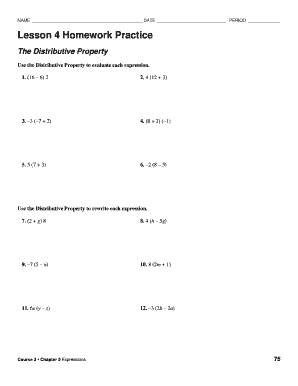
NAME DATE PERIOD Lesson 4 Homework Practice The Distributive Property Use the Distributive Property to evaluate each expression. 1. (16 6) 2 2. 4 (12 + 3) 3. 3 (7 + 2) 4. (8 + 3) (1) 5. 5 (7 + 3).
Open form follow the instructions
Easily sign the form with your finger
Send filled & signed form or save
How to fill out the Lesson 4 Homework Practice The Distributive Property online
This guide provides a detailed overview of how to successfully fill out the Lesson 4 Homework Practice on the Distributive Property. Follow the instructions step-by-step to ensure a smooth online experience.
Follow the steps to complete your homework practice form.
- Click ‘Get Form’ button to obtain the form and open it in your browser.
- Begin by entering your name in the designated field at the top of the form. Ensure that you use clear and legible handwriting if filling out by hand or type your name correctly in the online format.
- Next, input the date in the space provided, using the format MM/DD/YYYY. This will help keep your work organized.
- In the 'Period' field, indicate your class period, if applicable. This information allows instructors to categorize submissions effectively.
- Start answering the problems outlined in the form. For each question, use the Distributive Property accurately to evaluate expressions, making sure to show your work clearly.
- For questions that require rewriting expressions using the Distributive Property, ensure that you break down the elements of each term as demonstrated in your lessons.
- Towards the end of the form, you will encounter word problems involving calculations. Read these carefully and use the Distributive Property to justify your solutions.
- Once you have completed all sections of the form, review your answers for accuracy.
- Finally, save your changes and prepare to download, print, or share the completed form as required by your instructor.
Complete your Lesson 4 Homework Practice online to enhance your understanding of the Distributive Property.
Experience a faster way to fill out and sign forms on the web. Access the most extensive library of templates available.
Related content
Algebra 1 Chapter 4 practice test by Rachelle Wheelock 1 year ago 37 minutes 101 ... You...
So, 4 x 9 = 36. Practice. Decompose one factor. Color the array two colors to ... Lesson...
4. DIMENSIONS Marco is drawing a rectangle with a length of 12 inches and width of 10...
Get answers to your most pressing questions about US Legal Forms API.
What do you mean by distributive property?
The distributive Property States that when a factor is multiplied by the sum/addition of two terms, it is essential to multiply each of the two numbers by the factor, and finally perform the addition operation. This property can be stated symbolically as: A ( B+ C) = AB + AC.
What property multiplies the value outside the brackets?
The distributive property multiplies the value outside the brackets with each of the terms in the brackets.
What is an example of a commutative property?
Commutative property is applicable only for addition and multiplication processes. Thus, it means we can change the position or swap the numbers when adding or multiplying any two numbers. This is one of the major properties of integers. For example: 1+2 = 2+1 and 2 x 3 = 3 x 2.
What is meant by associative property?
What Is Associative Property in Math? Associative property is defined as, when more than two numbers are added or multiplied, the result remains the same, irrespective of how they are grouped. For instance, 2 × (7 × 6) = (2 × 7) × 6.
How to use distributive property to write an equivalent expression?
1:44 4:48 Write equivalent expressions using the Distributive Property ... - YouTube YouTube Start of suggested clip End of suggested clip 2 plus 4. I'm going to enclose that in parentheses. And i'm going to multiply. 3 by the whole amountMore2 plus 4. I'm going to enclose that in parentheses. And i'm going to multiply. 3 by the whole amount now in the distributive. Property. We're going to take the 3 and multiply it by 2.
What property means the numbers can be swapped?
The commutative property states that the numbers on which we operate can be moved or swapped from their position without making any difference to the answer.
What is closure property in maths?
The closure property states that when a set of numbers is closed under an arithmetic operation, performing the operation on any two numbers in the set always results in a number belonging to the same set of numbers.
Use professional pre-built templates to fill in and sign documents online faster. Get access to thousands of forms.
If you believe that this page should be taken down, please follow our DMCA take down process here.