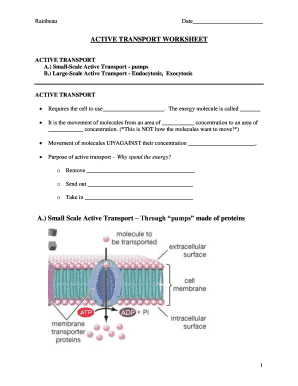
Rainbeau Date ACTIVE TRANSPORT WORKSHEET ACTIVE TRANSPORT A.) SmallScale Active Transport pumps B.) LargeScale Active Transport Endocytosis, Exocytosis ACTIVE TRANSPORT Requires the cell to use .
Open form follow the instructions
Easily sign the form with your finger
Send filled & signed form or save
How to fill out the Active Transport Worksheet online
Filling out the Active Transport Worksheet online can be straightforward if you follow the steps outlined in this guide. This comprehensive approach is designed to help users of all experience levels complete the form efficiently and accurately.
Follow the steps to complete the Active Transport Worksheet seamlessly.
- Click the ‘Get Form’ button to obtain the worksheet and open it in the editable format.
- Begin with the section labeled 'Active Transport.' Here, you will need to fill in the blanks regarding the energy required for active transport. Specify the energy molecule used in this process.
- In the next set of fields, indicate the concentration levels by describing the movement of molecules from an area of higher concentration to one of lower concentration. Make sure to note that this movement is against their natural inclination.
- For additional clarity, explain the purpose of active transport. List the reasons for utilizing energy in this process, including roles such as removing substances, sending out materials, and taking in necessary molecules.
- Next, address the section on Small-Scale Active Transport. Fill in the details about how 'pumps' made of proteins facilitate this process.
- Move to the Large-Scale Active Transport section. Here, specify the bulk movement of molecules entering the cell through endocytosis and exiting through exocytosis.
- Once you have completed filling out all sections, review your responses for accuracy and clarity. You can then save changes, download the completed worksheet, print it for your records, or share it as needed.
Start filling out your Active Transport Worksheet online today for a smoother experience.
Experience a faster way to fill out and sign forms on the web. Access the most extensive library of templates available.
Related content
Read PDF Diffusion Osmosis. And Active Transport. Worksheet Answers proper as with ease as...
Active Learning. Prior to class, students read sections in their textbook covering...
In 1949, a German scientist, Max Kramer proposed the two mechanisms of the water...
Get answers to your most pressing questions about US Legal Forms API.
What are 3 examples of active transport in plants?
Active transport examples in plants can be seen in the following cases: Ions move from the soil to the roots of plants. Chloride and nitrate are transported from the cytosol to the vacuole. Photosynthesis sugars move from leaves to the fruit. Calcium moves between cells with the help of ATP energy.
What are the 4 steps of active transport?
Active Transport A specific solute will bind to the protein pump on one side of the membrane. The hydrolysis of ATP (to ADP + Pi) causes a conformational change in the protein pump. The solute molecule is consequently translocated across the membrane (against the gradient) and released.
What is active transport worksheet the difference between active and passive transport?
Active transport moves molecules and ions from lower concentration to higher concentration with the help of energy in the form of ATP. On the other hand, passive transport moves molecules and ions from a higher concentration to lower concentration without any energy.
What is active transport and list two examples?
Active transport is usually associated with accumulating high concentrations of molecules that the cell needs, such as ions, glucose and amino acids. Examples of active transport include the uptake of glucose in the intestines in humans and the uptake of mineral ions into root hair cells of plants.
Which is the best example of active transport?
One of the greatest instances of active transport is the transfer of calcium ions out of heart muscle cells. Cells secrete proteins such as enzymes, antibodies, and a variety of other peptide hormones.
What are 5 examples of active transport?
Examples of Active Transport in Animals and Humans Sodium-potassium pump (exchange of sodium and potassium ions across cell walls) Amino acids moving along the human intestinal tract. Calcium ions moving from cardiac muscle cells. Glucose moving in or out of a cell. A macrophage ingesting a bacterial cell. Enzyme secretion.
What are the 3 types of active transport?
There are three main active transport methods - ion pumps, exocytosis and endocytosis.
What is 1 example of active transport?
Some examples of active transport include the uptake of glucose in the intestine of the human body and the uptake of minerals or ions into the root hair cells of plants.
Use professional pre-built templates to fill in and sign documents online faster. Get access to thousands of forms.
If you believe that this page should be taken down, please follow our DMCA take down process here.