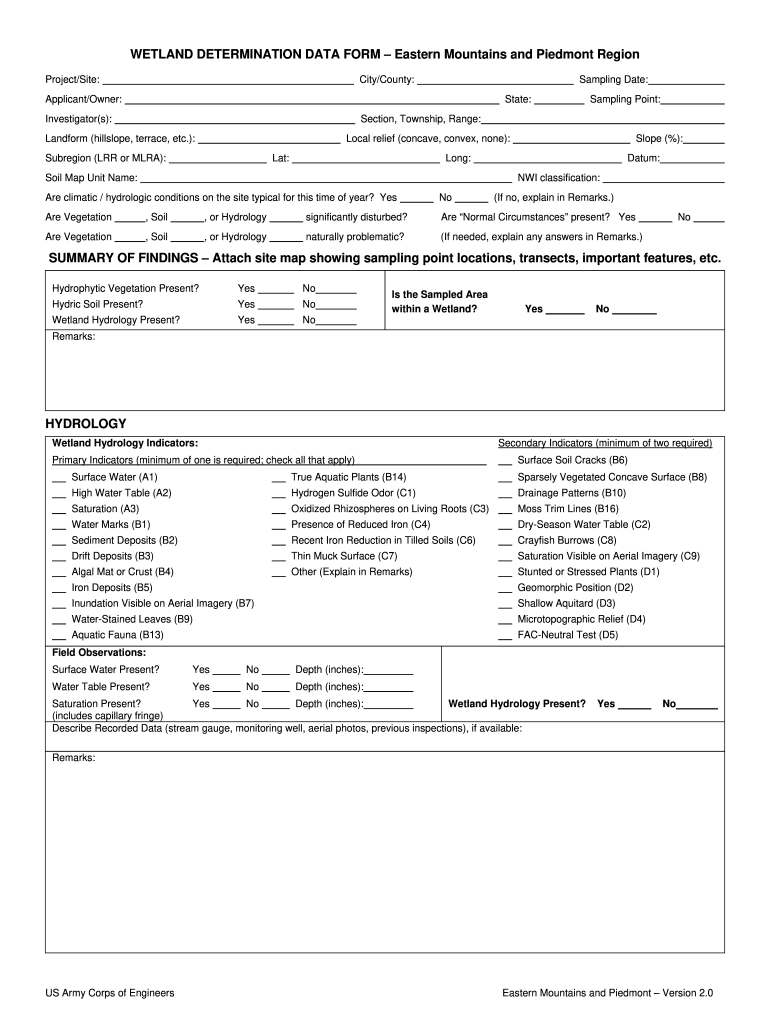
): Landform (hillslope, terrace, etc.): Local relief (concave, convex, none): Subregion (LRR or MLRA): Lat: Slope (%): Long: Datum: NWI classification: Soil Map Unit Name: Are climatic / hydrologic conditions on the site typical for this time of year? Yes No Are Vegetation , Soil , or Hydrology significantly disturbed? Are “Normal Circumstances” present? Yes Are Vegetation , Soil , or Hydrology naturally problematic? (If needed, explain any answers in Remarks.) (If no, exp.
Loading

Open form follow the instructions

Easily sign the form with your finger

Send filled & signed form or save
How to fill out the Wetland Determination Data Form - Eastern Mountains and Piedmont online
Completing the Wetland Determination Data Form for the Eastern Mountains and Piedmont region is a crucial step in assessing wetland areas. This guide provides clear and detailed instructions for users at all levels of experience on how to efficiently fill out the form online.
Follow the steps to complete the form accurately.
- Click ‘Get Form’ button to obtain the form and open it in the editor.
- Begin by entering the project or site name in the designated field. This identifies the location under review.
- Next, input the city or county where the site is located to provide geographical clarity.
- Fill in the date of sampling, noting when the assessment took place for accurate record-keeping.
- Complete the applicant or owner's name. This identifies who is seeking the wetland determination.
- Specify the state where the site is located to align with jurisdictional requirements.
- Record the sampling point details, ensuring precision in the identification of the assessment location.
- Fill in the section, township, and range as required, as these are important for mapping and documentation.
- List the investigator(s) responsible for the assessment. This establishes accountability.
- Describe the landform characteristics such as hillslope or terrace to help contextualize the assessment.
- Indicate the local relief, choosing from options like concave or convex, which affects hydrology.
- Select the appropriate subregion (LRR or MLRA) that categorizes the ecological characteristics of the area.
- Enter the latitude and longitude of the sampling point to ensure exact location mapping.
- Record the slope percentage of the site, providing an understanding of the terrain's characteristics.
- Choose the datum reference for your geographical data to maintain consistent measurements.
- Identify the NWI classification to classify the wetland type under the National Wetlands Inventory.
- Assess the climatic and hydrologic conditions on the site and mark yes or no in the designated fields.
- Evaluate if there are signs of significant disturbance in vegetation, soil, or hydrology, answering as appropriate.
- Indicate whether 'Normal Circumstances' are present, which reflects standard conditions for wetland determinations.
- Provide remarks in areas indicated, detailing any explanations for your selections.
- Attach a site map showing sampling point locations, transects, and important features for further clarity.
- At the hydrology section, detail the presence of hydrophytic vegetation, hydric soil, and wetland hydrology by marking yes or no.
- In the hydrology indicators section, check applicable primary and secondary indicators, ensuring a comprehensive assessment.
- Fill in the vegetation details across the four strata, using scientific names and providing the relevant percentage cover.
- Document soil profiles and indicators, noting essential details about hydric soil characteristics.
- Final remarks can be added, including any findings and photograph references.
- Review all entries for accuracy and completeness.
- Once the form is fully completed, save changes, download, print, or share the form as needed.
Start completing your Wetland Determination Data Form online today!
Experience a faster way to fill out and sign forms on the web. Access the most extensive library of templates available.
Related content
Eastern Mountains and Piedmont – Version 2.0. WETLAND DETERMINATION DATA FORM –...
Eastern Mountains and Piedmont – Interim Version. WETLAND DETERMINATION DATA FORM –...
May 16, 2007 — The Eastern Highlands region presents the most concerns, with only 18% of...
Get answers to your most pressing questions about US Legal Forms API.
Can you build on wetland delineation?
Building on areas determined as wetlands is often restricted due to environmental regulations aimed at preserving these ecosystems. However, there are specific permits and processes to consider if development is necessary. The Wetland Determination Data Form - Eastern Mountains and Piedmont helps clarify these requirements and guides you through the necessary steps.
How do you do a wetland delineation?
To perform a wetland delineation, you need to assess the site for hydrology, soil composition, and vegetation. This assessment typically involves fieldwork and documentation of your findings. Utilizing tools like the Wetland Determination Data Form - Eastern Mountains and Piedmont can streamline your delineation efforts and ensure accuracy.
What is the difference between wetland determination and delineation?
Wetland determination focuses on identifying whether an area qualifies as a wetland, while delineation involves mapping its specific boundaries. Understanding this distinction is crucial for effective land management practices. The Wetland Determination Data Form - Eastern Mountains and Piedmont simplifies both processes in a structured manner.
What is the meaning of land delineation?
Land delineation refers to the process of marking the boundaries of different land types, including wetlands. This process is essential for land use planning and ensuring proper management of ecological resources. Completing a Wetland Determination Data Form - Eastern Mountains and Piedmont provides clear documentation of these boundaries.
How are wetlands determined?
Wetlands are determined through field assessments that evaluate soil conditions, vegetation, and water presence. Experts conduct these assessments following established guidelines and the legal framework. The insights gained from the Wetland Determination Data Form - Eastern Mountains and Piedmont support environmental stewardship and regulatory compliance.
What are three criteria for determining or delineating a wetland?
The three primary criteria for determining wetlands include the presence of hydrophytic vegetation, hydric soils, and wetland hydrology. These criteria help assess whether the land functions as a wetland ecosystem. By utilizing the Wetland Determination Data Form - Eastern Mountains and Piedmont, you can efficiently document these characteristics.
What does a wetland determination mean?
A wetland determination identifies areas that meet the criteria for being classified as wetlands. This process is crucial for land management and environmental protection. The Wetland Determination Data Form - Eastern Mountains and Piedmont documents essential findings to aid in compliance with federal and state regulations.
What are the three criteria that are necessary for an area to be classified as wetland?
An area must meet three key criteria to be classified as a wetland: the presence of water, specific types of soil, and distinctive plant life. These factors work together to create a unique ecosystem that supports various wildlife. Correctly identifying these criteria with tools like the Wetland Determination Data Form - Eastern Mountains and Piedmont enhances the assessment process significantly.
What are the three things that make a wetland?
The three fundamental elements that define a wetland are water, soil, and vegetation. Water can either be surface water or groundwater, and it fosters the growth of specialized plants. Soil in wetlands often has unique properties due to prolonged saturation, creating a specific ecosystem that is vital for biodiversity.
What are the three criteria to be considered a wetland?
For an area to qualify as a wetland, it must possess three primary criteria: it must have inundated or saturated soils, appropriate vegetation adapted to wet conditions, and a persistent water source. If all these criteria are met, the area can be classified as a wetland, which is essential for environmental management. Utilizing the Wetland Determination Data Form - Eastern Mountains and Piedmont aids in assessing these criteria comprehensively.
Use professional pre-built templates to fill in and sign documents online faster. Get access to thousands of forms.
If you believe that this page should be taken down, please follow our DMCA take down process here.