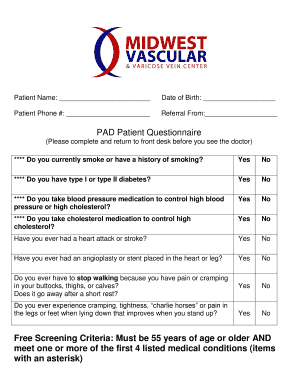
PAD Patient Questionnaire (Please complete and return to front desk before you see the doctor) **** Do you currently smoke or have a history of smoking? Yes No.

How it works
  • Open form

    Open form follow the instructions

  • Easily sign form

    Easily sign the form with your finger

  • Share form

    Send filled & signed form or save

How to fill out the Peripheral Arterial Disease Free Screening Form - Midwestvascular online

Filling out the Peripheral Arterial Disease Free Screening Form is a crucial step in assessing your vascular health. This guide provides clear instructions to ensure you can confidently complete the form online with ease.

Follow the steps to complete your screening form online.

  1. Press the ‘Get Form’ button to access the Peripheral Arterial Disease Free Screening Form and open it in your preferred document editor.
  2. Begin by entering your patient information at the top of the form. You will need to fill in your name, date of birth, and phone number accurately.
  3. In the Referral From section, provide the name of the individual or facility that referred you for this screening.
  4. Proceed to the PAD Patient Questionnaire section. For each question, select 'Yes' or 'No' based on your current health status. Ensure that you answer all questions truthfully to receive an accurate assessment.
  5. Address any medical history items, including smoking habits, diabetes status, and use of medications for blood pressure and cholesterol. This information is crucial for your healthcare provider to understand your risks.
  6. Continue answering questions regarding your cardiovascular history, including past heart attacks, strokes, and any procedures like angioplasty or stent placements.
  7. Finally, respond to questions about any symptoms such as pain or cramping in your legs or feet which could indicate peripheral arterial disease.
  8. After completing the questionnaire, review all the information for accuracy. Make any necessary adjustments.
  9. Save your changes to the document, and if needed, download, print, or share the form as per your requirements.

Complete your Peripheral Arterial Disease Free Screening Form online today to take proactive steps towards your health.

Get form

Experience a faster way to fill out and sign forms on the web. Access the most extensive library of templates available.

Related content

Carotid Endarterectomy National Trends Over A...

Dec 7, 2013 — Published in final edited form as: ... 9.2% had symptomatic carotid...

Learn more
Yung-Wei Chi, DO - UC Davis Health

Jan 7, 2019 — cellular based/angiogenesis therapy for peripheral arterial disease, and...

Learn more
Questions & Answers

Get answers to your most pressing questions about US Legal Forms API.

Contact support

What is a peripheral vascular screening?

A Peripheral Vascular Screening can help determine your risk for cardiovascular heart disease by assessing your risk for peripheral vascular disease (PVD). This screening is painless, non-invasive and takes about 30-minutes.

The resting ankle-brachial index (ABI) is the most commonly used screening and diagnostic test for PAD. It is defined as the ratio of systolic blood pressure at the ankle to the systolic blood pressure at the brachial artery.

The Venous Doppler ultrasound takes about 20 minutes for each arm or leg. The Arterial Doppler ultrasound is painless. During a Venous Doppler ultrasound, the technician will compress the veins in your arms or legs to check for blood clots.

If left untreated, PAD can result in the need for a major amputation of the foot or leg. This is most concerning because the life expectancy for 60% of PAD amputee patients is only 2 to 5 years.

This exam uses sound waves to create pictures of the arteries and locate blockages. Doppler ultrasound: Doppler ultrasound is a special ultrasound technique that can help detect areas of restricted blood flow through an artery.

A Peripheral Vascular Screening can help determine your risk for cardiovascular heart disease by assessing your risk for peripheral vascular disease (PVD). This screening is painless, non-invasive and takes about 30-minutes.

A water-soluble gel is placed on a handheld device called a transducer. This device directs high-frequency sound waves to the artery or veins being tested. Blood pressure cuffs may be put around different parts of the body, including the thigh, calf, ankle, and different points along the arm.

This test uses ultrasound to look at the blood flow in the large arteries and veins in the arms or legs. Doppler ultrasonography examines the blood flow in the major arteries and veins in the arms and legs with the use of ultrasound (high-frequency sound waves that echo off the body).

Get This Form Now!

Use professional pre-built templates to fill in and sign documents online faster. Get access to thousands of forms.

If you believe that this page should be taken down, please follow our DMCA take down process here.

Get Peripheral Arterial Disease Free Screening Form - Midwestvascular