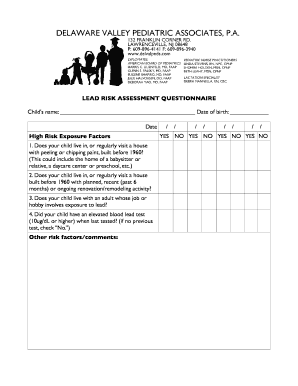
LEAD RISK ASSESSMENT QUESTIONNAIRE Child 's name: Date of birth: Date High Risk Exposure Factors 1. Does your child live in, or regularly visit a house with peeling or chipping paint, built before.

How it works
  • Open form

    Open form follow the instructions

  • Easily sign form

    Easily sign the form with your finger

  • Share form

    Send filled & signed form or save

How to fill out the LEAD RISK ASSESSMENT QUESTIONNAIRE Child's Name: Date Of ... online

Filling out the Lead Risk Assessment Questionnaire is an important step in assessing potential lead exposure for your child. This guide provides clear and detailed instructions on how to complete the questionnaire effectively online.

Follow the steps to complete your Lead Risk Assessment Questionnaire.

  1. To start, click the ‘Get Form’ button to obtain the form and open it in your editing platform.
  2. Begin filling out the child's name and date of birth in the designated fields. Ensure accuracy for effective assessment.
  3. Proceed to the high-risk exposure factors section. For each question listed, mark 'Yes' or 'No' based on your knowledge of your child's living environment and exposure history.
  4. For question one, consider whether your child lives in or frequently visits any houses with peeling or chipping paint that were built before 1960. If yes, check the 'Yes' box.
  5. For question two, determine if your child is in a location built before 1960 that has recent or ongoing renovation activities. Again, answer accordingly with 'Yes' or 'No.'
  6. Question three addresses whether your child lives with an adult who may have exposure to lead due to their occupation or hobbies. Mark appropriately.
  7. In question four, report any elevated blood lead test results. If your child has not been tested previously, select 'No.'
  8. If applicable, provide any other risk factors or comments in the designated space at the bottom of the form.
  9. Once all sections have been filled out, review the information for accuracy. Make any necessary changes.
  10. Finally, you can save your changes, download, print, or share the completed form as needed.

Complete your Lead Risk Assessment Questionnaire online today to ensure the health and safety of your child.

Get form

Experience a faster way to fill out and sign forms on the web. Access the most extensive library of templates available.

Related content

redacted indiana state dept of health - lead risk...

Aug 16, 2016 — indicates if a hazard has been identified by the risk assessor. ... Date:...

Learn more
James J Quackenboss | United States Environmental...

Relationship of Biomarkers of Exposure to Risk Assessment and Risk ... Publication Date:...

Learn more
Risk assessment - Wikipedia

Broadly speaking, a risk assessment is the combined effort of: identifying and analyzing...

Learn more
Questions & Answers

Get answers to your most pressing questions about US Legal Forms API.

Contact support

What are the guidelines for lead screening?

CDC uses a blood lead reference value of 3.5 micrograms per deciliter (µg/dL) to identify children with blood lead levels that are higher than most children's levels.

Children enrolled in Medicaid are required to get tested for lead at ages 12 and 24 months, or age 24–72 months if they have no record of ever being tested. For children not enrolled in Medicaid, CDC recommends focusing testing efforts on high-risk neighborhoods and children.

Exposure to lead can seriously harm a child's health, including damage to the brain and nervous system, slowed growth and development, learning and behavior problems, and hearing and speech problems.

Two types of blood tests may be used. A finger-prick or heel-prick (capillary) test is usually the first step to determine if a child has lead in their blood. While finger-prick tests can provide fast results, they also can produce higher results if lead on the skin is captured in the sample.

The average lead test result for young children is about 1.4 micrograms per deciliter (µg/dL). 5-14 • Your child's lead level is high. A result of 5 µg/dL or higher requires action. Your doctor or nurse will talk with you about your child's diet, growth and development, and possible sources of lead.

In October 2021, CDC lowered the blood lead reference value (BLRV) to 3.5 micrograms per deciliter (µg/dL) to identify children with higher levels of lead in their blood compared to most children. Capillary screening results at or above 3.5 μg/dL should be confirmed with blood drawn by venipuncture.

Lead screening measures the level of lead in the blood through a blood test in the finger or vein. It is important. Lead is a toxin that is particularly dangerous for young children because of their small size and rapid growth and development.

Get This Form Now!

Use professional pre-built templates to fill in and sign documents online faster. Get access to thousands of forms.

If you believe that this page should be taken down, please follow our DMCA take down process here.

Get LEAD RISK ASSESSMENT QUESTIONNAIRE Child's Name: Date Of ...