Loading
Get Chapter 10 Student-built Glossary Volume And Surface Area
How it works
-

Open form follow the instructions
-

Easily sign the form with your finger
-

Send filled & signed form or save
How to fill out the Chapter 10 Student-Built Glossary Volume And Surface Area online
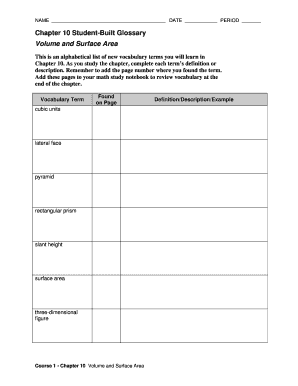
Completing the Chapter 10 Student-Built Glossary Volume And Surface Area online is an essential task for enhancing your understanding of new vocabulary terms. This guide will provide comprehensive, step-by-step instructions to ensure you accurately fill out the form and successfully document each term.
Follow the steps to complete your glossary effectively.
- Click the ‘Get Form’ button to access the form and open it in the online editor.
- Begin by entering your name in the designated field at the top of the form. This identifies who has completed the glossary.
- Next, input the date in the provided space. This helps keep track of when the glossary was completed.
- Fill in your period number in the respective area. This ensures that your glossary is organized by class periods.
- As you study Chapter 10, start filling in each vocabulary term in the 'Vocabulary Term' field. Make sure to include all relevant terms listed, such as 'cubic units' and 'pyramid'.
- For each vocabulary term, add the corresponding page number where you found the term in the 'Found on Page' section. This will assist you in quickly referencing these terms later.
- In the 'Definition/Description/Example' area, provide a clear and concise explanation of each term. This should reflect your understanding and can include examples if necessary.
- After completing all the required fields, review your entries for accuracy and clarity. Ensure that each term is well defined and that page numbers are correctly noted.
- Once satisfied with your entries, save the form to preserve your work. You may also have the option to download or print your glossary for offline reference.
Complete your Chapter 10 Student-Built Glossary Volume And Surface Area online today to enhance your learning experience!
The surface area of a three-dimensional object is the total area of all its faces. In real-life we use the concept of surface areas of different objects when we want to wrap something, paint something, and eventually while building things to get the best possible design.