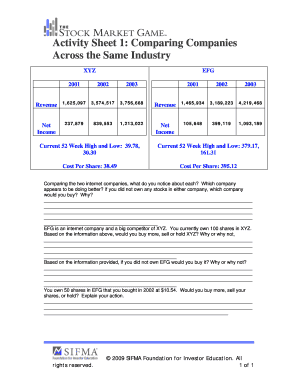
Activity Sheet 1: Comparing Companies Across the Same Industry XYZ 2001 EFG 2002 2003 Revenue 1,625,097 3,574,517 3,756,668 Net Income 237,879 839,553 1,213,022 2001 2002 2003 Revenue 1,465,934 3,189,223.

How it works
  • Open form

    Open form follow the instructions

  • Easily sign form

    Easily sign the form with your finger

  • Share form

    Send filled & signed form or save

How to use or fill out the Activity Sheet 1 Comparing Companies Across The Same Industry Answers online

The Activity Sheet 1 Comparing Companies Across The Same Industry Answers provides a structured format to analyze and compare two companies within the same industry. This guide offers step-by-step instructions for filling out the form online, ensuring that users can effectively complete their analyses with confidence.

Follow the steps to effectively fill out the activity sheet online.

  1. Click ‘Get Form’ button to obtain the form and open it in the editor.
  2. Begin by entering the revenue and net income figures for both companies from the provided data for the years 2001, 2002, and 2003. Make sure to input the values accurately in the designated fields.
  3. Next, enter the current 52-week high and low values for both companies, along with their cost per share, in the respective sections. These details are crucial for assessment.
  4. In the provided comment sections, analyze the performance of both companies based on the input data. Respond to the questions by comparing their financial metrics and share your insights on which company appears to be outperforming the other.
  5. Consider your own investment scenario based on your current holdings in XYZ and EFG. Record your thoughts on whether you would buy more shares, sell, or hold based on the financial data provided.
  6. Finally, after completing all sections, ensure that all your responses are clear and address the questions adequately. You can then save the changes, download the filled-out form, print it for your records, or share it if necessary.

Start comparing companies by filling out your Activity Sheet online today!

Get form

Experience a faster way to fill out and sign forms on the web. Access the most extensive library of templates available.

Related content

Answers - SEC.gov

Facts on Saving and Investing Campaign. 1. If you buy a company's stock,. A. you own a...

Learn more
Answers to Selected Problems

activities in which the banks can engage and calls for stricter rules for bank capital...

Learn more
Specification (technical standard) - Wikipedia

A specification often refers to a set of documented requirements to be satisfied by a...

Learn more
Questions & Answers

Get answers to your most pressing questions about US Legal Forms API.

Contact support

What is the difference between 1 stock and 1 share?

A stock is the actual asset in which you invest, while a share is the unit of measurement for that asset. So, a stock tells you what you are investing in, and a share tells you how much of that stock you own. For example, if you are interested in investing in a company called ABC, you will buy 100 shares of ABC stock.

The share market is a platform where buyers and sellers come together to trade on publicly listed shares during specific hours of the day. People often use the terms 'share market' and 'stock market' interchangeably.

Shares represent ownership of a company. When an individual buys shares in your company, they become one of its owners. Shareholders choose who runs a company and are involved in making key decisions, such as whether a business should be sold.

Stocks represent a share of ownership in a publicly held company. Private companies do not issue stock. As a stockholder, the investor has a claim on the assets of the company in exchange for money paid for the stock.

Class I shares might have lower overall fees than Class A, B or C shares, but they would be sold only to institutional investors making large fund share purchases. However, these shares may be available to retail investors through their employers (e.g., through a retirement plan).

Stocks represent ownership equity in the firm and give shareholders voting rights as well as a residual claim on corporate earnings in the form of capital gains and dividends. Individual and institutional investors come together on stock exchanges to buy and sell shares in a public venue.

Activity Sheet 1: What is a Stock? Stocks represent a share of ownership in a publicly held company. Private companies do not issue stock. As a stockholder, the investor has a claim on the assets of the company in exchange for money paid for the stock.

A share is the single smallest denomination of a company's stock. So if you're divvying up stock and referring to specific characteristics, the proper word to use is shares. Technically speaking, shares represent units of stock. Common and preferred refer to different classes of a company's stock.

Get This Form Now!

Use professional pre-built templates to fill in and sign documents online faster. Get access to thousands of forms.

If you believe that this page should be taken down, please follow our DMCA take down process here.

Get Activity Sheet 1 Comparing Companies Across The Same Industry Answers