Loading
Get Oral Risk Assessment
How it works
-

Open form follow the instructions
-

Easily sign the form with your finger
-

Send filled & signed form or save
How to use or fill out the Oral Risk Assessment online
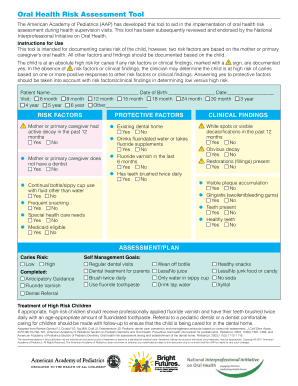
The Oral Risk Assessment tool is designed to evaluate the caries risk of children during health supervision visits. This professional guide will assist you in accurately completing the form online, ensuring all necessary details are documented efficiently and effectively.
Follow the steps to complete the Oral Risk Assessment online.
- Press the ‘Get Form’ button to access the Oral Risk Assessment document and open it in your preferred editor.
- Begin by entering the patient's information, including the child's name, date of birth, and the current date. Additionally, select the appropriate visit age option from the available choices.
- In the risk factors section, assess each characteristic. For example, does the mother or primary caregiver have active decay? Choose 'Yes' or 'No' for each question based on your observations.
- Proceed to the protective factors section. Evaluate all indicators such as whether the child drinks fluoridated water or has a dental home. Mark 'Yes' or 'No' accordingly.
- Next, move to the clinical findings section and answer the questions regarding white spots, obvious decay, or plaque accumulation as observed. Ensure to note down any findings accurately.
- After filling out all relevant sections, determine the caries risk level by selecting either 'Low' or 'High'. Document any completed anticipatory guidance or fluoride varnish applications as appropriate.
- Finally, review all entries for accuracy. Once confirmed, you can save the changes, download the completed form, print it for physical records, or share it as needed.
Complete the Oral Risk Assessment online today to ensure comprehensive oral health evaluation for children.
Risk assessment involves consideration for the preoperative, intraoperative, and postoperative periods and broadly includes the patient's susceptibility to infection, poor healing, bleeding, medication interactions, and physical and emotional ability to tolerate dental treatment.