Loading
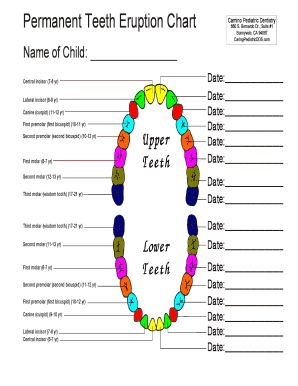
Get Permanent Teeth Eruption Chart - Camino Pediatric Dentistry
How it works
-

Open form follow the instructions
-

Easily sign the form with your finger
-

Send filled & signed form or save
How to fill out the Permanent Teeth Eruption Chart - Camino Pediatric Dentistry online
This guide provides comprehensive instructions for filling out the Permanent Teeth Eruption Chart offered by Camino Pediatric Dentistry. By following the steps outlined below, users can effectively record the eruption dates of their child's permanent teeth.
Follow the steps to complete the Permanent Teeth Eruption Chart online.
- Click ‘Get Form’ button to obtain the form and open it in the editor.
- Begin by entering the child's name in the designated field labeled 'Name of Child'. This should reflect the full name of the child whose teeth eruption is being tracked.
- Next, input the date in the 'Date' field. This date may represent the date on which you are completing the chart or any significant date relevant to tracking your child's dental health.
- For each type of tooth listed under 'Upper Teeth' and 'Lower Teeth', record the date of eruption in the corresponding 'Date' fields. The types of teeth are broken down as follows: Central incisor, Lateral incisor, Canine (cuspid), First premolar, Second premolar, First molar, Second molar, and Third molar (wisdom tooth). Be sure to note these dates accurately to ensure proper tracking.
- Confirm that all fields have been completed accurately. Review the chart for any omissions or errors that need correcting.
- Once you have filled out the form completely, you may save your changes. Options to download or print the completed chart will typically be available, allowing for easy sharing or archiving of the document.
Start filling out the Permanent Teeth Eruption Chart online today to keep track of your child's dental health!
The classic sequences: first molar-central incisor-lateral incisor-first premolar-canine-second premolar-second molar (M1-I1-I2-PM1-C-PM2-M2) in the upper arch and I1-M1-I2-C-PM1-PM2-M2 in the lower arch occurred in only 16% of upper arches and 13% of lower arches.