Loading
Get Respiratory System Scavenger Hunt
How it works
-

Open form follow the instructions
-

Easily sign the form with your finger
-

Send filled & signed form or save
How to fill out the Respiratory System Scavenger Hunt online
Filling out the Respiratory System Scavenger Hunt is an engaging way to learn about the functions and structures of the respiratory system. This guide will provide you with clear, step-by-step instructions to ensure you can easily complete the form online.
Follow the steps to successfully complete the scavenger hunt.
- Press the ‘Get Form’ button to access the scavenger hunt form and open it in your preferred online editor.
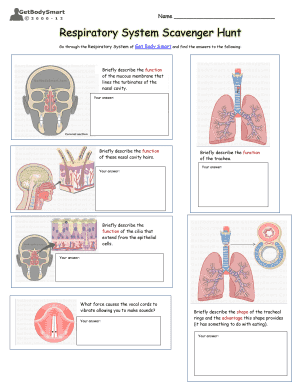
- Begin with the first section which asks you to describe the function of the mucous membrane that lines the turbinates of the nasal cavity. Type your answer in the provided text field.
- In the next field, provide a brief description of the function of the nasal cavity hairs. Ensure your answer is concise and relevant to respiratory system functions.
- Continue to the section that requests a description of the trachea's function. Focus on its role in the respiratory system.
- Next, describe the function of the cilia that extend from the epithelial cells. This function is crucial for understanding respiratory health.
- Answer the question regarding the force that causes the vocal cords to vibrate for sound production. Think about the mechanics of speech.
- Provide a brief description of the shape of the tracheal rings and the advantages it offers during eating, addressing the anatomical significance.
- Identify which lung contains less volume due to the space occupied by the heart. Input your findings in the corresponding field.
- Next, summarize why one lung is slightly shorter because of the liver's position. This anatomical detail is important for comprehension.
- Identify the structures that constitute most of the lung's volume in the specified field. Your input should reflect the main components.
- Answer the question about the approximate number of small air sacs present in each lung, aiming for accuracy.
- Describe the function of hemoglobin molecules found in red blood cells. This is pivotal to understanding gas transport within the body.
- Finally, elaborate on the function of a spirometer as requested in the last field. This relates to respiratory health assessment.
- Once you have filled out all sections, ensure you save your changes. You can download, print, or share the form based on your needs.
Complete the Respiratory System Scavenger Hunt online today to enhance your understanding of respiratory anatomy and functions!
The organs that are involved in breathing. These include the nose, throat, larynx, trachea, bronchi, and lungs. Also called respiratory tract.