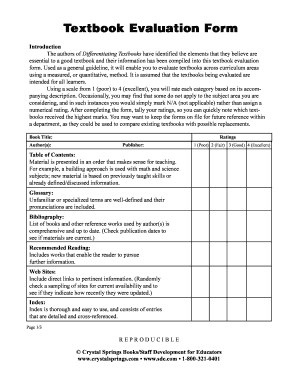
Ws: These communicate what is being discussed/developed in the paragraph or section/chapter; allow the reader to establish, identify, and absorb main ideas; and provide helpful information for beforereading activities. Section/Chapter Summaries: Key ideas and main points supporting the topic discussed in the section/chapter are clear and accurately restated. Extension Activities: Includes relevant activities offering sufficient practice so that the student can reinforce and retain what has been .
Loading
Open form follow the instructions
Easily sign the form with your finger
Send filled & signed form or save
How to fill out the Textbook Evaluation Form online
The Textbook Evaluation Form is a valuable tool for assessing textbooks across various curriculum areas. This guide provides clear and structured steps to help you complete this form accurately and effectively.
Follow the steps to successfully fill out the Textbook Evaluation Form.
- Click ‘Get Form’ button to obtain the form and open it in the available editor.
- Begin by entering the book title and the author(s) in the designated fields at the top of the form. This information is crucial for identifying the textbook you are evaluating.
- Fill out the publisher information in the appropriate section. This provides context for the textbook's origin and credibility.
- Rate each category using the provided scale from 1 (poor) to 4 (excellent). Assess the textbook’s materials, glossary, bibliography, and other criteria as listed. Make sure to refer to the accompanying descriptions to inform your ratings.
- If certain categories do not apply to the textbook you are evaluating, select N/A (not applicable) instead of assigning a numerical rating.
- Once you have completed all sections, tally your ratings to determine which textbooks have received the highest marks. This will assist in making informed comparisons.
- After finishing the evaluation, be sure to save changes. You can choose to download, print, or share the form as needed for future reference.
Start evaluating textbooks online to enhance the quality of educational resources.
Experience a faster way to fill out and sign forms on the web. Access the most extensive library of templates available.
Related content
Enter appropriate points for the final test average on the Textbook Course Evaluation...
Used as a general guideline, it will enable you to evaluate textbooks across curriculum...
Apr 1, 2009 — This book reviews quantitative methods and models of impact evaluation...
Get answers to your most pressing questions about US Legal Forms API.
What is an example of evaluation?
An example of evaluation is using a Textbook Evaluation Form to assess a new chemistry textbook. You might evaluate the clarity of explanations, the appropriateness of examples, and the overall presentation. By systematically reviewing these elements, you provide a clear assessment that can guide purchasing decisions for schools or personal use. This structured approach helps inform future educational materials.
How do you evaluate the content of a book?
Evaluating the content of a book through a Textbook Evaluation Form involves analyzing its themes, arguments, and clarity. Look for how well the textbook presents information, supports its claims, and engages the reader. Additionally, assess the accuracy of the content and how effectively it meets the learning objectives. This process is crucial in determining a book’s educational value.
How do you fill out an evaluation?
Filling out an evaluation requires you to reflect on the material's effectiveness and clarity. For a Textbook Evaluation Form, consider aspects like content depth and instructional clarity. Provide ratings and thoughtful comments to explain your scores, ensuring you share valuable input. Your insights can help inform others’ choices regarding educational resources.
How do I fill out an evaluation form?
To fill out a Textbook Evaluation Form, start by gathering relevant information about the textbook being evaluated. Carefully read each question, and respond based on your insights and experiences with the material. Ensure you provide specific examples to support your ratings. This helps create a thoughtful and comprehensive evaluation.
What are three examples of evaluation forms?
Three examples of evaluation forms include a Textbook Evaluation Form, a Course Evaluation Form, and a Student Performance Evaluation Form. Each serves a unique purpose in education, but they all share a common goal of providing constructive feedback. The Textbook Evaluation Form specifically allows you to assess the effectiveness and quality of a textbook, guiding future educational choices.
How to evaluate a textbook criteria?
To evaluate a textbook using a Textbook Evaluation Form, consider criteria such as content accuracy, pedagogical effectiveness, and engagement level. Assess whether the textbook aligns with your educational goals and supports the learner's journey. Additionally, evaluate the layout, visual appeal, and supplementary materials. This thorough analysis ensures you comprehensively understand the textbook's value.
How to fill evaluation form examples?
Filling out a Textbook Evaluation Form involves a few clear steps. Start by reviewing the textbook thoroughly, noting key sections and features. Next, use examples such as scoring its content relevance, organization, and user-friendliness to provide detailed feedback. This structured approach helps you convey your thoughts effectively.
How do you write an evaluation form?
Writing an evaluation form requires clarity and precision. Start with a brief introduction explaining the purpose of the form, followed by sections for various evaluation criteria. Use concise, straightforward language that encourages honest feedback, and consider including a Textbook Evaluation Form template from US Legal Forms for efficiency and effectiveness.
How do you create an evaluation form?
To create an effective evaluation form, start by defining your goals and the type of feedback you need. Outline the essential questions and criteria you wish to include, focusing on clarity and user-friendliness. Consider using a platform like US Legal Forms, where you can find templates for a Textbook Evaluation Form that allow easy customization.
How do I make my own evaluation form?
Creating your own Textbook Evaluation Form is quite straightforward. Start by identifying the key criteria you want to evaluate, such as clarity, relevance, and organization. Use a clear structure to list these criteria, then leave space for comments and ratings. You can leverage platforms like US Legal Forms to customize a template that fits your needs.
Use professional pre-built templates to fill in and sign documents online faster. Get access to thousands of forms.
If you believe that this page should be taken down, please follow our DMCA take down process here.