Loading
Get Hair Fiber Evidence Assignment
How it works
-

Open form follow the instructions
-

Easily sign the form with your finger
-

Send filled & signed form or save
How to fill out the Hair Fiber Evidence Assignment online
Completing the Hair Fiber Evidence Assignment online can be straightforward with the right guidance. This guide provides clear, step-by-step instructions to help users accurately fill out each section of the form.
Follow the steps to successfully complete your Hair Fiber Evidence Assignment
- Click the ‘Get Form’ button to access the Hair Fiber Evidence Assignment template, enabling you to fill it out in the designated online editor.
- Begin by entering your name in the designated field at the top of the form. Ensure that it is spelled correctly as it will be used for identification purposes.
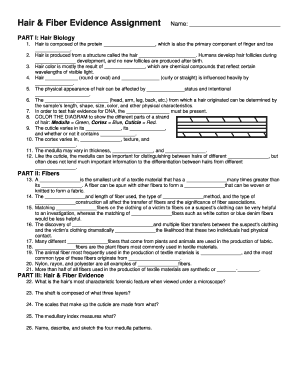
- Proceed to Part I: Hair Biology. Answer each question thoroughly, filling in the blanks with the correct scientific terms related to hair structure and biology.
- In Part I, questions may include topics such as hair composition, production, and characteristics. Be precise in your answers for accuracy in the assignment.
- Move on to Part II: Fibers. Address each prompt by supplying relevant definitions and descriptions regarding textile fibers and their properties.
- In Part II, questions will focus on the relationship between fibers and investigations. Make sure to articulate how fiber evidence can impact a case.
- Continue to Part III: Hair & Fiber Evidence. This section encompasses more analytical questions about forensic applications of hair and fiber evidence.
- Carefully review your responses in all sections for completeness and accuracy. Ensure that all required fields are filled and that you have answered each question to the best of your ability.
- Once you are satisfied with your responses, save your changes. You may then choose to download, print, or share the completed Hair Fiber Evidence Assignment as needed.
Start filling out your Hair Fiber Evidence Assignment online today for a seamless experience.
The examination of fiber and hair evidence is usually comparative. It can associate persons, places, and objects. Individual fibers cannot be 'matched' to a single source. However, a torn or cut piece of fabric may be physically fit (as a jigsaw) to another piece of fabric, thereby making a definitive association.