Loading
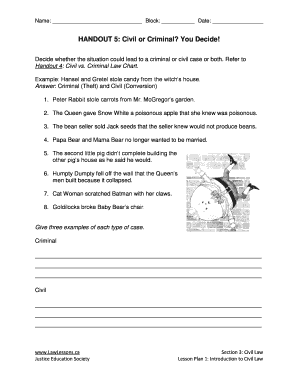
Get Handout 5 Civil Or Criminal
How it works
-

Open form follow the instructions
-

Easily sign the form with your finger
-

Send filled & signed form or save
How to fill out the Handout 5 Civil Or Criminal online
This guide will assist you in completing the Handout 5 Civil or Criminal form online. We will walk you through each section of the form, ensuring that you understand how to identify and classify legal situations accurately.
Follow the steps to fill out the Handout 5 form accurately.
- Click ‘Get Form’ button to obtain the form and open it in the editor.
- Begin by reviewing the introduction on the form that explains the objective — deciding whether the situation could lead to a criminal or civil case, or both. Carefully read the examples provided to familiarize yourself with the criteria.
- In the first section, you will see a scenario involving Peter Rabbit. Based on your understanding of civil and criminal law, determine if it is a criminal case, a civil case, or both. Write your answer in the provided space.
- Continue analyzing the subsequent scenarios, following the same method. For each case, make sure to clearly define whether it falls under criminal or civil law and provide a brief explanation, if necessary.
- Once you reach Section 2, you will need to provide three examples of criminal cases and three examples of civil cases based on your understanding and research. Make sure to fill in each blank accurately.
- After completing the entire form, review your entries to ensure that all parts are filled out correctly and clearly.
- Finally, save your changes, download the completed form for your records, or print it out if you need to submit it physically. You can also share the file if required.
Get started with your document completion online today!
A criminal case is a type of court proceeding in which a prosecutor employed by the federal, state, or local government charges a person with the commission of a crime. Criminal cases generally begin after the person is arrested and informed of their charges, usually at a hearing known as an indictment.